Swing Trading Forex: A Weekly Plan Built on Positioning, Structure and Patience
Swing trading forex means holding for days to weeks, which turns the trader's biggest costs into rounding errors and makes the slow inputs, positioning, the rate differential and daily structure, the ones that matter. This guide sets out a weekly routine that takes two hours on Sunday and fifteen minutes a day, the one setup it looks for, the stop and target rules in ATR terms, how swap and weekend gaps are handled, and the realistic numbers a swing trader produces.
Swing trading forex is holding positions for several days to a few weeks, aiming for moves of 100 to 400 pips on the majors rather than the day trader's 20 to 60. The style changes what matters. Costs shrink: a one-pip spread on a 200-pip target is half a percent of it, so the arithmetic that defeats the scalper does not apply. Screen time shrinks with it: a swing trader works from daily closes and a weekly review, not from a live chart. And the inputs that decide the outcome change from session timing to the slow forces, positioning, the rate differential and daily structure, that move a pair over weeks. This guide sets out a weekly plan built on those inputs: two hours on Sunday, fifteen minutes a day, one setup, and the numbers a swing trader should expect.
Why the slow inputs matter more
A pair's path over a week is mostly noise around its path over a month, and the path over a month is set by the rate differential and by how the speculative crowd is positioned against it. A swing trader who reads only the chart is reading the output and ignoring the inputs; a swing trader who reads the COT report on Friday and the two-year yield spread on Sunday knows which direction has fuel before marking a single level. The chart then supplies the location and the timing, which is the job it does well. The COT trading strategy is a swing strategy built entirely on this division of labour, and this guide generalises it.
The weekly routine
Sunday, two hours
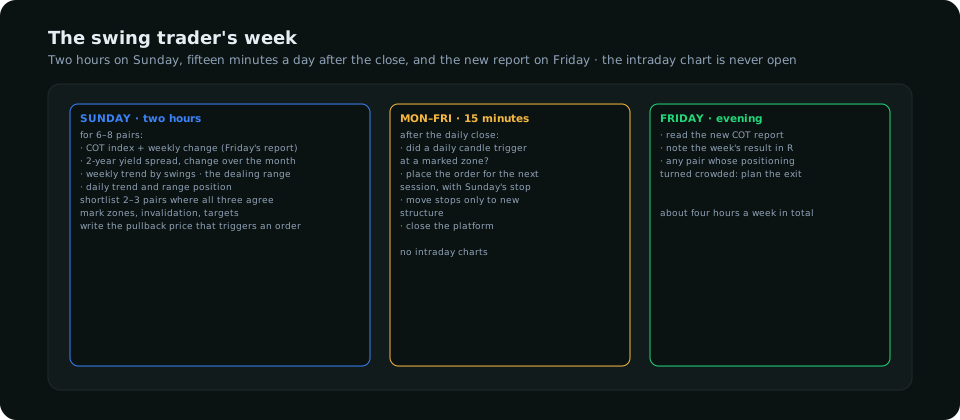
- Positioning: for the six to eight pairs you follow, Friday's COT index and the weekly change in the speculative net. Note which are mid-range and building (room to run), which are crowded (room to reverse), and which did something unusual this week.
- Rates: the two-year yield spread for each pair and its change over the past month. The direction of the change is the macro lean.
- Structure: the weekly chart's trend by swing points and the dealing range; the daily chart's trend and where price sits in the range. The trend guide covers the read.
- Shortlist: the two or three pairs where positioning, rates and structure point the same way. Most weeks that is two; some weeks it is none, and those are the weeks a swing trader does nothing, which is the hardest part of the style.
- Levels: on each shortlisted pair, the weekly and daily zones to enter from, the invalidation (the swing beyond which the idea is wrong), and the first and second targets at the next liquidity. Written down, with the pullback price that would trigger an order.
Monday to Friday, fifteen minutes
After the daily close (21:00 UTC, 02:00 Pakistan time, or the following morning): did any daily candle produce the trigger at a marked zone? If yes, place the order for the next session with the stop and targets from Sunday's sheet. If a position is open, move the stop only to a new structural level (behind a new daily higher low), never to a round number or to breakeven for comfort. Then close the platform. The intraday chart is not consulted; everything that happens inside a day is noise at this horizon, and watching it is how swing trades get closed early.
The one setup
| Element | Rule |
|---|---|
| Condition | Positioning mid-range and building in the direction of the rate lean; weekly structure agrees or has just broken that way |
| Trigger | A daily close beyond the last daily swing in the bias direction (a break of structure on the daily), or a daily rejection candle at a weekly zone in the discount (long) or premium (short) half of the range |
| Entry | The first pullback after the trigger, into the broken swing or the daily order block; entered on the daily close that rejects it, or with a limit at the zone |
| Stop | Beyond the pullback's extreme plus 0.5 × the daily ATR; typically 1–1.5 daily ATRs from entry (80–120 pips on EUR/USD) |
| Targets | First at the nearest weekly liquidity (2–3 R); second at the following pool, or held until the positioning read turns crowded |
| Size | 1% of equity per trade; 2% total open across correlated pairs |
The stop in ATR terms is what distinguishes a swing stop from a day trader's. A 40-pip stop on a swing trade is a stop inside the daily noise, taken by the first ordinary session against the position; a stop of one to one and a half daily ATRs is outside the noise and survives the week's chop. The position is correspondingly smaller, and the position size guide turns the wider stop into lots. The stop placement guide covers the structure-plus-ATR rule.
Swap, weekends and events
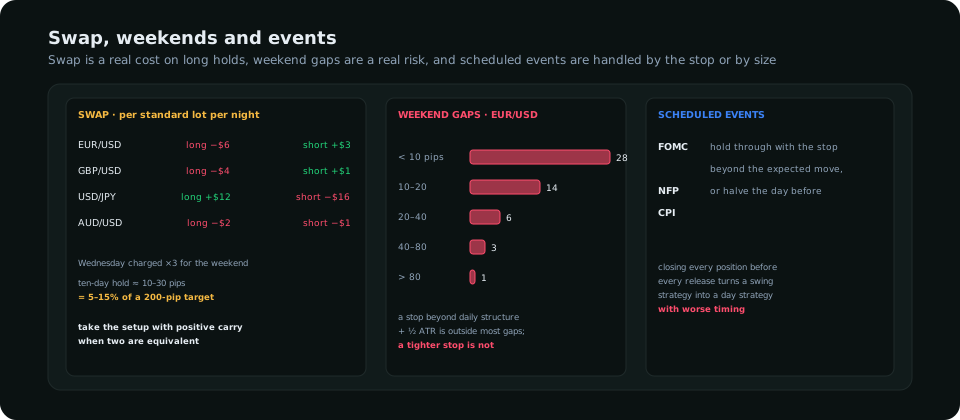
- Swap is the overnight financing on a held position: positive when you are long the higher-yielding currency, negative when short it, charged triple on Wednesday for the weekend. Over a ten-day hold it is 10–30 pips on a major, 5–15% of a 200-pip target; it belongs in the plan as a cost, and a swing trader with a choice of two equivalent setups takes the one with positive carry.
- Weekend gaps are the swing trader's version of slippage. Most Monday opens gap under 20 pips; a few a year gap 50–100 on weekend news. A stop beyond the daily structure plus half an ATR is usually outside the gap; a stop any tighter is not, and the gap takes it at a worse price than set.
- Scheduled events (the FOMC, payrolls, CPI) are held through if the stop is beyond the expected move, or the position is halved the day before. Closing every position before every release turns a swing strategy into a day strategy with worse timing.
Realistic numbers
A swing trader following this plan on eight pairs takes two to four trades a month, holds each for five to fifteen trading days, and at a 45% win rate with 2.5 R average winners and 1 R losers produces an expectancy near 0.55 R per trade, roughly 1.5–2.5% a month at 1% risk, with drawdowns of 5–8% during the two- or three-trade losing runs that happen a few times a year. That is slower than the day trader's good months and faster than most day traders' actual results, and it is achieved in about four hours a week. The expectancy guide shows how those numbers combine and the backtesting guide how to confirm them on your own pairs before trusting them; a swing strategy needs three years of history to produce a hundred trades, which is the one real cost of the style.
Frequently asked
Is swing trading forex profitable?
For traders with a tested setup and the patience to take two to four trades a month, yes: costs are negligible at 200-pip targets and the slow inputs that decide weekly direction are readable. The failure mode is boredom, not the market.
What timeframe is best for swing trading forex?
The weekly chart for direction and the dealing range, the daily for the trigger and the entry. The four-hour chart can refine an entry; anything lower is noise at this horizon and a temptation to close early.
How long does a swing trade last?
Five to fifteen trading days for a 2–3 R target on a major; longer when the second target is held until positioning turns crowded. Trades that have not moved in ten days are usually closed at breakeven rather than held.
Everything on SMC Terminal is analysis and education, not a recommendation to buy or sell. Figures in the example are illustrative. Trading carries a substantial risk of loss. Manage your risk.