Forex Position Size Calculator: Calculate Risk Before Entry
Position size is the one decision that controls how much a trade can hurt you, and it has to be made before the entry, from the stop. This guide gives the formula a forex position size calculator uses, the pip values for every kind of pair, worked examples in lots, the adjustments for gold and indices, and the mistakes that make a 1% risk turn into 4%.
Two traders take the same EUR/USD long with the same 30-pip stop. One loses $100 when it fails; the other loses $1,400. Same idea, same entry, same stop — the only difference is the position size, and the second trader did not calculate it. A position size calculator exists to make that impossible: you tell it the account, the risk you accept, and the stop; it tells you the lots. This guide is the arithmetic behind the tool, so that you understand the number it gives you and can do it by hand when you must.
The formula
Position size is derived from the stop, never the other way round. Three inputs, one output:
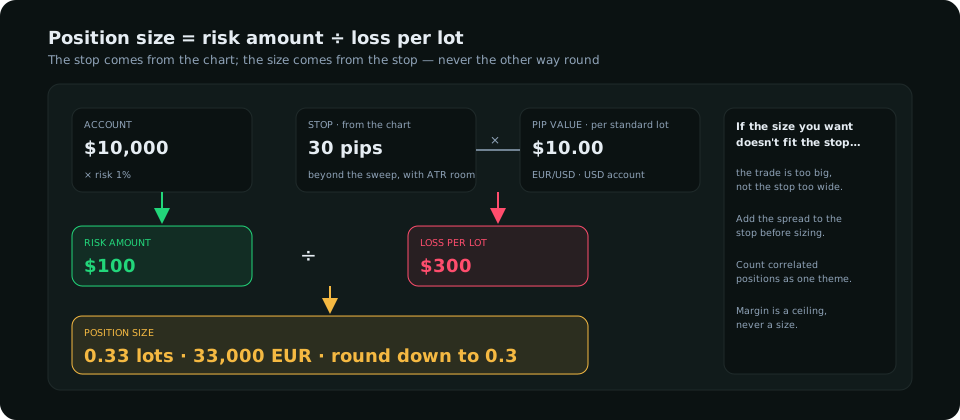
| Step | Formula | Example ($10,000 account, 1% risk, EUR/USD, 30-pip stop) |
|---|---|---|
| 1. Risk amount | Account × risk % | $10,000 × 1% = $100 |
| 2. Loss per lot | Stop in pips × pip value per standard lot | 30 × $10 = $300 |
| 3. Position size | Risk amount ÷ loss per lot | $100 ÷ $300 = 0.33 lots |
0.33 standard lots is 3.3 mini lots or 33 micro lots, 33,000 units of EUR. Round down to what the broker allows (0.33 or 0.3), never up.
Pip values: the part that varies
A standard lot is 100,000 units of the base currency. A pip is 0.0001 for most pairs and 0.01 for yen pairs. The pip value in your account currency depends on which side of the pair your account currency sits on.
| Pair type (USD account) | Examples | Pip value per standard lot | How to get it |
|---|---|---|---|
| USD is the quote currency | EUR/USD, GBP/USD, AUD/USD | $10.00 — fixed | 100,000 × 0.0001 |
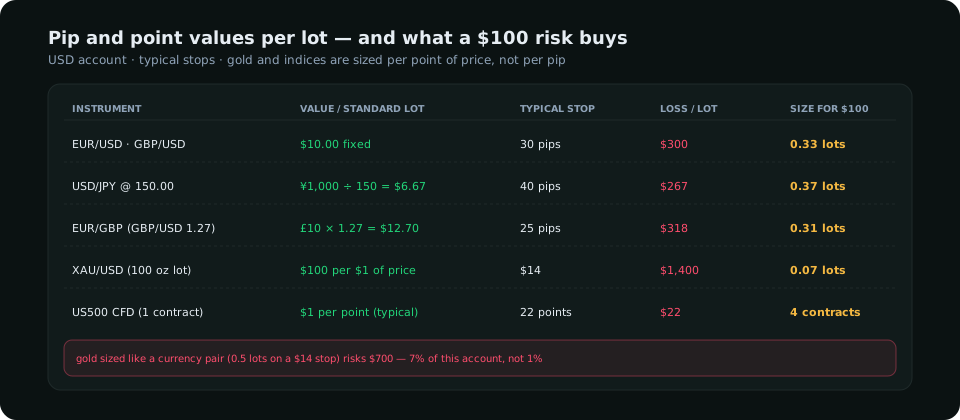
| USD is the base currency | USD/JPY, USD/CAD, USD/CHF | Varies with the rate — e.g. USD/JPY at 150.00: ¥1,000 ÷ 150 = $6.67 | 100,000 × pip ÷ current rate |
| Cross (no USD) | EUR/GBP, GBP/JPY, EUR/AUD | Pip in quote currency, converted — e.g. GBP/JPY: ¥1,000 ÷ USD/JPY rate | 100,000 × pip, then convert quote → USD |
For a EUR or GBP account the logic is identical with the home currency swapped in. The practical shortcut: most brokers show the pip value per lot in the contract specification, and a calculator does the conversion live. Do it by hand once so you can sanity-check the tool.
Worked examples
| Trade | Account / risk | Stop | Pip or point value / lot | Loss per lot | Size |
|---|---|---|---|---|---|
| GBP/USD long | $5,000 / 1% = $50 | 45 pips | $10 | $450 | 0.11 lots |
| USD/JPY short (rate 150.00) | $10,000 / 0.5% = $50 | 40 pips | $6.67 | $266.80 | 0.18 lots |
| EUR/GBP long (GBP/USD 1.2700) | $20,000 / 1% = $200 | 25 pips | £10 × 1.27 = $12.70 | $317.50 | 0.63 lots |
| XAU/USD long | $10,000 / 1% = $100 | $14 of price | $100 per $1 move (100 oz lot) | $1,400 | 0.07 lots |
| US500 CFD long | $10,000 / 1% = $100 | 22 points | $1 per point (1 contract, typical) | $22 | 4.5 → 4 contracts |
Notice the gold example. A standard gold lot is 100 troy ounces, so a $14 stop costs $1,400 per lot — and 0.07 lots is the right size for a $100 risk. Traders who size gold like a currency pair (0.5 lots "because the account can afford the margin") are risking $700 on a trade they think is 1%. See the gold structure guide for why gold's stops need to be set in ATR as well.
What risk percentage?
The formula works for any percentage; the percentage decides whether a losing streak is survivable. The arithmetic of drawdown is unforgiving:
| Risk per trade | Account after 10 straight losses | Account after 20 straight losses | Gain needed to recover from 20 |
|---|---|---|---|
| 0.5% | 95.1% | 90.5% | +10.5% |
| 1% | 90.4% | 81.8% | +22.3% |
| 2% | 81.7% | 66.8% | +49.8% |
| 5% | 59.9% | 35.8% | +179% |
Ten consecutive losses happen to every method eventually; twenty happen to methods with a 35% win rate often enough to plan for. At 1% they are a bad month. At 5% they are the end of the account. The risk management guide goes deeper; the short version is 0.5–1% per trade for a discretionary method, and less while the method is unproven.
The adjustments calculators forget
- Spread and commission. Add the spread (paid on entry) to the stop distance before sizing; on short stops it is a large fraction of the risk. A 10-pip stop with a 1.5-pip spread is an 11.5-pip stop.
- Correlated positions. Long EUR/USD and long GBP/USD at 1% each is closer to one 2% position on "dollar down". Size the theme, not each ticket. The same applies to gold and AUD/USD, or two index CFDs.
- News risk. A stop can be gapped through on a release. Either stand aside or size as if the stop were twice as wide.
- Account currency moves. A GBP account trading USD pairs has its pip values shift as GBP/USD moves. A live calculator handles it; a hand calculation from last week does not.
The mistakes that multiply risk
- Choosing the size first, then placing the stop where the size "allows". The stop becomes too tight for the structure, gets hit by noise, and the trader re-enters — at the same wrong size. Stop first, always.
- Widening the stop after entry without cutting the size. A 30-pip stop moved to 60 pips doubles the risk of a position that was sized for 30. If the stop needs to move, the position needs to halve.
- Adding to a loser at the original size. Two positions at 1% with the same stop is 2%. "Averaging in" is a sizing decision, and it should be made at the start.
- Using margin as the limit. Leverage tells you the maximum you can buy. It has no relationship to what you should buy. Sizing by "how much margin I have" is how a 1% idea becomes a 20% loss.
A pre-entry checklist
- Stop placed at the invalidation point on the chart, with ATR room — before the size is considered
- Stop distance measured in pips or points, spread added
- Risk amount = account × the percentage you decided before looking at this trade
- Pip or point value for this instrument, in your account currency, today
- Size = risk amount ÷ (stop × value), rounded down
- Other open positions on the same theme counted toward the total
Once this is a habit it takes thirty seconds. It is the only thirty seconds in trading that guarantees anything: it guarantees that the worst case of this trade is a number you chose.
Everything on SMC Terminal is analysis and education, not a recommendation to buy or sell. Pip values and contract sizes vary by broker — check the contract specification. Trading carries a substantial risk of loss. Manage your risk.