Forex Fundamental Analysis: Interest Rates, Inflation and Economic Growth
Fundamental analysis in forex reduces to three drivers and one transmission mechanism: inflation and growth set what a central bank is likely to do, the expected interest-rate path is what the currency actually trades on, and the differential between two countries' paths is what moves the pair. This guide explains each driver, how they feed the rate path, how to read the differential rather than the level, and the two situations where the model inverts.
Fundamental analysis in forex is simpler than its reputation. A currency pair is the exchange rate between two economies, and over weeks and months that rate is driven by one thing above all: the difference between the interest rates investors expect each central bank to set. Everything else that gets called fundamental, inflation prints, employment reports, growth figures, purchasing-manager surveys, matters because it changes that expectation. This guide sets out the three drivers (interest rates, inflation, growth), the transmission from a data release to a rate path to a currency, how to read the differential rather than any single country's number, and the two conditions under which the whole model runs backwards.
The three drivers and what each does
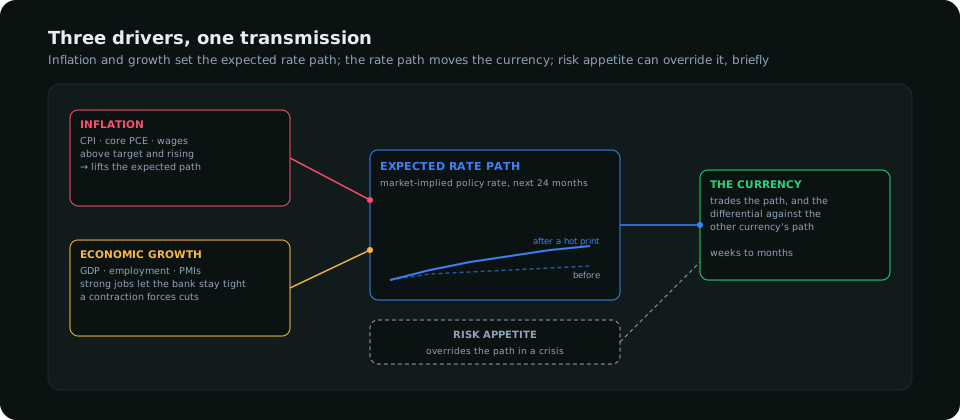
| Driver | Measured by | Lifts the currency when | Horizon |
|---|---|---|---|
| Interest rates | The policy rate and, more importantly, the market-implied path over the next 12–24 months | The expected path rises relative to the other currency's | Weeks to months; the direct driver |
| Inflation | CPI, core CPI, core PCE (US), wage growth | Above target and rising, forcing the bank to hold or hike | Monthly releases; shifts the path |
| Economic growth | GDP, employment, PMIs, retail sales | Strong enough to let the bank stay tight; weak enough to force cuts lowers it | Monthly and quarterly; shifts the path |
The order matters. Interest rates are the driver; inflation and growth are the inputs the central bank reacts to. A trader who watches CPI without asking "what does this do to the expected rate path" is reading the input and missing the output. The interest rates article covers the mechanics of the rate itself; this one is about how the other two drivers move it.
Inflation: the driver the bank cannot ignore
Every major central bank has an inflation target, usually 2%, and its policy rate is the tool for hitting it. Inflation above target and rising means the bank holds rates high or raises them; inflation falling toward target lets it cut. The currency follows the expected path, not the level: a CPI print of 3.4% when 3.6% was forecast is a dovish surprise, because it brings cuts closer, and the currency falls even though 3.4% is high. The component the bank watches is the one that moves the path: in the US that is core PCE and, within CPI, services ex-shelter; in the euro area core HICP; in the UK services inflation. Headline prints driven by energy are discounted. The calendar guide explains how to read the surprise against the forecast; the point here is that the surprise is translated into basis points of expected policy before it reaches the exchange rate.
Growth: the driver that sets the bank's room
Growth matters through the labour market more than through GDP. Employment data (US payrolls, unemployment rates, wage growth) tells the bank whether the economy can absorb high rates; a strong labour market lets it stay tight to fight inflation, a weakening one forces it to cut regardless. The asymmetry is worth knowing: in a hiking cycle, strong growth data is currency-positive (the bank can keep going); in a cutting cycle, strong growth data is also currency-positive (the bank can go slower), while weak data is currency-negative in both. Purchasing-manager surveys lead the hard data by a month or two and move the path at the margin; GDP itself is backward-looking and rarely moves a currency unless it shocks.
The transmission: from a release to the pair
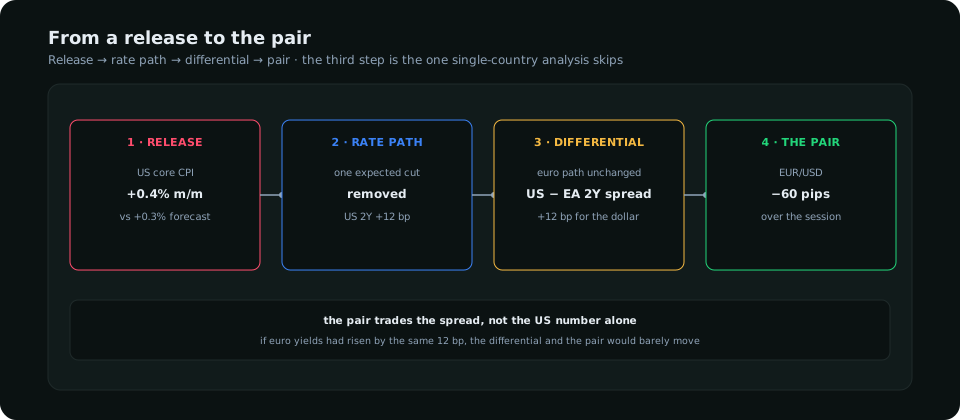
A data surprise changes the number of hikes or cuts the market prices over the next year or two; the cleanest expression of that is the 2-year government yield, which moves within seconds of a release. But a pair trades the difference between two countries' paths. If US yields rise 12 basis points on a hot CPI and euro-area yields rise 10 on the same day because the ECB is expected to follow, the differential barely moves and neither does EUR/USD. This is why single-country fundamental analysis fails so often: the trader is right about the dollar and wrong about the pair. The Treasury yields article covers the yield side in depth; the differential is the number to track.
Reading the differential
- Track the 2-year spread for each pair you trade: US minus euro area for EUR/USD, UK minus US for GBP/USD, US minus Japan for USD/JPY. Its one-month change is the macro bias.
- Ask what is priced. If the market already expects three cuts from one bank and one from the other, a dovish print from the first adds little. The surprise relative to what is priced is what moves the path.
- Watch the direction of the change, not the level. A spread of 150 basis points in the dollar's favour is bullish only if it is widening; a narrowing from 180 is a dollar headwind even though the dollar still yields more.
- Check positioning. A widening spread with speculators already record long the currency is a story mostly priced; the COT read tells you how much fuel remains.
When the model inverts
Two situations reverse the normal relationships. Risk-off: in a sharp fall in equities or a credit event, capital flees to the dollar, yen and Swiss franc regardless of their rate paths, and the high-yielding currencies (Australian and New Zealand dollars, emerging-market currencies) fall even if their central banks are hawkish. The rate differential is temporarily irrelevant and the risk tone is the driver. Terminal rates: when a hiking cycle is judged complete, further strong data can weaken a currency because the market reads it as raising recession risk rather than raising rates, and "good news is bad news" takes over. Both conditions announce themselves (equities, credit spreads, the shape of the rate path) and both pass; the discipline is to notice which regime is operating before applying the table above. The companion fundamental analysis article covers the individual data releases in more detail.
A worked pair read
GBP/USD. UK services inflation printed 5.2% against 5.0% forecast; the Bank of England's expected path lost half a cut over the next year and the UK 2-year yield rose 9 basis points. US data the same week was in line; the US 2-year was flat. The UK minus US spread widened 9 basis points in sterling's favour. Positioning: speculators mildly long sterling, COT index 58. Risk tone: equities steady. Read: macro bias long GBP/USD for the coming weeks, not crowded, no regime override. The chart decides where; the market analysis routine takes it from here.
Frequently asked
What is the most important fundamental factor in forex?
The expected interest-rate differential between the two currencies. Inflation and growth matter because they change it; the differential is what the pair trades.
Does high inflation make a currency stronger or weaker?
Stronger while it forces the central bank to raise or hold rates above the other country's; weaker once the market believes the bank has lost control or will be forced to cut into a slowdown. Read the rate path, not the inflation number.
How quickly does fundamental analysis affect forex prices?
The rate path reprices within seconds of a release; the pair follows within minutes. The trend the differential implies plays out over weeks, which is the horizon fundamental analysis is useful for.
Everything on SMC Terminal is analysis and education, not a recommendation to buy or sell. Figures in the example are illustrative. Trading carries a substantial risk of loss. Manage your risk.