Scalping Trading Strategy: Rules, Sessions, Costs and Why Most Scalpers Lose to the Spread
A scalping trading strategy lives or dies on arithmetic most scalpers never do: with a 6-pip target and a 1-pip spread, a sixth of every winner is gone before the trade starts. This guide sets out the conditions under which scalping can work, the session windows and pairs where the costs are lowest, a complete rule set built around the London and New York opens, and the numbers a scalper has to hit to break even, let alone profit.
A scalping trading strategy takes many small trades, each held for minutes, each aiming for a few pips. It is the most popular style among new traders and the one with the worst results, and the two facts are connected: scalping multiplies every cost a trader pays. A 1-pip spread is nothing to a swing trader targeting 150 pips and a sixth of the target to a scalper aiming for 6. This guide starts with that arithmetic, because any scalping strategy that does not is a strategy for paying the broker, then sets out the conditions under which scalping can work, a complete rule set, and the point at which a trader is better off holding longer.
The cost arithmetic
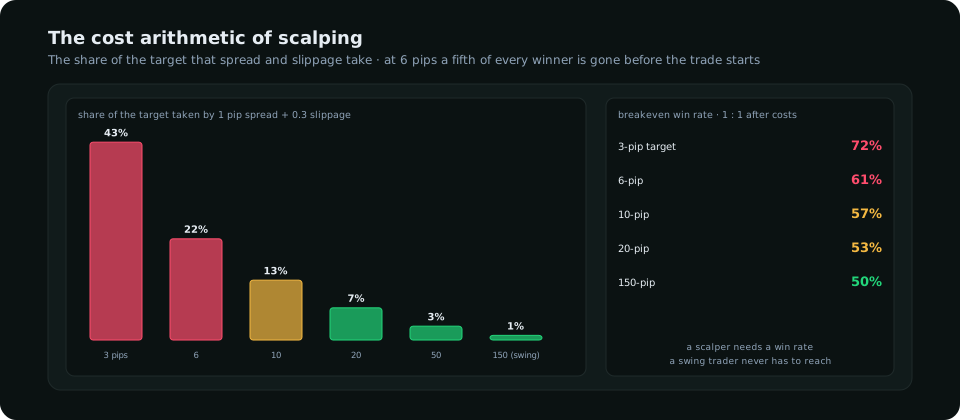
| Target | Cost (1 pip spread + 0.3 slippage) | Share of target | Breakeven win rate at 1 : 1 |
|---|---|---|---|
| 3 pips | 1.3 pips | 43% | 72% |
| 6 pips | 1.3 pips | 22% | 61% |
| 10 pips | 1.3 pips | 13% | 57% |
| 20 pips | 1.3 pips | 7% | 53% |
| 150 pips (swing) | 1.3 pips | 1% | 50% |
At a 6-pip target and a 6-pip stop, the scalper pays 1.3 pips on entry and exit combined, so a winner nets 4.7 and a loser costs 7.3; the win rate needed to break even is 61%, before commission. A swing trader with the same 1 : 1 ratio breaks even at 50%. That 11-point gap is the whole difficulty of scalping, and the win rate and expectancy guide shows how rarely discretionary strategies sustain win rates above 60%. Everything in a workable scalping strategy is about pushing the cost share down: tighter spreads, larger targets within the style, fewer trades.
Where scalping is viable
- Pairs: EUR/USD, USD/JPY and GBP/USD, with raw spreads of 0.1–0.5 pips plus commission on an ECN account. Crosses and exotics with 2–5 pip spreads are not scalpable at any win rate a human achieves.
- Account type: raw spread plus commission (typically 3–3.5 dollars per side per lot), not a "zero commission" account with a 1.5-pip spread. The all-in cost on a raw account is 0.5–0.8 pips; on the other it is 1.5 or more.
- Sessions: the first two hours of London (07:00–09:00 UTC) and the first two of New York (13:00–15:00 UTC), when spreads are tightest and the ranges are widest. Spreads double in the Asian session and triple in the minutes around a release.
- Gold and indices: gold scalps in dollars, not pips, and its 20–40 cent spread against a 3–5 dollar target is a cost share near 10%, workable in the London–New York overlap. Indices during their cash sessions are similar. The gold sessions guide covers the windows.
A complete rule set
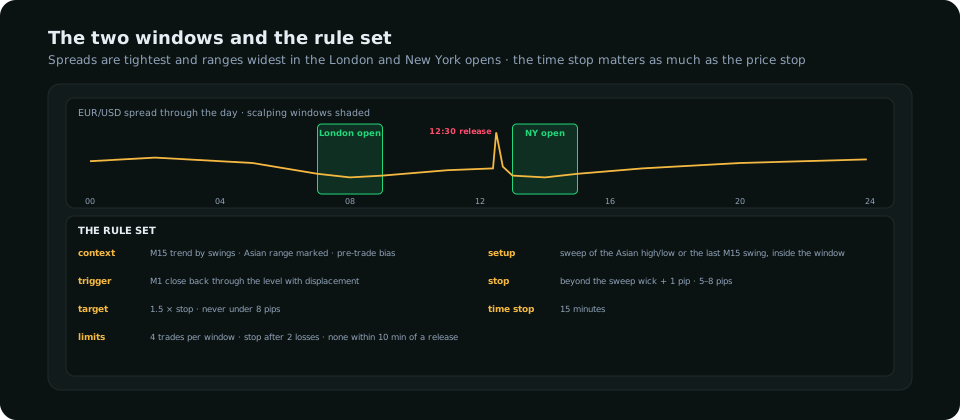
| Element | Rule | Why |
|---|---|---|
| Context | M15 trend by swing points; the Asian range marked; the pre-trade bias from the daily routine | Scalping with the M15 trend roughly doubles the win rate against scalping both ways |
| Setup | A sweep of the Asian high or low, or of the last M15 swing, inside the window | The sweep is where the stops are; the reversal after it is the only intraday move with a defined edge |
| Trigger | An M1 close back through the swept level with a displacement candle | The close is the confirmation; the push through was the trap |
| Stop | Beyond the sweep's wick plus 1 pip; typically 5–8 pips | Structural, not arbitrary; a stop inside the wick is taken by noise |
| Target | At least 1.5 × the stop and never under 8 pips; the opposite side of the Asian range when nearer | Pushes the cost share under 15% and the breakeven win rate toward 45% |
| Time stop | Close at breakeven or market after 15 minutes if the target is not hit | A scalp that has not worked in 15 minutes has stopped being a scalp |
| Limits | Four trades per window; stop after two consecutive losses; nothing within ten minutes of a red release | Caps the cost drag and the revenge loop the psychology guide describes |
The target rule is the one that changes the outcome. A 1.5 : 1 reward-to-risk at 8-pip targets gives a breakeven win rate near 45% after costs, which a sweep-and-reclaim setup inside the London open can beat. The same setup at 1 : 1 and 5-pip targets cannot, however good the execution.
Execution details that matter more than the setup
- Limit orders where possible. A market order at the open of a displacement candle fills a pip worse than the chart shows. Entering with a limit at the reclaim level trades a few missed fills for a pip saved on every one taken, which at 8-pip targets is 12% of the edge.
- Spread check before every entry. If the live spread is above 1 pip on a major, the window is not open regardless of the clock.
- One pair at a time. Scalping two correlated pairs is one trade at double size with double the costs.
- Position size fixed in lots per trade, recalculated weekly from equity, not per trade; the stop varies by a few pips and the risk varies with it within a tolerable band. Recalculating lots per trade at this speed produces errors.
The numbers a scalper has to produce
A trader running the rule set above for twenty sessions, four trades a session, has eighty trades. At a 50% win rate, 1.5 : 1, 8-pip targets and 0.7 pips all-in cost per trade on a raw account: forty winners net 11.3 pips each, forty losers cost 6 pips each, which is 452 − 240 = 212 pips, or 2.65 pips per trade. At 0.5% risk per trade that is roughly +0.2 R per trade and about 16% in the month, before the inevitable bad week. At a 40% win rate the same strategy makes 362 − 288 = 74 pips, barely positive. At a 1.5-pip all-in cost (a "commission-free" account) the 50% case drops to 136 pips and the 40% case loses. The strategy is viable in a narrow band of win rate and cost, and the trader has to measure both monthly. The strategy tester guide covers testing it on tick data, which for scalping is the only data that counts.
When to stop scalping
The honest answer for most traders is: after the first hundred logged trades, if the win rate after costs is below 55% at 1 : 1 or below 45% at 1.5 : 1. Below those lines the strategy has no edge and no amount of discipline supplies one. The traders who do well at scalping tend to be the ones who could also trade longer timeframes and choose not to; the traders who come to scalping because a longer hold feels slow are usually paying for the speed. The same sweep-and-reclaim logic on the one-hour chart, with 30-pip stops and 50-pip targets, has a cost share of 2% and a breakeven win rate of 41%, and the day-trading plan shows what that looks like. Scalping is a legitimate style; it is simply the one with the least room for error.
Frequently asked
Is scalping profitable in forex?
For a minority of traders, on raw-spread accounts, in the London and New York opens, on the majors, with targets of at least 8 pips at 1.5 : 1. Outside those conditions the spread takes the edge before the trader has one.
What is the best timeframe for scalping?
M15 for context and M1 or M5 for the trigger. Lower than M1 is reading the spread, not the market.
How many pips should a scalper target?
At least 8 on a major, at 1.5 times the stop. Targets under 5 pips need win rates above 70% after costs, which almost no one sustains.
Everything on SMC Terminal is analysis and education, not a recommendation to buy or sell. Figures in the example are illustrative. Trading carries a substantial risk of loss. Manage your risk.