Where to Place a Stop Loss in Forex: Structure, Volatility and Risk
A stop loss belongs at the price where the trade's idea is wrong — not at the distance that feels affordable. This guide gives the three placement methods (structure, volatility, time), the buffer that keeps noise from hitting a correct stop, the sizing arithmetic that makes any stop distance safe, and the mistakes that get stops hunted.
A stop loss is the price at which you have agreed, in advance, that the trade's idea was wrong. That sentence decides where it goes. A long taken because a demand level held is wrong when the level breaks, so the stop goes beyond the level; it is not wrong at 20 pips because 20 pips felt affordable. Affordability is handled separately, by size. This guide covers the three ways to place a stop (structure, volatility, time), the buffer that keeps noise from taking a correctly placed stop, the arithmetic that makes any stop distance affordable, and the habits that get stops hunted.
Three placement methods
| Method | Where the stop goes | Best for | Weakness |
|---|---|---|---|
| Structure | Beyond the swing, sweep wick, order block or range edge that defines the trade | Every discretionary trade; it is the "idea is wrong" price | Obvious levels attract stop runs — hence the buffer |
| Volatility (ATR multiple) | Entry ± 1.5–2 × ATR of the trading timeframe | Trend-following and systematic entries with no single structural level | Ignores structure; can be wider or tighter than the level warrants |
| Time | Exit flat after N candles or at session end if the trade has not progressed | Session-based trades expecting a move in a window | Not a price stop; used alongside one of the other two, never instead |
For most trades the answer is structure plus a volatility buffer. The structure says where; the buffer says how far beyond. A stop placed exactly at the sweep low is placed where the next sweep will reach.
The buffer: structure plus a fraction of ATR
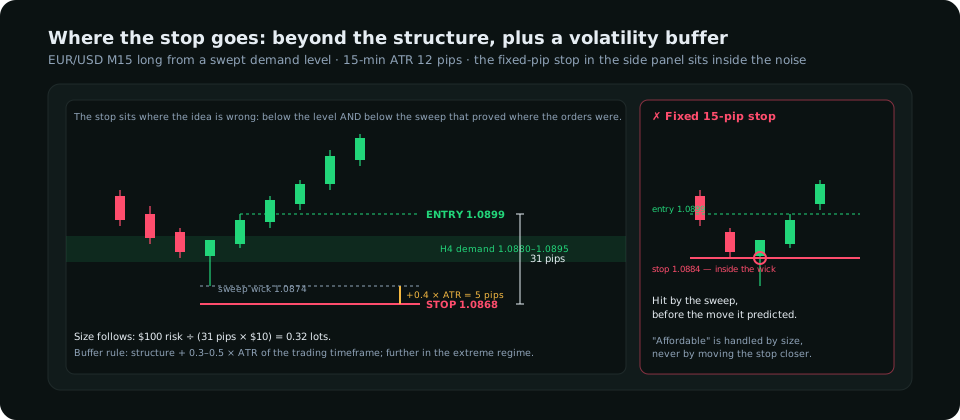
Markets overshoot levels by an amount that scales with their volatility, so the buffer should too. A workable rule is the structural level plus 0.3–0.5 × ATR(14) of the timeframe you are trading, further in the extreme regime. On a 15-minute EUR/USD chart with a 12-pip ATR, that is 4–6 pips beyond the wick; on a 4-hour gold chart with a $9 ATR, $3–5 beyond. The ATR guide covers the calculation and the regimes. The buffer is the difference between a stop that is hit by the second sweep and one that survives it.
Distance sets size — never the reverse
The objection to a wide stop is always the money. The answer is that the money is fixed first and the lot size derived, so a wider stop simply means a smaller position with the same risk:
| Account | Risk per trade | Stop distance | Pip value (per standard lot) | Lot size |
|---|---|---|---|---|
| $10,000 | 1% = $100 | 15 pips | $10 | 0.67 |
| $10,000 | 1% = $100 | 31 pips | $10 | 0.32 |
| $10,000 | 1% = $100 | 60 pips | $10 | 0.17 |
| $10,000 | 1% = $100 | $8 on gold | $100 per $1 per lot | 0.125 |
Each row carries exactly $100 of risk. The trader who keeps the lot size fixed and moves the stop closer to "afford" it is the one who gets stopped out, because the stop is now inside the noise. The lot size calculator article has the pip values for every major pair, and the risk-to-reward guide explains what the stop distance has to be relative to the target.
Why stops get hunted, and what to do
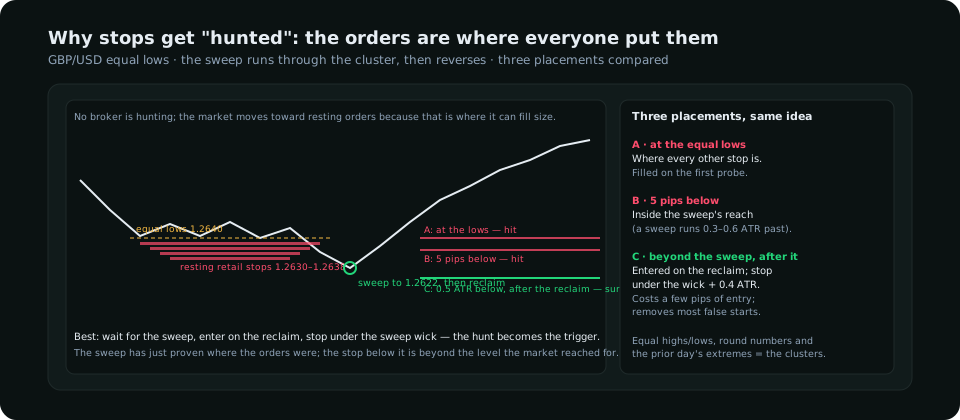
Stops are not hunted by a broker; they are reached by a market that moves toward resting orders because that is where it can fill size. Equal lows, round numbers and the prior day's extremes are where retail stops sit, and the sweep through them before the real move is routine. Two responses work. Place the stop beyond the sweep's likely reach, which the ATR buffer approximates. Or, better, wait for the sweep to happen and enter after price reclaims the level — then the stop goes under the sweep wick, which has just proven where the orders were, and the hunt has become the entry signal.
Moving the stop
A stop should move only on new evidence, never on time or discomfort. The rule that survives is: move the stop to break-even after the market prints a new structural point in your favour (a higher low on the trading timeframe), and trail it behind each subsequent one. Moving to break-even after a fixed number of pips is the most common way to turn winners into scratches: the move retraces to entry on noise, stops the trade, and then continues. Widening a stop after entry is not a management rule; it is the original stop being wrong, and the trade should be closed instead.
Worked examples
EUR/USD long, 15-minute execution
Demand at 1.0880–1.0895 on the 4-hour. Price sweeps to 1.0874 and closes back above 1.0885; entry 1.0899 after a 15-minute break of structure. ATR(14) on the 15-minute is 12 pips. Stop: below the sweep wick (1.0874) minus 0.5 × 12 = 6 pips → 1.0868. Distance 31 pips. At 1% of $10,000, size 0.32 lots.
Gold short, 4-hour swing
Supply at $2,385–2,392 after a 4-hour change of character. Entry $2,386 on the retest. 4-hour ATR $9. Stop: above the supply's high ($2,392) plus 0.4 × 9 ≈ $3.6 → $2,396. Distance $10. At $100 risk and $100 per $1 per lot, size 0.10 lots.
Frequently asked
How many pips should a stop loss be in forex?
There is no fixed number. The stop goes beyond the structure that defines the trade plus a volatility buffer, and the lot size is then set so the distance costs the planned risk. On EUR/USD 15-minute trades that is typically 20–40 pips; on 4-hour swings 60–120.
Should I use a fixed percentage stop?
Use a fixed percentage of the account as the risk, not as the stop distance. A 1% stop distance on EUR/USD is 100 pips — far wider than most structures warrant — and on gold it is $24, often too tight.
Is it better to trade without a stop loss?
No. A trade without a stop has no defined risk, so it cannot be sized, and one gap or one news candle can remove weeks of gains. Mental stops are the same thing with a delay.
Everything on SMC Terminal is analysis and education, not a recommendation to buy or sell. Prices in the examples are illustrative. Trading carries a substantial risk of loss. Manage your risk.