FOMC Meeting: What It Is, How Markets React and How to Trade Around It
An FOMC meeting is the eight-times-a-year event at which the Federal Reserve sets US interest rates, and it moves every dollar pair, gold and the indices more than any scheduled release except payrolls. This guide explains what the committee decides and publishes, the timeline of an FOMC day to the minute, why the statement and the press conference so often move markets in opposite directions, the typical reaction sizes, and a plan that avoids the first move and trades the second.
An FOMC meeting is where the Federal Open Market Committee, the twelve voting members of the US Federal Reserve system, decides the federal funds rate and the stance of US monetary policy. It happens eight times a year, the decision is published at 14:00 Eastern time (18:00 UTC during US daylight saving time, 19:00 UTC in winter; 23:00 or 00:00 Pakistan time) with a press conference half an hour later, and for the following two hours every dollar pair, gold, and the equity indices move more than on almost any other scheduled day. Traders know the date months ahead and still lose money on it, because the day has a structure they trade against. This guide explains what the committee decides and publishes, the day's timeline to the minute, why the two releases so often pull in opposite directions, the reaction sizes to expect, and a plan built around the second move rather than the first.
What the FOMC decides and publishes
| Output | What it is | When | What moves on it |
|---|---|---|---|
| Rate decision | The target range for the federal funds rate; usually unchanged or moved by 25 basis points | Statement, 18:00 UTC | Rarely a surprise; the market has it priced to within a few percent by meeting day |
| Statement | A one-page text describing the economy and the committee's leaning; changes of a word matter | 18:00 UTC | The first move: algorithms compare it to the previous statement in seconds |
| Summary of Economic Projections ("dot plot") | Each member's projection for the rate at year-end and beyond; four meetings a year (March, June, September, December) | With the statement | Often larger than the decision: a shift in the median dot reprices the whole path |
| Press conference | The Chair's prepared remarks and forty-five minutes of questions | 18:30 UTC | The second move, frequently the opposite of the first |
| Minutes | A detailed record, published three weeks later | 18:00 UTC, three weeks on | A smaller, secondary event |
The decision itself is almost never the news. Futures markets price the probability of each outcome continuously, and by meeting day the expected decision is usually above 90% likely. What the market trades is the path: how many moves over the next year the statement, the dots and the Chair imply, measured against what was priced that morning. The rate-path guide explains why the path, not the level, moves currencies.
The FOMC day timeline
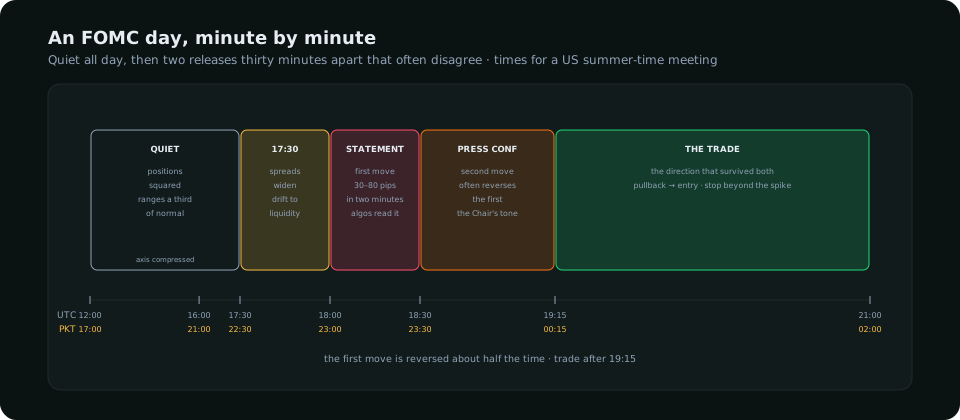
Before 18:00 UTC: FOMC days are quiet. Ranges in the European session and the first hours of New York run at a third to a half of normal as participants wait, and the cash equity open at 13:30 is subdued. Setups that appear in this window are low-quality by construction; the market is not committing. Spreads widen from about 17:30.
18:00 UTC, the statement: the decision, the statement text and (four times a year) the projections publish together. Algorithms compare the statement to the previous one word by word and trade the differences within seconds; a changed phrase about inflation or the labour market moves EUR/USD 30–80 pips and gold 15–40 dollars in two minutes. This is the first move, and it is reversed, in whole or part, roughly half the time.
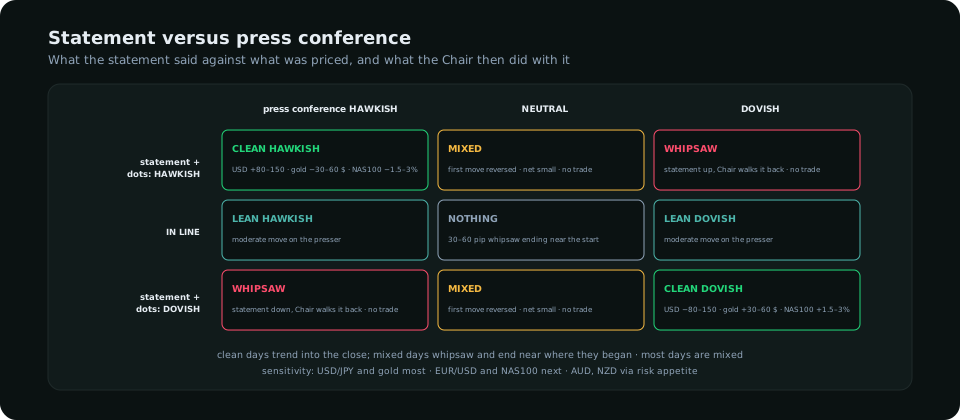
18:30 UTC, the press conference: the Chair reads prepared remarks and then takes questions for about forty-five minutes. The tone, and any answer that goes beyond the statement, produces the second move, which frequently runs against the first: a statement read as hawkish is softened in the questions, or a dovish statement is walked back. The two moves can be in the same direction (a clean day, less common) or opposite (the whipsaw most traders remember).
After 19:15 UTC: the direction that has survived both releases is the information. The calendar guide's before-during-after structure applies, with the "during" window stretched to seventy-five minutes.
Why the two releases disagree
The statement is written by committee and vetted for weeks; it is deliberately measured and often lags the Chair's own view. The press conference is one person answering live questions, and the Chair uses it to adjust how the statement landed. Markets have learned this, so the first move is a reaction to text and the second is a reaction to intent, and intent wins. The practical rule is that nothing is known until the Chair has spoken for fifteen minutes; a trader positioned on the statement is trading half the information at the moment the other half is about to arrive.
Reaction sizes and what reacts
| Market | Typical net move by 20:00 UTC on a clean day | Why it reacts |
|---|---|---|
| USD/JPY | 100–200 pips | The most rate-sensitive major; tracks the 10-year yield |
| Gold | 30–60 dollars | Real yields reprice in minutes; the real yields guide |
| EUR/USD | 80–150 pips | The dollar leg of the rate differential |
| NAS100 | 1.5–3% | Long-duration valuations move with real yields; the NAS100 guide |
| AUD/USD, NZD/USD | 60–120 pips | Through risk appetite as much as through the dollar |
On a mixed day, which is the common case, the net move by the close is often a third of these figures and the path to it crossed zero twice. That path is what makes FOMC profitable for the house and expensive for anyone who entered at 18:01.
A plan for FOMC day
- The week before: note what is priced (the probability of each decision from fed funds futures) and the previous statement's wording. Read the COT positioning in the dollar: a crowded dollar long falls further on a dovish outcome than it rises on a hawkish one.
- The morning: no new positions. Existing positions either have stops beyond the clean-day move (above) or are closed. Mark the day's range and the nearest liquidity above and below; those are where the spike will go.
- 18:00–19:15 UTC: watch. No orders. Note which liquidity the statement spike took, and whether the press conference reversed it.
- After 19:15: if the two releases agreed and price is trending, trade the pullback to the pre-release level or the spike's midpoint in the direction that held, stop beyond the spike extreme, target the next liquidity. If they disagreed and price is back inside the morning range, there is no trade; the day is done.
- The next morning: the Asian and London sessions after FOMC often extend the clean-day move or complete the reversal of a mixed day; the daily close on FOMC day is the level to read.
The dot plot meetings
March, June, September and December include the projections, and those four meetings produce the largest moves because a change in the median dot reprices a year of expected policy at once. A 25-basis-point shift in the year-end median is worth more than the decision itself, and it is read within seconds of the release. On those days the statement move is larger and the press conference reversal is less frequent, because the dots are harder to walk back than a phrase. Size down further and expect the clean-day figures above rather than the mixed ones.
Frequently asked
What time is the FOMC announcement?
The statement at 14:00 Eastern time, which is 18:00 UTC during US daylight saving time (March to early November) and 19:00 UTC in winter; the press conference thirty minutes later. In Pakistan time, 23:00 for the statement during US summer time and 00:00 in winter.
Should I trade during the FOMC meeting?
Not between the statement and the first fifteen minutes of the press conference; the first move is reversed about half the time. Trade the pullback after 19:15 UTC in the direction that survived both, or nothing on a mixed day.
Why did the dollar fall after a rate hike?
Because the market had priced the hike and traded the path instead: if the statement or the Chair implied fewer future hikes than expected, the path fell even as the rate rose. The surprise relative to pricing, not the decision, moves the currency.
Everything on SMC Terminal is analysis and education, not a recommendation to buy or sell. Figures in the example are illustrative. Trading carries a substantial risk of loss. Manage your risk.