Day Trading for Beginners: A Realistic Plan for the First 90 Days
Day trading for beginners usually starts with a live account, a dozen indicators and no plan, and ends within a quarter. This guide lays out the first ninety days in the order that actually builds a trader: one market, one session, one setup, a demo kept to live rules, a journal from day one, and the three numbers that have to be positive before real money is risked. It also sets honest expectations about returns, screen time and what day trading costs.
Day trading for beginners is mostly a story of the same first quarter: a live account opened in week one, a chart covered in indicators by week two, a run of small wins, a large loss, and a closed account by month three. The pattern is not a character flaw. It is what happens when the order of operations is wrong: money first, method later. This guide puts the order right for the first ninety days, one market, one session, one setup, a demo kept to live rules, a journal from the first trade, and a go-live decision made on three numbers rather than a feeling. It also sets expectations about returns and screen time that the marketing around day trading does not.
What day trading is, and costs
A day trader opens and closes positions inside a session, holding for minutes to hours and never overnight. The appeal is fast feedback; the price is that every cost a trader pays is paid more often. Spread and slippage on a 30-pip target are 3–5% of the target; on a 10-pip target they are 10–15%, which is why the scalping guide warns beginners away from very short holds. Realistic day-trading returns for a consistently profitable discretionary trader are 2–5% a month on the account with 8–15% drawdowns along the way; the figures quoted on social media are either annualised, cherry-picked, or simulated. A beginner's first-year goal is not a return; it is a positive expectancy over a hundred trades at small size, which is the thing every later return is built on.
The 90-day plan
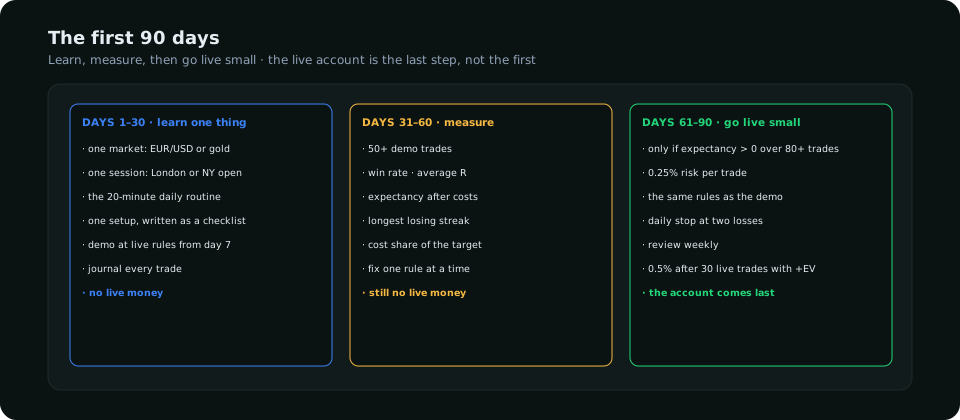
Days 1–30: one market, one session, one setup
- One market. EUR/USD for the tightest costs and the most regular behaviour, or gold if you prefer larger daily ranges and can trade the London–New York overlap. Not both; the point is to learn how one thing moves.
- One session. The London open (07:00–10:00 UTC, 12:00–15:00 Pakistan time) or the New York open (12:30–15:00 UTC). Two hours a day in the same window teaches the rhythm that twelve hours of random watching never does. The session guide explains which pairs move when.
- One setup, written down. The sweep-and-reclaim of the session range is the beginner's best choice because it has a structural stop and a defined target: price takes out the Asian high or low, closes back inside on the fifteen-minute chart, you enter on the close with the stop beyond the sweep and the target at the other side of the range. The sweep guide covers it. Write it as a checklist two people would apply identically.
- The routine. Before the session: daily trend by swings, the Asian range, the calendar, the bias. The daily workflow guide is the template; it takes twenty minutes.
- Demo at live rules from day 7. Same size you would trade live, same stop, same daily limit, same hours. A demo traded loosely teaches nothing.
- Journal from the first trade. Pair, direction, setup checklist, entry, stop, target, result in R, and what triggered the trade (planned, missed move, boredom). The last field is the one that matters later.
Days 31–60: measure
By day 60 the journal should hold fifty or more trades. Compute the three numbers that decide the next step: expectancy (win rate times average winning R minus loss rate times average losing R, after costs), the longest losing streak, and the cost share (spread plus slippage as a share of the average target). The expectancy guide walks through the arithmetic. Fix one rule at a time if the numbers are poor: most beginners find their entries are fine and their exits are not (targets too tight, stops too wide), or that half their trades were not the setup at all. Do not add a second setup or a second market in this month; the sample is too small to tell two things apart.
Days 61–90: go live, small
Go live only if expectancy is positive over eighty or more demo trades and the trigger field shows most trades were planned. Start at 0.25% risk per trade, a daily stop at two losses, and the same rules as the demo; the risk per trade guide explains why small. The first thirty live trades are a test of whether the demo results survive real money and real emotions, not an attempt to earn. Raise to 0.5% only after those thirty trades show positive expectancy. If they do not, go back to demo; the fee for the lesson was a quarter of a percent a trade, which is the cheapest tuition in trading.
The day's structure
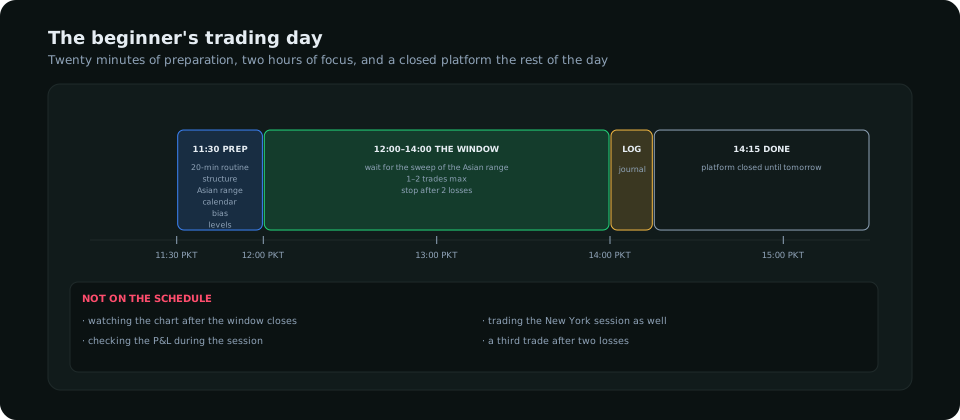
A beginner's day has four parts and the last is the most important: the platform closes when the window does. Watching the chart after the session is where the boredom trades come from, and the psychology guide explains why a closed platform beats willpower every time.
The mistakes that end most beginners
| Mistake | Why it ends the account | The rule that prevents it |
|---|---|---|
| Live money in week one | Losses teach fear before skill | Demo at live rules for 60 days; three numbers positive before going live |
| Risking 2–5% per trade | A normal streak of six losses is a 20% drawdown | 0.25% to start; the longest streak sets the number |
| No stop, or a mental stop | One trade becomes the month | A structural stop in the platform on every order |
| Chasing after a missed move | Entries with no structural stop and poor reward-to-risk | No entry further than half a day's ATR from the planned level |
| Changing the setup after three losses | Nothing is ever tested | One setup for 90 days; rule changes only after fifty trades |
| Trading every session | Fatigue and boredom trades | One window; platform closed outside it |
What to learn, and what to skip
Learn: how to read a trend by swing points, how to mark a session range and a zone, what a sweep looks like and what the close after it means, how to size a position from a stop, and how to keep a journal. The beginners' market guide and the pip guide cover the mechanics. Skip, for now: indicator stacks, signal services, every setup with a name you saw this week, and anything that promises a return. A beginner who can do the five things above has more of a method than most traders with three years of indicators, and after ninety days has the numbers to prove whether it works.
Frequently asked
How much money do I need to start day trading forex?
Enough that 0.25% of it is a meaningful position at your broker's minimum size: with micro lots, about 1,000–2,000 dollars. More capital does not help a beginner; it makes the early mistakes more expensive.
How long does it take to become a profitable day trader?
Ninety days to a tested setup with positive demo expectancy if the plan above is followed; six to twelve months of live trading at small size before the results are consistent enough to rely on. Anyone promising less is selling something.
What is the best market for a beginner day trader?
EUR/USD during the London open for the lowest costs and the most regular session behaviour. Gold is a reasonable second choice for traders who can trade the London–New York overlap and accept larger swings.
Everything on SMC Terminal is analysis and education, not a recommendation to buy or sell. Figures in the example are illustrative. Trading carries a substantial risk of loss. Manage your risk.