What Is a Pip in Forex? Pip Value, Pipettes and How to Calculate It for Every Pair
A pip in forex is the standard unit of price movement: the fourth decimal on most pairs and the second on yen pairs. This guide explains what a pip is, why the yen pairs differ, what the fifth decimal (the pipette) is for, how to convert pips into money for any pair and lot size, why pip value changes with the quote currency, and how gold and indices are measured instead.
A pip in forex is the smallest standard move in a currency pair's price: one unit in the fourth decimal place for most pairs (0.0001) and one unit in the second decimal place for pairs quoted in Japanese yen (0.01). When EUR/USD moves from 1.0850 to 1.0851 it has moved one pip; when USD/JPY moves from 150.20 to 150.21 it has moved one pip. The word is a convention that lets traders talk about moves, stops and spreads in the same units across pairs with very different prices. This guide explains the convention, the fifth-decimal "pipette" brokers now quote, how to turn pips into money for any pair and position size, and how markets that are not currency pairs are measured instead.
Anatomy of a quote
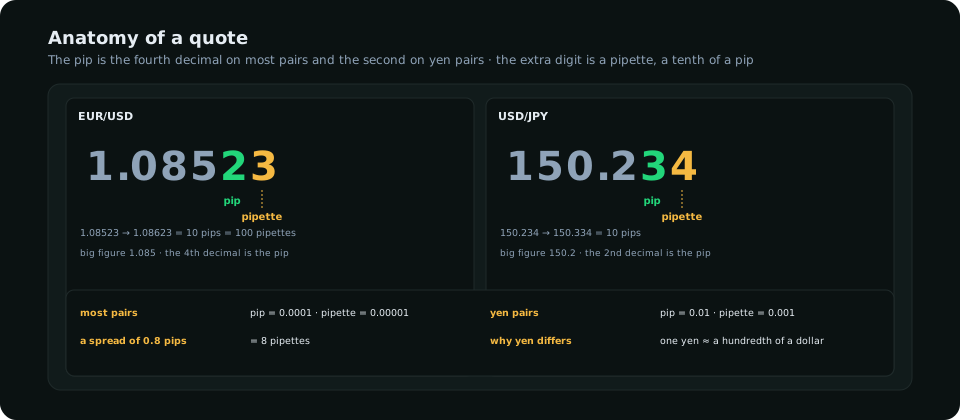
| Pair type | Example quote | One pip | One pipette |
|---|---|---|---|
| Most pairs (EUR/USD, GBP/USD, AUD/USD, USD/CHF, EUR/GBP…) | 1.08523 | 0.0001 | 0.00001 |
| Yen pairs (USD/JPY, EUR/JPY, GBP/JPY…) | 150.234 | 0.01 | 0.001 |
Yen pairs differ because the yen is worth roughly a hundredth of a dollar, so a quote like 150.23 has only two decimals of meaningful precision; the second decimal plays the role the fourth plays elsewhere. The pipette (also called a point or fractional pip) is the extra digit brokers added when electronic pricing allowed finer quotes. A spread of "0.8 pips" is 8 pipettes. Platforms differ in whether they display it, which is the usual source of a beginner's confusion about whether a 50-pip stop is 50 or 500 units on the price ladder.
Pip value: turning pips into money
A pip's value in money depends on two things: the size of the position and the currency the pair is quoted in. For a pair quoted in US dollars (the quote currency is USD, as in EUR/USD or GBP/USD), one pip on a standard lot of 100,000 units is 100,000 × 0.0001 = 10 dollars. A mini lot (10,000) is 1 dollar a pip and a micro lot (1,000) is 10 cents a pip. That is the whole calculation for dollar-quoted pairs, and it does not change with the pair's price.
| Position | Units | Pip value (USD-quoted pair) | Pip value (USD/JPY at 150.00) | Pip value (USD/CHF at 0.9000) |
|---|---|---|---|---|
| Standard lot | 100,000 | $10.00 | $6.67 | $11.11 |
| Mini lot | 10,000 | $1.00 | $0.67 | $1.11 |
| Micro lot | 1,000 | $0.10 | $0.07 | $0.11 |
For a pair where the dollar is the base currency (USD/JPY, USD/CHF, USD/CAD), a pip is worth a fixed amount of the quote currency, and converting that to dollars means dividing by the pair's price. One pip on a standard lot of USD/JPY is 100,000 × 0.01 = 1,000 yen; at a price of 150.00 that is 1,000 ÷ 150 = 6.67 dollars. The same lot of USD/CHF at 0.9000 is 10 francs per pip, which is 11.11 dollars. For crosses with neither currency the dollar (EUR/GBP, GBP/JPY), the pip is worth a fixed amount of the quote currency, and the dollar value needs one more conversion through the quote currency's dollar rate. Platforms do this for you; the lot size guide covers the arithmetic for each case.
Why pip value matters: stops and size
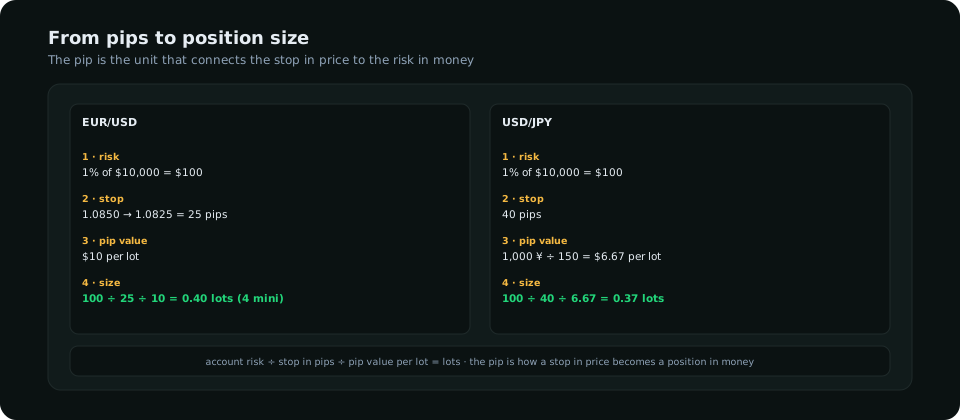
Every stop-loss is set in price and every risk limit is set in money, and the pip is the unit that connects them. A trader risking 1% of a 10,000-dollar account (100 dollars) with a 25-pip stop on EUR/USD divides 100 by 25 to get 4 dollars per pip, and 4 dollars per pip is 0.4 standard lots. Change the stop to 50 pips and the position halves to 0.2 lots at the same risk. Traders who fix the lot size and vary the stop are varying their risk without knowing it; traders who fix the risk and let the stop set the lots have the same amount at stake on every trade, which the risk per trade guide shows is most of what keeps an account alive. The position size calculator guide turns it into a repeatable routine.
Markets that are not measured in pips
- Gold (XAU/USD) is quoted in dollars per ounce to two decimals, and traders speak in dollars: "gold fell 40 dollars", not pips. Some platforms call a one-cent move a pip, others a ten-cent move; check your platform's contract specification before setting a stop in "pips" on gold. A standard lot is 100 ounces, so a one-dollar move is 100 dollars per lot.
- Silver is dollars per ounce to three decimals; a standard lot is 5,000 ounces.
- Indices (NAS100, US500, US30) move in index points, and a CFD is typically one currency unit per point per contract.
- Crude oil is dollars per barrel to two decimals; a standard lot is 1,000 barrels.
- Bitcoin is dollars to two decimals; "pips" is not used.
The sizing rule is the same for all of them: risk in money divided by the stop in the instrument's own units divided by the value of one unit per contract. Only the unit's name changes.
Pips in practice
A few conventions worth knowing. Spreads are quoted in pips and the majors run 0.5–1.5 pips on a decent account; a 3-pip spread on EUR/USD is expensive. Daily ranges are measured in pips, and the 14-day ATR of EUR/USD is typically 60–100 pips, which is the number that sizes a sensible stop. Reward-to-risk compares target pips to stop pips, so 60 pips of target against 30 of stop is 2 : 1 regardless of lot size. And "pip" has nothing to do with profit: a 50-pip gain on a micro lot is 5 dollars and on a standard lot 500; the pip measures the move, the lot size measures the money. The beginners' guide to pairs, pips, lots and spreads places the pip among the other units a new trader meets in the first week.
Frequently asked
How much is one pip worth?
On a standard lot of a dollar-quoted pair, 10 dollars; on a mini lot, 1 dollar; on a micro lot, 10 cents. On USD/JPY it depends on the price, about 6.67 dollars per standard lot at 150.00.
Why do yen pairs use two decimals?
Because the yen is worth roughly a hundredth of a dollar, so a quote like 150.23 carries its meaningful precision in two decimals; the second decimal is the pip for the same reason the fourth is on EUR/USD.
What is the difference between a pip and a point?
A point, or pipette, is a tenth of a pip: the fifth decimal on most pairs and the third on yen pairs. Brokers quote spreads in pips with one decimal, so 0.8 pips is 8 points.
Everything on SMC Terminal is analysis and education, not a recommendation to buy or sell. Figures in the example are illustrative. Trading carries a substantial risk of loss. Manage your risk.