Best Time to Trade Forex: Sessions, Liquidity and Your Trading Style
The best time to trade forex is not a clock time — it is the overlap between when the market has liquidity, when your pairs move, and when you can actually be at the screen. This guide maps the four sessions and their overlaps, shows which pairs move in which window, and matches each trading style to the hours where it earns, with the dead zones to avoid.
The forex market is open twenty-four hours a day, five days a week, and that fact is responsible for more losing trades than any indicator. Because the market is always open, traders assume it is always worth trading, and they take setups at 03:00 that would be excellent at 09:00. The best time to trade forex is a smaller window than the market's hours, it differs by pair, and it differs by what kind of trader you are. This guide maps it.
The four sessions and the two overlaps
Forex liquidity follows the sun through four banking centres. The times below are in UTC; the daylight-saving shifts in the UK and the US move London and New York by an hour twice a year, which is why the overlap is quoted as a range.
| Session | Hours (UTC) | Character | Pairs that move |
|---|---|---|---|
| Sydney | 21:00 – 06:00 | Thin; often just the continuation of New York's close | AUD, NZD pairs — modestly |
| Tokyo | 00:00 – 09:00 | Range-building; defines the Asian high and low that London later tests | JPY pairs, AUD/JPY; gold is quiet |
| London | 07:00 – 16:00 | Largest share of daily volume; the day's direction is usually set here | EUR, GBP, CHF pairs; gold; crosses |
| New York | 12:00 – 21:00 | US data at 12:30–14:00; the second push or the reversal of London's move | USD pairs; gold and indices; CAD on its data |
| London / New York overlap | 12:00 – 16:00 | Peak liquidity and volatility of the whole day | Everything |
| Tokyo / London overlap | 07:00 – 09:00 | Brief; London takes the Asian range | JPY and EUR pairs |
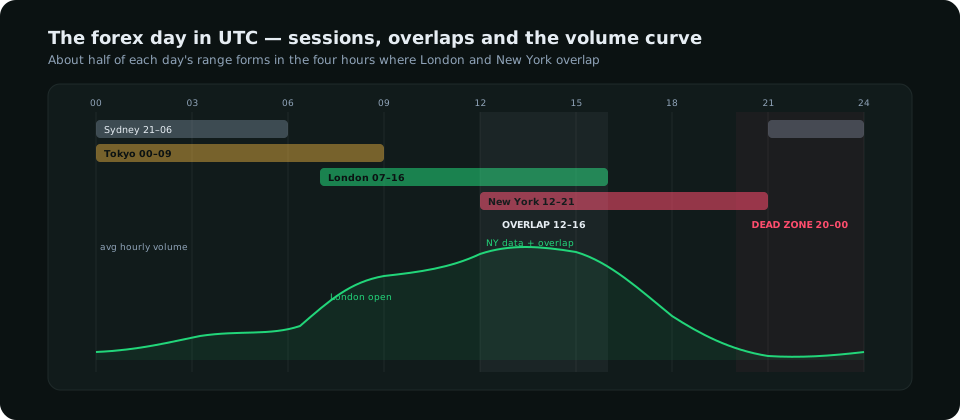
Two practical points follow. The London open (07:00–09:00 UTC) is where the Asian range is usually taken, one side then often the other, and where the day's real direction tends to begin; the London session guide covers how to prepare for it. The New York open (12:00–14:00 UTC) is where US data lands and where London's move either extends or reverses — the New York guide has a plan for it.
Which pairs, which hours
A pair moves when at least one of its currencies' home market is open. EUR/USD is active from London's open to New York's close; USD/JPY has two active windows, Tokyo and New York; AUD/USD moves in Sydney/Tokyo on Australian data and again in the overlap. Trading a pair outside its windows means wider spreads, more random movement and sweeps that go nowhere.
| Pair | Best window (UTC) | Avoid |
|---|---|---|
| EUR/USD, GBP/USD | 07:00 – 16:00, best 12:00 – 16:00 | 21:00 – 06:00 |
| USD/JPY | 00:00 – 03:00 and 12:00 – 16:00 | 17:00 – 23:00 |
| AUD/USD, NZD/USD | 00:00 – 04:00 (data) and 12:00 – 16:00 | 17:00 – 23:00 |
| USD/CAD | 12:30 – 16:00 (US and Canadian data) | Asia entirely |
| EUR/GBP, EUR/CHF | 07:00 – 12:00 | Everything outside London |
| Gold (XAU/USD) | 07:00 – 09:00 and 12:30 – 16:00 | Asia (narrow range, false breaks) |
The hours by trading style
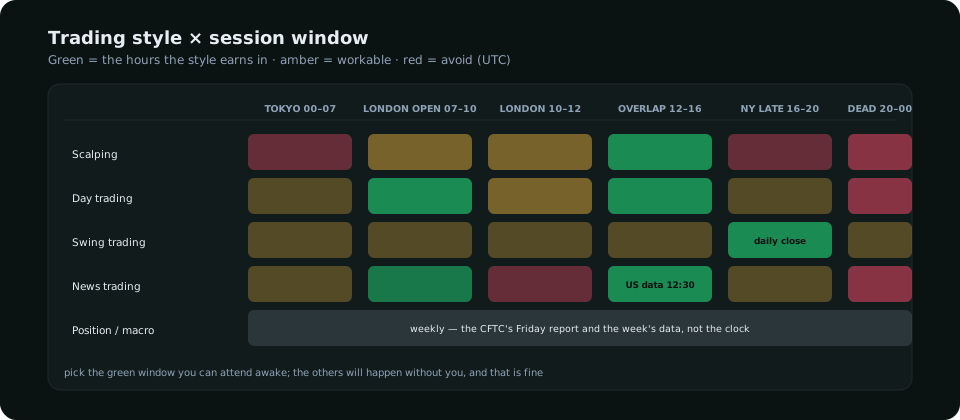
Liquidity is one half of the answer; the other half is what you are trying to do in the market. Different styles need different hours.
| Style | Best hours (UTC) | Why |
|---|---|---|
| Scalping | 12:00 – 16:00 | Tightest spreads and deepest book; a 5-pip target needs both |
| Intraday / day trading | 07:00 – 10:00 and 12:30 – 15:30 | The session opens produce the sweeps and structure shifts that intraday setups are built from |
| Swing trading | Daily close (21:00) for decisions; any hour for execution via pending orders | The signal is the daily candle; the hour of entry barely matters |
| News trading | 12:30 – 14:00 (US data), 07:00 – 09:00 (UK / EU data) | The release is the event; nothing else that day compares |
| Position / macro | Weekly | Driven by the CFTC's Friday report and the week's data, not by the clock |
The dead zones
- 20:00 – 00:00 UTC. New York has closed, Sydney is thin. Spreads widen, moves are random, and a "breakout" here is usually filled back by the Asian open.
- Friday after 16:00 UTC. Positions are squared for the weekend; moves reverse without reason; the weekend gap risk is not worth a day trade.
- The hour before a major release. Markets sit still while the order books thin; a setup forming at 12:00 UTC on a US CPI day is a setup that will be decided by the number, not by structure. Check the calendar first — a red-events panel or any economic calendar will do.
- Bank holidays in the relevant centre. A UK holiday hollows out London; a US holiday hollows out the overlap. Volume on those days is often a third of normal.
Converting to your own time zone
Everything above is in UTC because the session times are anchored to it (after the daylight-saving adjustments). Add your offset: Gulf Standard Time is UTC+4, Pakistan is UTC+5, Central European Time is UTC+1 (UTC+2 in summer), Eastern Time is UTC−5 (UTC−4 in summer). For a trader in the Gulf, the London open is 11:00–13:00 local and the overlap is 16:00–20:00 — a workable evening. For a trader in East Asia, the overlap is 20:00–00:00, which is why many there trade the Tokyo open and the London open rather than New York. The killzones in Gulf and Pakistan time guide works the clock through for that region.
Your own schedule is the third constraint
The best session is worthless if you cannot be awake for it with a clear head. A trader who works days in Europe has the London open before work and the overlap after lunch; a trader who works days in Asia has the London open in the evening and not much else. Fighting sleep for a session is itself a losing strategy — tired traders break rules. Choose the best window you can reliably attend, build your routine around it, and accept that some days' moves will happen without you. They always will; the point is that the ones you take are the ones with liquidity behind them.
Summary
- The London / New York overlap, 12:00–16:00 UTC, is the deepest market of the day; the London open, 07:00–09:00, is where direction usually starts.
- Trade a pair in the hours its home markets are open; everything else is spread and noise.
- Scalpers need the overlap, day traders need the opens, swing traders need the daily close.
- Avoid 20:00–00:00 UTC, Friday afternoons, the hour before major data, and holidays in the relevant centre.
- Pick the window you can attend awake and build the routine around it.
Everything on SMC Terminal is analysis and education, not a recommendation to buy or sell. Session hours shift with daylight-saving changes; verify against your broker's server time. Trading carries a substantial risk of loss. Manage your risk.