Forex Trading for Beginners: A Practical Guide to How the Market Works
Forex is the largest market in the world and the easiest one to misunderstand. This guide explains what you are actually trading, who sets the price, what a pip and a lot really cost, and the three habits that separate traders who last from traders who don't.
Around 7.5 trillion dollars changes hands in the foreign exchange market every day. Almost none of it is retail traders. Banks settle trade, corporations hedge payrolls in other currencies, central banks manage reserves, and funds express views on interest rates. Retail trading sits on top of that machine, and the first thing a beginner needs to understand is that the machine does not care about you — which is good news, because it means price is driven by forces you can study rather than by anyone trying to trick you personally.
This guide covers what you are actually trading, how the price is made, what the numbers on your platform mean in money, when the market is worth watching, and the three habits that keep new traders in the game long enough to learn.
What a currency pair actually is
You never buy a currency in isolation. You always buy one by selling another, which is why every instrument is a pair. In EUR/USD the euro is the base currency and the dollar the quote. A price of 1.1200 means one euro costs 1.12 dollars. Buying EUR/USD is a bet that the euro strengthens against the dollar; selling it is the reverse. There is no "going to cash" — a long in one currency is always a short in another.
Pairs fall into three groups that behave differently:
- Majors (EUR/USD, GBP/USD, USD/JPY, USD/CHF, AUD/USD, USD/CAD, NZD/USD): the dollar on one side, the deepest liquidity, the tightest spreads, and the most predictable session rhythm. Start here.
- Crosses (EUR/JPY, GBP/JPY, EUR/GBP…): no dollar. Their moves are the difference between two dollar pairs, which makes them trend hard when two central banks diverge and chop when they don't.
- Exotics (USD/TRY, USD/ZAR…): wide spreads, thin liquidity, political risk. Not for a first year.
Who moves the price
The interbank market — a handful of large dealers quoting each other — sets the price you see. Your broker streams a version of that price to you with its own spread on top. Three forces move the interbank price, and they operate on different clocks:
- Interest-rate expectations (months). Money flows toward the currency whose central bank is expected to pay more. This is the single biggest driver of trends and the reason a CPI print can move a pair for weeks.
- Positioning (weeks). When speculators are crowded on one side, the next move is often the squeeze. The CFTC's weekly Commitments of Traders report is the public record of that crowding.
- Order flow and liquidity (minutes to days). Stops cluster at obvious levels; large orders need those stops to get filled. This is the world of Smart Money Concepts, and it is where most retail traders spend their time without ever learning the two layers above it.
Pips, lots and leverage, in money
A pip is the fourth decimal place on most pairs (0.0001) and the second on yen pairs (0.01). A lot is 100,000 units of the base currency; a mini lot is 10,000 and a micro lot 1,000. The maths that matters is what one pip is worth to you:
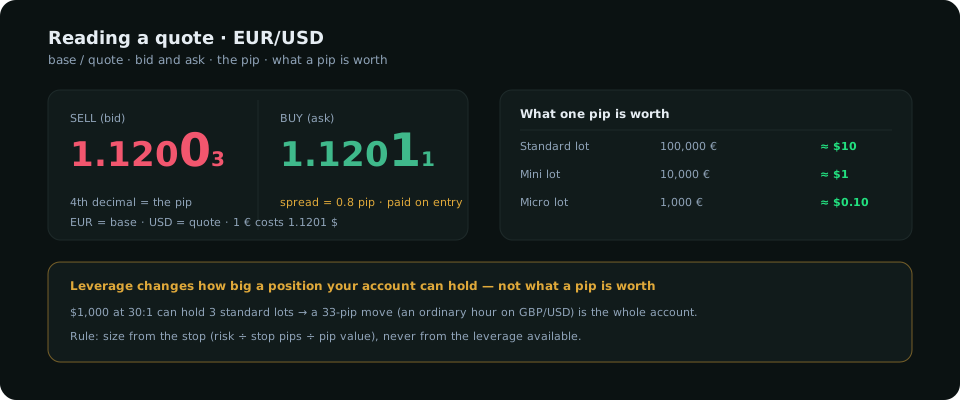
| Lot size | Units | Value of 1 pip (EUR/USD) | A 30-pip stop costs |
|---|---|---|---|
| Standard | 100,000 | ≈ $10 | $300 |
| Mini | 10,000 | ≈ $1 | $30 |
| Micro | 1,000 | ≈ $0.10 | $3 |
Leverage is the loan your broker extends so you can hold a 100,000-unit position with far less than 100,000 in the account. At 30:1 you post about 3.3% as margin. Leverage does not change what a pip is worth; it changes how large a position your account can hold. That is the trap. A $1,000 account at 30:1 can open three standard lots and lose the whole account on a 33-pip move — an ordinary hour on GBP/USD. Treat leverage as a ceiling you never approach, not a target.
When the market is worth watching
Forex trades 24 hours from Sunday evening to Friday evening (New York time), but it is not equally alive. Volume and direction cluster around the opening hours of the big centres: London (roughly 02:00–05:00 New York, 11:00–14:00 Pakistan time) and New York (07:00–10:00). Asia builds a range overnight; London breaks it; New York either extends London's move or reverses it. A beginner who only trades the London window will see cleaner structure than one who trades all day, and will trade less — which is the point. The full session clock, converted to Gulf and Pakistan time, is in our London session guide.
Reading a chart without an indicator
Before you add a single indicator, learn to read structure. In an uptrend price makes higher highs and higher lows; in a downtrend lower highs and lower lows; everything else is a range. A break of the last swing in the direction of the trend is a continuation; a break against it is the first sign of a change. That one skill — labelling swings — tells you which way to lean and where the obvious stops are sitting. Indicators can help you measure things; they cannot replace this. Our indicator guide explains which ones measure what, once you want them.
The three habits that keep beginners in the game
- Risk a fixed fraction, never a fixed lot. Decide the loss you can accept on a trade — 0.5% to 1% of the account — and size the position from the stop distance, not the other way round. The formula and a worked example are in Forex Risk Management. This is the habit that makes all the others survivable.
- Trade one pair, one session, one setup for three months. Edge comes from repetition. Twelve pairs across all sessions is noise you cannot learn from.
- Write the reason before the trade and the result after. Not the P&L — the reason. After fifty trades the journal tells you which reasons made money. Nothing else will.
What to expect
Most new traders lose money for the first six to twelve months, mostly through size, not through being wrong about direction. The market will still be there when you have learned to size. A demo account teaches the platform; a tiny live account — micro lots, real money, real feelings — teaches the trading. Start there, keep the risk small enough to be boring, and spend your attention on structure, positioning and timing rather than on finding the perfect indicator.
Everything on SMC Terminal is analysis and education, not a recommendation to buy or sell. Trading carries a substantial risk of loss. Manage your risk.