Trading Psychology: How to Reduce Impulsive Decisions
Trading psychology advice usually asks the trader to feel differently; this guide asks them to arrange things differently. Impulsive trades follow a predictable loop, a trigger, an urge, a fast action with no friction in between, and the loop is broken by adding friction at the action step, not by willpower at the urge. It covers the four triggers that produce most impulsive decisions, the friction rules that interrupt each one, and how to measure whether they are working.
Most trading psychology advice fails because it is addressed to the wrong moment. "Stay disciplined", "control your emotions", "trade without fear" are instructions to the trader at the instant the urge arrives, which is the instant the trader is least able to follow them. The impulsive trade is not a failure of character; it is a loop that runs the same way every time, a trigger produces an urge and the urge produces an action, and the loop runs fast because nothing stands between the urge and the platform's buy button. The loop is broken by putting something there. This guide names the four triggers that produce most impulsive decisions, gives a friction rule for each that works without willpower, and sets out how to measure in the journal whether the rules are holding.
The loop
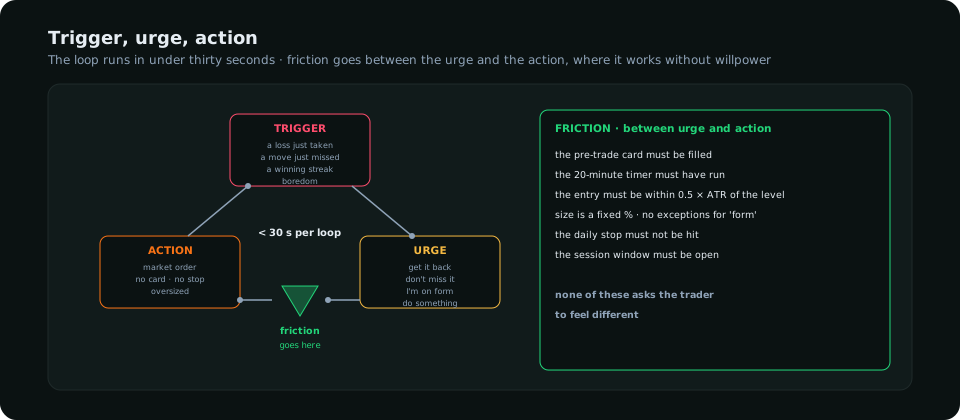
The timing is the point. The urge after a loss or a missed move peaks within seconds and decays within minutes; the impulsive trade is taken inside that window because taking it is easy. A rule that makes the action take three minutes outlasts the urge. That is the whole mechanism, and it works the same for a trader who is calm by nature and one who is not.
Four triggers and the rule for each
| Trigger | The urge | The impulsive action | Friction rule |
|---|---|---|---|
| A loss just taken | Get it back now | Re-enter the same pair immediately, often larger | A 20-minute timer after any stop-out before a new order; no size above the standard |
| A move just missed | Don't miss the rest of it | Chase at a worse price with no structural stop | No entry more than 0.5 × ATR from the planned level; the card must show the original entry |
| A winning streak | I'm on form; press it | Raise size, skip the checklist, take marginal setups | Size is a fixed percentage; the card must be complete for every trade, winners included |
| Boredom | Do something | Trade a pair or session outside the plan | A fixed session window; outside it the platform is closed; a written list of allowed pairs |
Each rule works on the action, not the feeling. The timer does not ask the trader to stop wanting revenge; it makes revenge take twenty minutes, by which time the urge has decayed and the chart has usually changed. The distance rule does not ask the trader to stop fearing a missed move; it makes chasing impossible by definition. The fixed-percentage rule removes the decision about size entirely, so that a streak has nothing to inflate; the risk per trade guide sets the number. The session window and the pair list make boredom trades unavailable rather than resisted.
The friction that covers all four
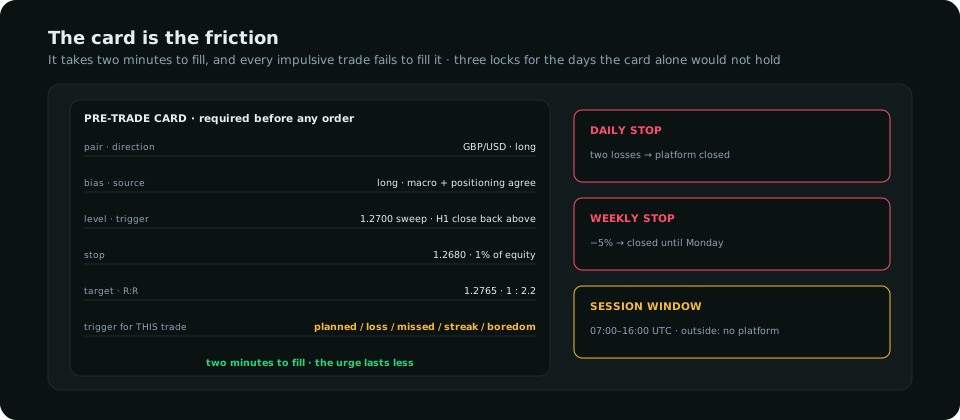
The pre-trade card from the market analysis routine is the single rule that interrupts every trigger, because an impulsive trade cannot complete it: there is no bias line, no trigger that completed, no structural stop. Make it unconditional: no card, no order, including the trades that feel obviously right. Add one field the routine does not have: what triggered this trade, with the honest options "planned", "loss", "missed", "streak", "boredom". Writing "loss" on the card is usually enough to end the trade before it starts, and when it is not, the journal has the record. The daily stop (two losses, or the day's loss limit) and the weekly stop close the platform mechanically on the days the card alone would not hold; the drawdown guide explains why those limits exist independently of psychology.
Measuring it
Discipline is measured, not felt. Three journal fields, kept for every trade, show whether the rules are working. Trigger: the proportion of trades marked "planned" should rise toward 90% over a few months; the others are the impulsive ones, and their results, kept separately, are almost always worse. Time since last close: a cluster of entries within five minutes of a stop-out is the revenge loop running; the timer rule should empty that cluster. Distance from planned entry: trades entered more than 0.5 ATR from the level are chases; count them. A monthly review of these three numbers is more useful than any amount of introspection, and it converts "I need to be more disciplined" into "I chased four times in March, all four lost, the distance rule goes on the card". The win rate and expectancy article shows what to do with the split results.
Why willpower is the wrong tool
Willpower is a resource that is lowest exactly when it is needed: after a loss, late in a session, during a drawdown. Rules that depend on it hold on good days and fail on bad ones, which is the opposite of the days they are for. Rules that depend on friction, a timer, a card, a closed platform, hold on all days equally, because they do not ask the trader to be anyone other than who they are at that moment. The traders with the best records are not the calmest; they are the ones whose process has the fewest places where a thirty-second urge can reach an order ticket. The daily workflow is that process; the friction rules here are what keep it running on the days it is tested.
Frequently asked
How do I stop impulsive trading?
Put friction between the urge and the order: a pre-trade card that must be filled, a timer after any stop-out, a fixed size, a session window and a daily stop. The urge lasts seconds; make the action take minutes.
What is revenge trading and how do I avoid it?
Re-entering immediately after a loss to recover it, usually larger and without a plan. A twenty-minute timer after any stop-out and a fixed position size remove both the speed and the size the urge needs.
Does trading psychology matter more than strategy?
A strategy with an edge traded impulsively loses; the edge is collected only by the trades taken as planned. The journal's trigger field shows how much of the strategy's result the trader is actually keeping.
Everything on SMC Terminal is analysis and education, not a recommendation to buy or sell. Figures in the example are illustrative. Trading carries a substantial risk of loss. Manage your risk.