How Interest Rates Affect Forex Currency Pairs
Interest rates are the engine under every major currency pair: capital moves toward the currency that pays more, and the pair follows the difference, not the level. This guide explains the mechanism from central-bank decision to exchange rate, why expectations move pairs before the actual change, how to read a rate differential chart, what carry and swap mean for a position, and the moments when the rule breaks.
Every currency is a claim on an economy's interest rate. Hold dollars in a money-market fund and you earn the Federal Reserve's rate; hold yen and you earn the Bank of Japan's. When those two rates diverge, capital moves toward the higher one, and the exchange rate moves with it. That is the whole mechanism, and it explains more of a major pair's direction over months than any chart pattern. This guide follows it from the central-bank decision to the price on your screen, and then to the exceptions.
The mechanism in four steps
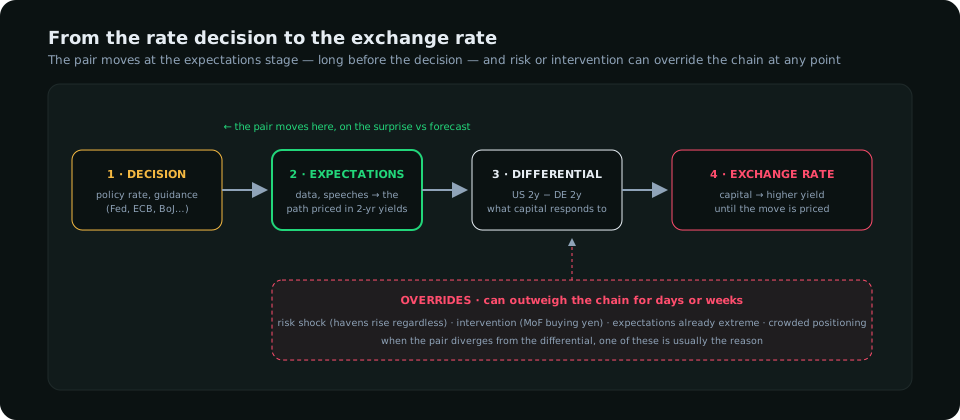
- The central bank sets a policy rate — the Fed funds rate, the ECB deposit rate, the BoJ policy rate — to manage inflation and employment.
- Markets form expectations about where that rate will be in six, twelve, twenty-four months, from the bank's guidance and from the data (inflation, jobs, growth). These expectations are visible in short-dated government bond yields, especially the 2-year yield.
- The differential between two countries' 2-year yields is what capital responds to. If US 2-year yields are 4.5% and German 2-year yields are 2.5%, holding dollars pays two points more than holding euros, before any price move.
- The exchange rate adjusts: demand for the higher-yielding currency pushes the pair in its favour, until the exchange rate has moved enough that the expected gain is priced in.
The key word in step 2 is expectations. A pair moves when the outlook for rates changes — a hot inflation print, a speech, a revised forecast — not on the day the rate is actually changed, which by then is usually fully priced. This is why EUR/USD can fall on a day the ECB raises rates: the hike was expected, and the guidance that came with it was softer than hoped.
Reading a rate differential chart
Plot the spread between two countries' 2-year yields against the pair. Over months they track; over days they diverge and reconverge.
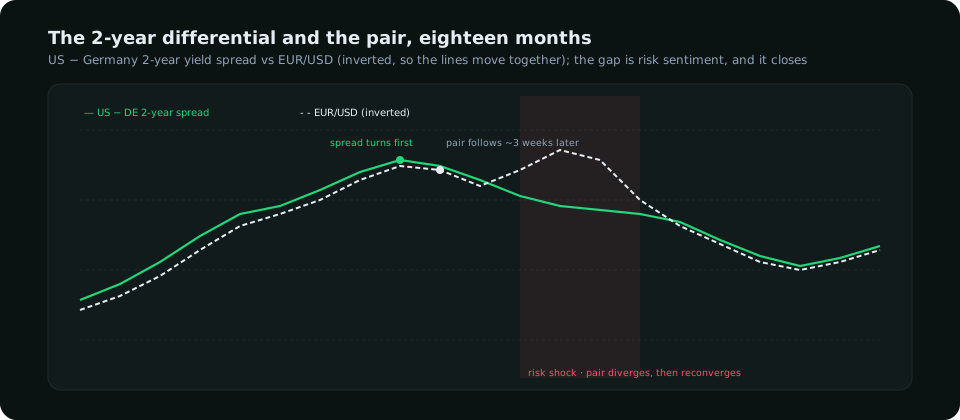
- Direction: when the spread is widening in the dollar's favour, EUR/USD tends to fall; narrowing, it tends to rise. The spread often turns before the pair does, by days to weeks.
- Divergence: when the pair moves against the spread, something other than rates is driving it — usually risk sentiment or positioning. Those divergences are where a rates-aware trader looks for the pair to come back.
- Where to get it: 2-year yields are published daily by the US Treasury and by FRED; many charting platforms let you plot the difference directly (e.g. US02Y − DE02Y). The terminal's Valuation & Yields read does this per market.
Carry and swap: rates inside your position
When you hold a pair overnight, the broker credits or charges the interest difference between the two currencies as swap. Long a high-yield currency against a low-yield one earns a small daily credit; the reverse pays a daily charge. This is the carry trade in miniature: borrow the cheap currency, hold the expensive one, collect the difference, and hope the exchange rate doesn't erase it.
| Position | Earns / pays | What it depends on |
|---|---|---|
| Long AUD/JPY (high yield vs low) | Earns swap | The differential staying wide; risk appetite staying calm |
| Short AUD/JPY | Pays swap | A short held for weeks must beat the daily cost |
| Long EUR/USD when US rates are higher | Pays swap | The differential's sign, not the pair's direction |
For a day trader swap is noise. For a swing trader holding for weeks it is a cost or an income that belongs in the trade's arithmetic — the pairs, pips and lots guide covers where it shows up on the platform. Carry trades have a known failure mode: they unwind violently when risk appetite collapses, as every yen-funded carry has learned in a crisis.
The catalysts: what moves expectations
| Event | Why it moves the pair | Typical reaction size (majors) |
|---|---|---|
| Central-bank decision and statement | Confirms or shifts the path; the statement and press conference matter more than the decision | 50–150 pips on a surprise |
| Inflation (CPI, PCE, core measures) | Hotter than forecast → more hikes or fewer cuts expected → currency up | 40–120 pips |
| Jobs (payrolls, unemployment, wages) | Strong labour market → bank can stay tight | 40–100 pips |
| Central-bank speeches, minutes | Guidance between meetings | 20–60 pips |
| Growth (GDP, PMIs) | Weakness → cuts expected → currency down | 20–60 pips |
The reaction is to the surprise — actual versus forecast — not to the number itself. A 3.5% CPI print is bullish for the currency if 3.3% was expected and bearish if 3.7% was. An economic calendar that shows the forecast is essential; the session guide shows where these releases fall in the trading day.
When the rule breaks
- Risk shocks. In a global selloff the dollar, yen and Swiss franc rise regardless of their rates, as capital runs to safety and funding currencies are bought back. The rate differential still exists; it is simply outweighed for days or weeks.
- Intervention. Japan's Ministry of Finance has bought yen at levels it considered disorderly, moving USD/JPY hundreds of pips against a differential that said the opposite. Watch for verbal warnings first.
- Expectations already extreme. When the market has priced six cuts and the bank delivers four, the currency rises on "fewer cuts than feared". Read the pricing before the decision, not just the decision.
- Positioning. A differential can be fully reflected in a crowded position (the COT index shows this); further differential widening then moves the pair less, and any narrowing moves it a lot.
Using rates in a trade
- Know the direction of the 2-year differential for the pair this week, and whether it is widening or narrowing. That is the bias.
- Know the next catalyst and the forecast. Do not hold a structure-only trade through a CPI print; it is a different trade afterwards.
- Check risk sentiment: if equities are selling off hard, the haven currencies win regardless of rates.
- Enter on structure in the direction of the differential; treat a setup against it as counter-trend and size it that way.
Rates will not tell you the entry; the chart does that. But they will tell you which direction the week's entries should be in, and that is most of what a currency trader needs to get right.
Everything on SMC Terminal is analysis and education, not a recommendation to buy or sell. Reaction sizes are typical ranges for illustration. Trading carries a substantial risk of loss. Manage your risk.