Forex Fundamental Analysis: How Economic Data Influences Currency Prices
Economic data does not move currencies directly. It moves expectations of what central banks will do, and the currency follows the rate path. This guide shows the chain from a CPI print to a EUR/USD trend, which releases matter, how to read a number against its forecast, and how to turn it all into one bias per pair.
Ask a beginner why EUR/USD fell after a strong US jobs report and you will hear "because the economy is strong". That is one step short of the real answer, and the missing step is where all the money is. A strong jobs number makes the Federal Reserve less likely to cut rates, which makes dollar deposits pay more relative to euro deposits, which makes capital flow into dollars. The economy is the input; the rate path is the mechanism; the currency is the output.
Once you see that chain, fundamental analysis stops being a list of releases to memorise and becomes a single question you ask of every number: does this change what the central bank will do, and by how much more than the market already expected?
The chain, step by step
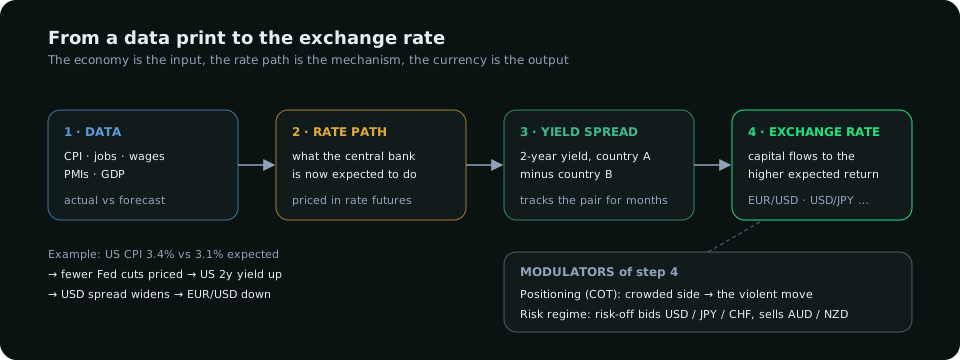
- Data: inflation, employment, growth and the surveys that lead them.
- Policy expectations: the market's priced path of the policy rate — visible in rate futures and swaps — moves within seconds of a release.
- Yield differential: the gap between two countries' two-year yields is the cleanest single summary of relative policy. EUR/USD tracks the German–US two-year spread over months with startling fidelity.
- Exchange rate: follows the differential, with positioning deciding how fast and risk appetite deciding which currencies are bought in a panic (dollar, yen, franc) and sold (Australian and New Zealand dollars, emerging markets).
The releases that matter, by currency
| Release | What it tells the central bank | Why the market cares |
|---|---|---|
| CPI / core CPI (monthly) | Whether inflation is on target | The direct input to the policy mandate; the biggest single mover in the current cycle |
| Employment (US NFP, unemployment, wages) | Slack in the labour market | Wage growth feeds inflation; weak jobs force cuts |
| Central-bank decisions and minutes | The policy itself and the reasoning | The statement's wording and the projections move the whole curve |
| PMIs (manufacturing, services) | Growth momentum, a month early | Leading; a surprise here is often the first sign a cycle is turning |
| GDP | Growth, after the fact | Mostly priced by the time it prints; revisions can surprise |
| Retail sales, trade balance | Demand and external position | Second tier; matter when they confirm or contradict the trend |
The weighting differs by central bank. The Fed and the ECB are inflation-first; the Bank of Japan is wage-first; the Reserve Banks of Australia and New Zealand watch China and commodity prices; the Bank of Canada watches oil and the US. Learn the one sentence each bank repeats and you know which release moves its currency most.
Reading a number: actual, forecast, previous, revision
A release is four numbers, and the one that moves price is the gap between actual and forecast — because the forecast is what was already in the price. A CPI of 3.4% when 3.4% was expected is a non-event even if it is "high"; 3.4% against 3.1% expected is a hawkish shock. Three refinements:
- Revisions to last month can matter more than this month. A payrolls print of +150k with the prior revised from +200k to +80k is a weak report.
- The detail beats the headline. Core (ex food and energy) CPI drives policy; headline drives the first thirty seconds. Average hourly earnings matter more than the payroll count once the labour market has cooled.
- Reaction tells you the positioning. A hawkish surprise that cannot lift the dollar means the market was already long dollars. That failure is information — see the COT report guide for the public record of that crowding.
From data to a bias per pair
A tradable bias is a comparison, because every pair has two sides. The method the terminal uses, which you can reproduce with a spreadsheet:
- For each currency, score the direction of the rate path (hiking, holding, cutting), the surprise trend (are releases beating or missing forecasts), and the growth–inflation mix.
- Compose a pair by subtracting: the stronger side is the one whose central bank is on the more hawkish path relative to expectations.
- Overlay the risk regime: in risk-off the dollar, yen and franc get an extra bid regardless of their data; the Australian and New Zealand dollars an extra offer.
- Hold the bias for weeks; change it only on a release that shifts the rate path, not on a single miss.
That last rule is the one worth tattooing somewhere. Fundamentals move on quarters. A trader who flips bias on every data point has no fundamental view — he has a news feed.
Where fundamentals stop and the chart starts
Fundamental analysis gives direction and conviction. It does not give an entry. A bearish euro bias says "look for shorts"; it does not say where. The chart does that — the area of interest, the sweep, the shift, the session window — and the two together are the whole trade. Our Smart Money Concepts guide covers the execution half; the terminal's Macro tab shows the per-currency scores and the week's releases with their expected effect on each pair, so the fundamental half is read for you before the session starts.
Three habits of good fundamental traders
- Know the calendar a week ahead, and know which releases can change the rate path for the currencies you trade. Everything else is noise you can ignore.
- Trade the second move, not the first. The first minute after a release is algorithms and stops. The direction that holds thirty minutes later is the one with information in it.
- Write the bias down with the reason, and the condition that would change it. If you cannot name the release that would flip you, you do not have a view yet.
Everything on SMC Terminal is analysis and education, not a recommendation to buy or sell. Manage your risk.