How to Use an Economic Calendar Before Trading Forex News
An economic calendar is the one input every forex trader has and most use badly: as a list to glance at rather than a schedule that decides when trades are allowed. This guide sorts releases into the three tiers that matter, explains what the forecast and previous columns actually tell you, sets out the before, during and after windows for a red release, and shows how to plan the post-release trade instead of gambling on the number.
The economic calendar is the only part of forex analysis that tells you the future with certainty: not what the number will be, but exactly when the market will care. A trader who knows that US CPI prints at 12:30 UTC on Wednesday knows that EUR/USD and gold will have a window of violent two-way movement at that minute, that the hour before it will be thin, and that a position carried into it is a bet on a number no chart can predict. Used that way, the calendar is a schedule of when trades are and are not allowed. This guide sets out which releases matter, what the columns mean, the windows around a release, and how to plan the trade that comes after the number instead of the one that guesses it.
Three tiers of releases
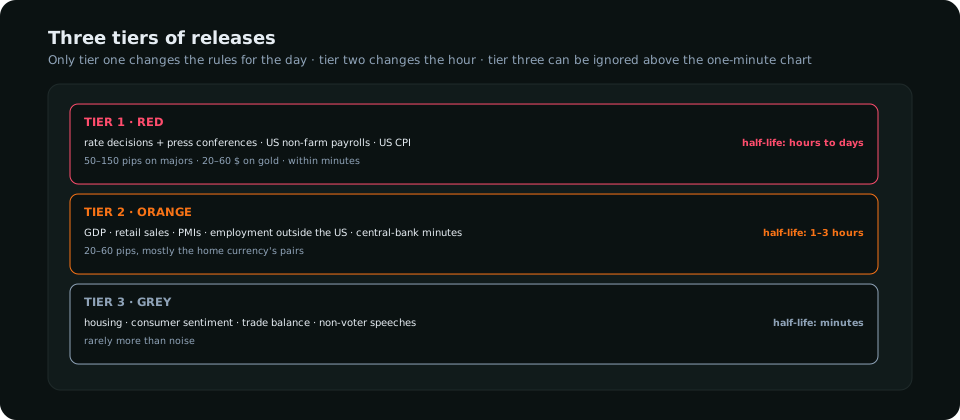
| Tier | Releases | Typical move | Rule |
|---|---|---|---|
| 1 · Red | Rate decisions and press conferences · US non-farm payrolls · US CPI · occasionally core PCE and a major-economy CPI | 50–150 pips on majors; 20–60 dollars on gold within minutes | No new positions 30 min before; no positions held through unless the stop is beyond the expected move; plan the post-release trade |
| 2 · Orange | GDP · retail sales · PMIs · employment outside the US · central-bank minutes | 20–60 pips, mostly in the home currency's pairs | No new entries 15 min before; existing positions kept with stops in place |
| 3 · Grey | Housing · consumer sentiment · trade balance · speeches by non-voters | Rarely more than noise | Ignore unless the pair is unusually quiet |
Calendars grade impact themselves, with some disagreement at the margins. The grading that matters is yours, per currency: UK data moves GBP pairs, not EUR/USD; Australian employment moves AUD/USD at 00:30 UTC when Europeans are asleep. Mark a release as red for the pairs it moves, not for the calendar as a whole.
Reading the columns
Previous is last period's figure; forecast (consensus) is the median of economists' estimates; actual is the print. The market reaction is to the surprise, actual minus forecast, not to the level: a CPI of 3.4% when 3.6% was forecast is a dovish surprise and the dollar falls, even though 3.4% is high. Three subtleties decide most reactions. The revision to the previous figure, published alongside the actual, can outweigh the headline (payrolls routinely revise the prior month by 50,000 or more). The whisper number, what the market has actually positioned for, can differ from the published consensus; a print that beats the forecast but misses the whisper falls. And which component the central bank cares about this cycle (core versus headline, average hourly earnings versus the payroll count) is the one that moves rates, so it is the one that moves the currency. The fundamental analysis guide covers how each release feeds the rate path; the interest rates article covers the rate path's effect on pairs.
The three windows
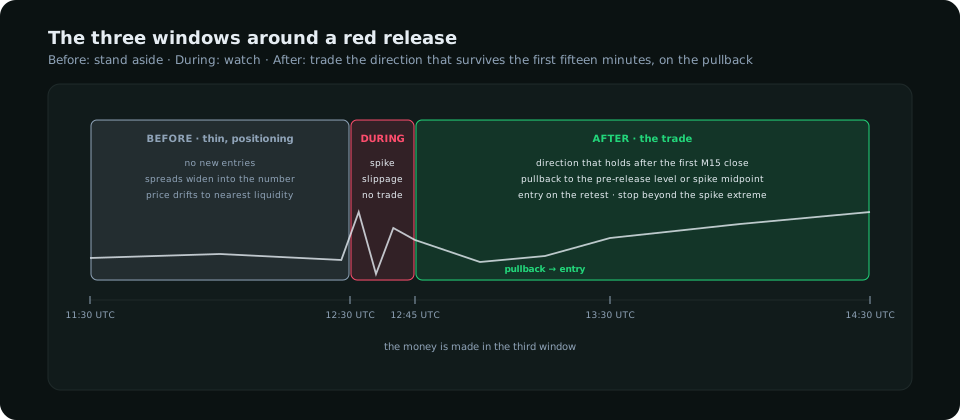
Before. The hour before a red release is thin; the market positions toward the nearest liquidity and spreads widen in the final minutes. No new entries. Existing positions either have a stop beyond the expected move (roughly 1.5 times the average reaction, which for payrolls on EUR/USD is 60–100 pips) or are closed.
During. The first minute is unreadable: both sides are hit, the initial move is reversed roughly half the time as algorithms react to the headline and then to the detail, and slippage on a market order can be twenty pips. There is nothing to trade here that a retail account can execute at the price it sees.
After. Once the first fifteen-minute candle has closed, the direction that holds is the information. The trade is the pullback: price retraces toward the pre-release level or the midpoint of the spike, rejects, and continues in the post-release direction. Entry on the retest, stop beyond the spike's extreme, target the next liquidity in that direction. This is a defined-risk trade on known information, and it is where the reliable money around news is made. The New York session guide builds the 12:30 release into the session plan.
The time-zone trap
Most calendars default to the reader's local zone or to Eastern Time, and the US shifts its clocks on different dates from Europe, so "8:30 ET" is 12:30 UTC in summer and 13:30 UTC in winter. A trader in Pakistan or the Gulf working in local time has been wrong by an hour twice a year for as long as calendars have existed. Set the calendar to UTC and learn the two or three conversions that matter for your session; or use a tool that shows the release in your own zone and updates it when either side changes its clocks. SMC Terminal's calendar and session clock are in the member's zone for exactly this reason.
What is not on the calendar
Unscheduled central-bank interventions, emergency rate moves, geopolitical events and large option expiries do not appear, and the first three move markets more than anything that does. The protection is the same as for scheduled events: a stop on every position and an exposure limit that keeps a surprise from ending the account. Option expiries (10:00 New York, daily) are published by the exchanges and are worth adding to your own calendar for gold and the majors, since price is drawn to large strikes into the expiry.
Building the calendar into the routine
- Sunday: mark the week's tier-one releases per currency and the days they fall on. Those days have a different plan from the others.
- Each morning: note the next red release and its countdown. It gates every entry decision in the pre-trade routine.
- Thirty minutes before: no new entries; check stops on open positions against the expected move.
- Fifteen minutes after: read the direction that held, mark the spike's extremes and midpoint, wait for the pullback.
- After the session: note the surprise (actual minus forecast) and the reaction. Over a few months this becomes a record of which releases actually move your pairs and by how much, which is better than any calendar's impact rating.
Frequently asked
Which economic calendar events move forex the most?
Central-bank rate decisions and press conferences, US non-farm payrolls and US CPI, in roughly that order. Everything else is a tier below, and most of the calendar is noise for anyone trading above the one-minute chart.
Should I trade during news releases?
Not during the release itself; the execution is too poor and the first move too unreliable. Trade the pullback after the first fifteen-minute candle has established the direction that held.
Why did the currency fall on good news?
Because the market reacts to the surprise against the forecast and the whisper, not to the level; because the revision to the previous figure was bad; or because the component the central bank watches went the other way from the headline.
Everything on SMC Terminal is analysis and education, not a recommendation to buy or sell. Figures in the example are illustrative. Trading carries a substantial risk of loss. Manage your risk.