How US Treasury Yields Influence the Dollar, Gold and Major Currencies
US Treasury yields are the price of the world's reserve currency over time, and they transmit into the dollar, gold and every major pair through a few mechanisms that can be watched directly. This guide explains the chain — 2-year yields and rate expectations, 10-year yields and term premium, real versus nominal — and how to read a yield move as a currency signal.
A Treasury yield is the return the market demands to lend to the US government for a given term. Because the dollar is the currency most of the world borrows, trades and holds reserves in, those yields set the price of the dollar itself: higher yields pull capital toward dollar assets, lower yields push it out. The transmission into forex and gold runs through a few specific channels, and each can be watched. This guide covers which yields matter for which market, the difference between nominal and real, what the shape of the curve adds, and how to read a yield move on the day it happens.
The chain, from the Fed to the chart
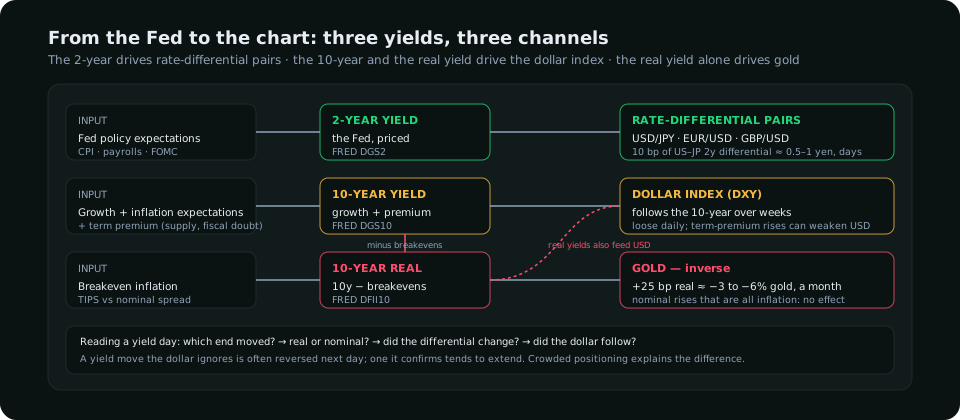
| Yield | What moves it | What it moves | Typical sensitivity |
|---|---|---|---|
| 2-year | Fed policy expectations over the next two years; CPI, payrolls, FOMC | Rate-differential pairs: USD/JPY, EUR/USD, GBP/USD | A 10 bp move in the US–Japan 2-year differential ≈ 0.5–1 yen on USD/JPY over days |
| 10-year | Growth and inflation expectations plus term premium; Treasury supply | The dollar index broadly; equities via discount rates | Dollar index tends to follow the 10-year's direction over weeks, not every day |
| 10-year real (TIPS) | The 10-year minus breakeven inflation | Gold, inversely; the dollar's long-run strength | A 25 bp rise in the 10-year real yield has typically coincided with a 3–6% fall in gold over the following month |
The 2-year: the Fed, priced
The 2-year yield is the market's forecast of the average Fed funds rate over the next two years. It jumps on CPI and payrolls because those prints change the forecast. For forex the 2-year matters as a differential: the US 2-year minus the other country's 2-year is the carry a trader earns holding the dollar against that currency, and the direction of the differential is the direction of the pair over weeks. USD/JPY is the clearest case because Japanese yields moved so little for so long that the differential was almost entirely the US side; EUR/USD follows the US–German 2-year gap. The interest rates article covers the differential mechanism and the carry trade built on it.
The 10-year and the dollar index
The 10-year embeds expectations further out plus a term premium — the extra yield investors demand for holding a long bond through uncertainty, which rises with heavy Treasury issuance and with inflation doubt. The dollar index tracks the 10-year's direction over weeks because foreign investors buying long Treasuries have to buy dollars first. The relationship is loose day to day and strong over a quarter. A rising 10-year with a falling dollar is the exception worth noting: it usually means the rise is term premium (fiscal worry) rather than growth, and foreign money is demanding more yield rather than buying more dollars. The DXY article covers what the index itself measures.
Real yields and gold
The real yield is what a Treasury pays after inflation, read from inflation-protected securities (TIPS). Gold pays nothing, so the real yield is the opportunity cost of holding it, and the two move inversely over any horizon longer than a few days. The practical discipline is to look at the real yield, not the nominal, on every gold day: a nominal 10-year rise that is all inflation expectations (breakevens up, real flat) does nothing to gold; the same rise in real terms is the headwind. The gold analysis guide ranks this as the single most important driver.
Curve shape: what steepening and flattening say
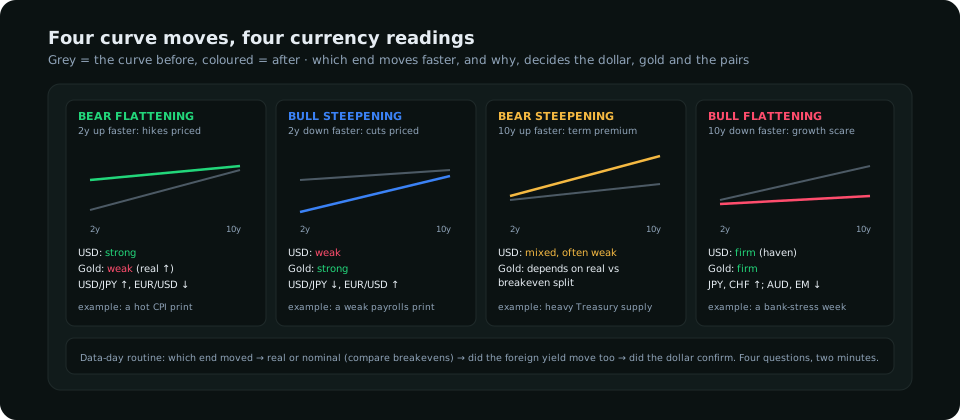
| Regime | What is happening | Dollar | Gold | Pairs |
|---|---|---|---|---|
| Bear flattening | 2-year up faster than 10-year: Fed hikes priced | Strong | Weak (real yields up) | USD/JPY up; EUR/USD down |
| Bull steepening | 2-year down faster: cuts priced | Weak | Strong | USD/JPY down; gold and EUR/USD up |
| Bear steepening | 10-year up faster: term premium, supply, inflation doubt | Mixed; often weak | Weak if real yields lead; firm if it is inflation | Volatile; watch breakevens |
| Bull flattening | 10-year down faster: growth scare | Firm (haven) | Firm | Yen and franc strong; AUD and emerging currencies weak |
Reading a yield move on the day
- Which end moved? The 2-year on a Fed-expectation print; the 10-year on supply, growth or inflation news. The end that moved says which channel is active.
- Real or nominal? Compare the 10-year move with the breakeven move. Real yields rising is dollar-positive and gold-negative; breakevens rising alone is neither.
- Did the differential change? If German or Japanese yields moved as much, the pair has no reason to; if they did not, the pair should.
- Did the dollar follow? A yield move the dollar ignores is often reversed the next day; a yield move the dollar confirms tends to extend. Positioning explains the difference — a crowded dollar long (see COT net positions) stops responding to good news.
Where to read the numbers
FRED publishes daily series for the 2-year (DGS2), 10-year (DGS10), 10-year real (DFII10) and breakevens (T10YIE), all free. The US Treasury publishes the daily curve. SMC Terminal's Valuation & Yields tab reads the curve and the real yield hourly and composes them with the other currencies' rates into a rate-differential read per pair, so the differential question above is answered on the dashboard rather than in a spreadsheet. The fundamental analysis guide covers the data releases that move the front end.
Frequently asked
Do higher Treasury yields always strengthen the dollar?
Over weeks, usually. On a given day, no: a yield rise driven by fiscal worry (term premium) can weaken the dollar, and a crowded dollar position can ignore a rise entirely.
Which yield matters most for gold?
The 10-year real yield. Nominal yields can rise with no effect on gold if inflation expectations rise with them.
Why does USD/JPY track the 2-year so closely?
Because Japanese short rates barely moved for decades, the US–Japan 2-year differential was almost entirely the US side, and that differential is the carry the pair pays. As Japanese rates normalise, the Japanese end of the differential matters more.
Everything on SMC Terminal is analysis and education, not a recommendation to buy or sell. Sensitivities are typical historical values for illustration. Trading carries a substantial risk of loss. Manage your risk.