The Fed Sounded Less Hawkish Than Priced. Two Weeks Later a December Hike Is Almost Certain. Here Is What Changed
Markets went into the 28 October 2026 FOMC meeting braced for a hawkish Kevin Warsh after September's hike and another month of elevated inflation. They got a hold at 3.75–4.00%, a chair who declined to commit to December and asked for more information, and a 2-year yield and dollar that fell on the day. Then five data releases arrived. This guide tracks the probability of a 9 December hike from 85.7% on decision day through a dip to about 75% and back to fully priced, explains what the chair said against what the calendar did, and sets out what is left to price: 25 or 50 basis points, and the path beyond.
Written on 14 November 2026. Probabilities are the CME FedWatch readings quoted in press reports on the dates given, rounded.
There is a version of the October Fed meeting that reads as dovish, and it is the version the market traded for two days. Investors arrived on 28 October 2026 expecting Chair Kevin Warsh to sound hawkish: the Committee had raised rates in September, inflation had not come down, oil was above $100, and two months of commentary had prepared everyone for a chair who would all but name the December hike. Instead the FOMC held at 3.75–4.00%, said it wanted "the accumulation of more information" before its next step, and declined to characterise December at all. Warsh repeated that inflation "remains elevated" and that price stability was the priority, but he would not pre-commit, and he announced that the Committee would meet less often from 2027. The 2-year yield fell, the dollar slipped, and the probability of a December move, 85.7% at the close that evening, drifted to about 75% by 30 October. Two weeks later it is as close to 100% as the futures market expresses, and the live question is whether the increase will be a quarter point or a half. This guide tracks that round trip, separates what the chair said from what the data did, and sets out what is actually left to price before 9 December. The pause guide written on the night covers the immediate reaction; this is the fortnight after.
The odds, day by day
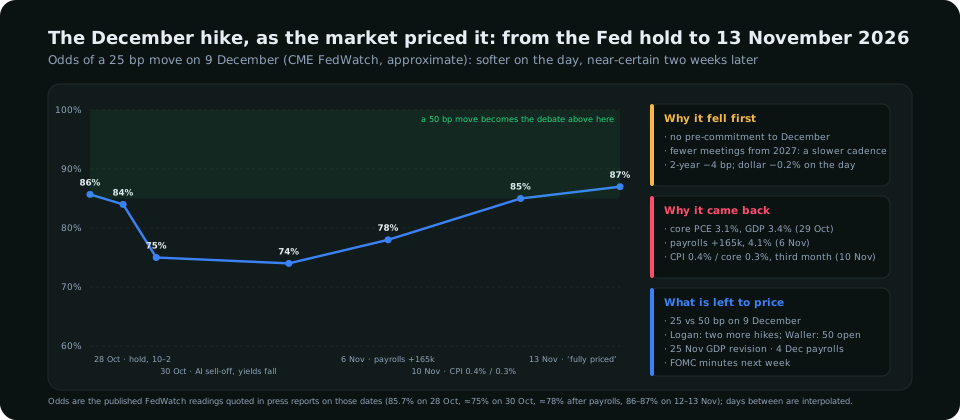
| Date | December hike odds | What moved them |
|---|---|---|
| 28 Oct, after the decision | ≈86% | Hold with two dissents for a hike; the number barely moved on the day, but the 2-year fell and the dollar slipped because the chair would not guide |
| 29 Oct | ≈84% | Core PCE 3.1% y/y and GDP 3.4%: hot, but in line with forecasts, so already priced |
| 30 Oct | ≈75% | An AI-led equity sell-off sent money into Treasuries; yields fell across the curve and the dollar with them; the Bank of Japan's hold added nothing hawkish |
| 6 Nov | ≈78–80% | Payrolls +165,000 against roughly 60,000 expected, unemployment 4.1%, wages +3.1% y/y |
| 10 Nov | ≈85% | October CPI +0.4% m/m, core +0.3% for a third month; Dallas Fed President Logan calls for two more hikes |
| 12–13 Nov | ≈87%, described as fully priced | Producer prices; Governor Waller says a half point is open if core CPI stays at 0.3%; Vice Chair Bowman expects October core PCE near 3.3% |
The important thing about the dip is what caused it. The odds did not fall because the Fed said anything new after the press conference; they fell because the Nasdaq fell and the bond market rallied on 30 October, which is a risk-off repricing rather than a policy one. Risk-off repricings fade when the next piece of hard data arrives, and this one faded on schedule.
What the chair said against what the data did
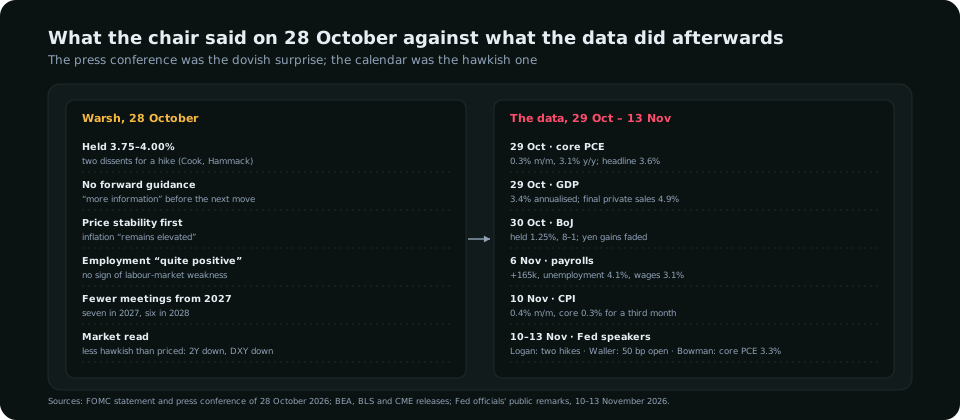
Three things made the meeting feel less hawkish than it was:
- No pre-commitment. The market had priced December at better than 80% going in and wanted the chair to ratify it. He did not. "More information" is a neutral phrase, but to a market positioned for a hawkish surprise, neutral is a disappointment, and the 2-year yield fell three to four basis points on it.
- Fewer meetings. Seven scheduled decisions in 2027 and six in 2028 instead of eight is an institutional change, not a signal about this cycle. The front end read it as fewer opportunities to hike, which is arithmetic rather than analysis, but it moved prices all the same.
- The dissents cut both ways. Two votes for a hike show where the Committee is heading; they also show that the majority, ten members, was not ready. On the day the market weighed the ten more than the two.
And three things made the data more hawkish than the meeting. Growth came in at 3.4%, not the 3.2% expected, with final sales to private buyers at 4.9%. The labour market, which the chair had called "quite positive", produced a payroll gain nearly three times the forecast. And inflation did not merely stay elevated; October's core CPI printed 0.3% for a third consecutive month, which Waller had publicly named as the threshold for considering a half-point move. The statement guide explains why the Committee's own language had already pointed this way; the payrolls guide and the calendar guide cover how to prepare for the releases that did the work.
What is left to price
| Question | Where the market is | What settles it |
|---|---|---|
| Will the Fed hike on 9 December? | Yes; fully priced for at least 25 bp | Only a collapse in the 4 December payrolls or a shock in the October PCE report would reopen it |
| 25 or 50 basis points? | 25 favoured; a minority probability on 50 | October core PCE (Bowman expects ≈3.3%), November CPI, and whether Waller's condition is met |
| How many more after December? | Logan says two; the curve has roughly one and a half priced for the first half of 2027 | The December projections: the median for end-2027 is the number that moves the dollar |
| Does the energy shock change the path? | Treated as a reason for caution, not for easing | Oil and the Hormuz situation; headline inflation versus core |
The calendar between now and the decision: the minutes of the October meeting and US retail sales next week, the second estimate of third-quarter GDP with corporate profits on 25 November, the October PCE report before the meeting, November payrolls on 4 December, and the decision with new projections on 9 December. The GDP guide covers what the revision can change; it is more than people assume, because the advance estimate's inventory and trade figures are built on incomplete September data.
How to trade an event that is already priced
- The hike is not the trade; the path is. With 25 basis points fully priced, the dollar's reaction on 9 December will come from the projections and the statement's language about further moves, not from the decision itself. A median dot showing December as the last move would be a dovish surprise with the rate going up; a median showing two or three more would be a hawkish one.
- Watch the 2-year, not the headline. The 2-year yield at 4.87% on 13 November carries the whole expected path. A data release that moves it ten basis points matters; one that moves the December probability from 87% to 90% does not.
- Respect the risk-off channel. The 30 October dip in the odds came from equities, not from the Fed. A sharp fall in the Nasdaq between now and December would lower hike odds again and weaken the dollar for a day or two, regardless of the data. That is a fade, not a trend, as long as the data hold.
- Size for the first candle, not the thesis. The FOMC guide covers the mechanics; the risk management rules set the size.
What to read in the terminal
The red-events panel on the terminal's Home screen counts down to every release in the table above, with the consensus and the last print beside each, so the "what settles it" column is answered as it happens rather than afterwards. The Macro Economics module shows the implied policy path for the Fed, the ECB, the Bank of England and the Bank of Japan on one chart, which is the fastest way to see that December is priced and 2027 is not. Both are part of every plan on the pricing page, and the live sessions walk through the plan for each red event on the week it lands.
Frequently asked
Why did the Fed seem less hawkish than expected in October 2026?
Because Chair Warsh held rates at 3.75–4.00%, declined to pre-commit to a December increase, said the Committee wanted more information first, and announced fewer meetings from 2027. Markets had positioned for a chair who would all but confirm December, so a neutral message read as a soft one: the 2-year yield and the dollar fell on the day.
Why did December hike odds fall to 75% and then recover?
The fall came on 30 October, when an AI-led equity sell-off pushed money into Treasuries and lowered yields across the curve, a risk-off move rather than a policy one. The recovery came from data: payrolls of +165,000 on 6 November, October CPI of 0.4% with core at 0.3% on 10 November, and hawkish remarks from Fed officials. By 13 November a December hike was described as fully priced.
Will the Fed raise rates by 25 or 50 basis points in December?
A quarter point is the base case. Governor Waller has said a half point is open if core CPI stays at 0.3%, which it did in October, and Dallas Fed President Logan has called for two more quarter-point increases. The October PCE report and the November CPI, both due before 9 December, decide it.
What should traders watch before the December FOMC meeting?
The October FOMC minutes and retail sales next week, the second GDP estimate on 25 November, the October PCE report, November payrolls on 4 December, and the 2-year Treasury yield as the running summary of all of them.
Everything on SMC Terminal is analysis and education, not a recommendation to buy or sell. Probabilities are market-implied readings quoted in published reports through 13 November 2026 and change continuously. Trading carries a substantial risk of loss. Manage your risk.