Fed Pause Explained: What Today's Hold at 3.75–4.00% Means for the Dollar, Gold and Stocks
The Federal Reserve is expected to pause today, 28 October 2026, leaving the target range at 3.75–4.00% with a hold priced above 90%. A pause is not a pivot: September inflation was 3.7%, payrolls rose only 29,000, the last minutes said most participants saw another increase before year-end, and every one of 100 economists surveyed expects a December hike. This guide explains what a Fed pause actually is, why this one is a skip rather than an end, how the dollar, gold and equities have behaved after past pauses, and what to watch at 18:00 and 18:30 UTC.
Written on the morning of 28 October 2026, before the 18:00 UTC decision. Pricing is from the 27 October close.
A Fed pause is the most searched phrase in markets today, and it is widely misread. The Federal Open Market Committee is expected to leave the target range at 3.75–4.00% at 18:00 UTC (23:00 in Pakistan), with futures pricing a hold at about 90%. Retail traders tend to hear "pause" and think "the hikes are over"; the data say the opposite. September inflation came in at 3.7%, payrolls rose by only 29,000, the September minutes recorded that most participants thought another increase could be appropriate before year-end, and in a Reuters survey all 100 economists polled expect a hike in December. Futures go further and price at least three more hikes by September 2027. This is a skip inside a hiking cycle, not the end of one, and the difference decides what the dollar does next. This guide covers what a pause is, why this one is a skip, how the dollar, gold and equities have behaved after both kinds, and what to watch in the statement and the press conference. Yesterday's decision preview sets out the four scenarios; this piece is about the word itself.
What a pause is, and what it is not
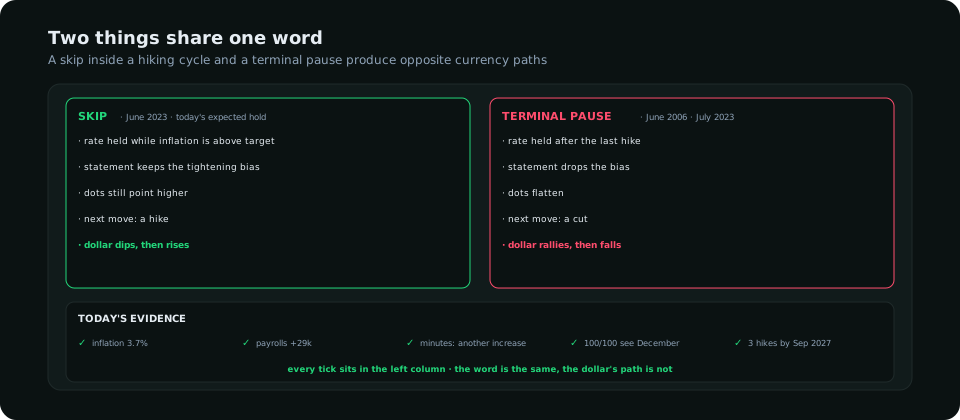
A pause is a meeting at which the committee does not change the rate. There are two kinds, and they produce opposite currency paths. A skip holds the rate while the tightening bias stays in the statement and the dot plot still points higher; the next move is a hike, and the committee is buying a meeting's worth of data. A terminal pause is the hold after the last hike; the bias comes out of the statement, the dots flatten, and the next move, eventually, is a cut. June 2023 was a skip (the Fed hiked again in July); July 2023 turned out to be terminal. Today's hold is a skip by every available measure: the inflation rate is nearly two points above target, the committee's own minutes anticipate another increase, the economists are unanimous on December, and the futures curve has a further 75 basis points in it. The FOMC guide explains the mechanics of the day; the point here is that a skip is a hawkish event dressed in a dovish word.
Why pause at all with inflation at 3.7%?
| Reason | What it means |
|---|---|
| The labour market cracked | Payrolls of 29,000 in September are close to zero; a hike into a stalling jobs market is a policy error the committee does not want to own in an election week |
| The oil shock is ambiguous | Oil near $100 raises headline inflation (hawkish) and taxes consumers (dovish); the committee wants a quarter of data to see which dominates |
| The September hike is still working | Policy acts with a lag; the first hike in three years was six weeks ago |
| December has the projections | The 8–9 December meeting publishes new dots, and a hike with a fresh path is easier to explain than a hike without one |
| The midterms are in six days | The Fed does not admit to this; it also does not usually move in the week before a national vote |
How markets behaved after past pauses
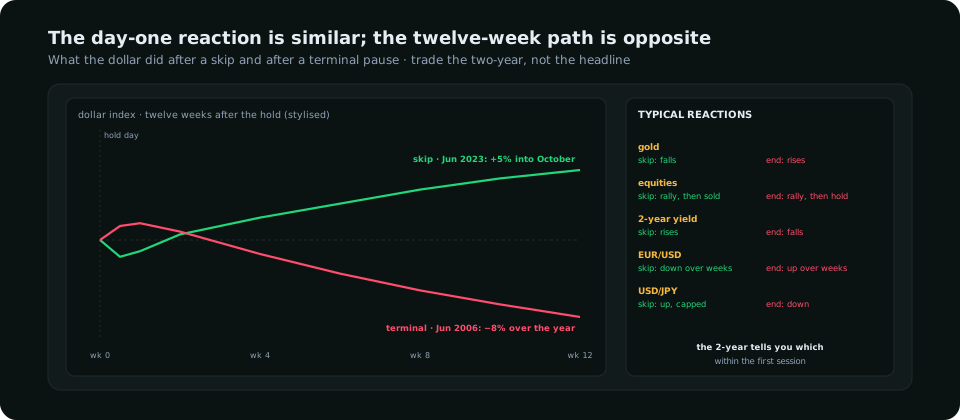
The dollar. After a skip, the dollar tends to dip on the day as the word "pause" is traded, then rise over the following weeks as the next hike is priced; after the June 2023 skip the dollar index gained about 5% into October. After a terminal pause the dollar rallies on relief and then declines as cuts are priced; after the June 2006 pause it fell roughly 8% over the following year. Gold. The mirror image: gold falls after a skip because real yields keep rising, and rallies after a terminal pause. Gold is already down a quarter from its January record on the skip story; the gold pullback guide covers the levels. Equities. Rally on the day in both cases, then diverge: a skip with a hawkish presser is sold within a week. The tell. The two-year Treasury yield rises after a skip and falls after a terminal pause, usually within the first session; the yields guide explains why it is the cleanest read of the rate path.
What to watch at 18:00 and 18:30 UTC
- The bias sentence. September's statement said the committee would assess "the extent of additional firming" or similar language; if that phrase survives, it is a skip. If it is replaced by language about "the extent to which policy is restrictive", the market will read a terminal pause and the dollar will fall hard.
- Dissents. A dissent in favour of a hike makes December near-certain and is dollar-positive on the day. A dissent in favour of a cut, on the jobs data, would be the surprise of the meeting.
- Warsh on December. The Chair has said he prefers not to signal decisions in advance, so the guidance may be less explicit than the market wants. A refusal to confirm December is not dovish; it is his style. Watch whether he describes the September hike as "the start" or as "an adjustment".
- The oil question. Someone will ask whether $100 oil is an inflation risk or a growth risk. His answer sets the tone for gold and the yen for a week.
The plan is the one in yesterday's preview: no new dollar positions before 18:00, watch both releases, trade the pullback after 19:15 in the direction that survived both, and size for a 100-pip move in EUR/USD with the position size guide's arithmetic. Tomorrow adds the third-quarter GDP and the September PCE at 12:30 UTC, covered in the GDP and PCE guide, which can confirm or reverse whatever the Fed does tonight.
What to read in the terminal
The macro regime read tracks the two-year yield against the dollar; if the two-year makes a new high on a "pause" headline, the skip reading is confirmed and the dollar dip is a buy. The Positioning dashboard shows the speculative dollar long, which decides how far the day-one dip runs before the rally; a crowded long dips further. The COT guide covers the read.
Frequently asked
What does a Fed pause mean?
A meeting at which the Fed leaves rates unchanged. It can be a skip, where the tightening bias remains and the next move is a hike, or a terminal pause, where the bias is dropped and the next move is a cut. Today's expected hold is a skip: inflation is 3.7%, the minutes anticipate another increase, and a December hike is almost unanimously expected.
Is a Fed pause good for the dollar?
A skip is, over weeks: the dollar usually dips on the day and then rises as the next hike is priced. A terminal pause is not: the dollar rallies briefly and then falls as cuts are priced. The two-year Treasury yield's reaction in the first session tells you which one you have.
What time is the Fed decision today?
14:00 Eastern, 18:00 UTC, 23:00 Pakistan time, with Chair Warsh's press conference at 18:30 UTC.
Everything on SMC Terminal is analysis and education, not a recommendation to buy or sell. Pricing and data are as of 27–28 October 2026 and change continuously. Trading carries a substantial risk of loss. Manage your risk.