EUR/USD: Retail Traders Were Heavily Long Into the ECB. Speculators Were Record Short. One of Them Got Paid
Into the 29 October 2026 ECB decision, broker sentiment feeds showed roughly 67–71% of retail EUR/USD positions long. The CFTC's large speculators were net short about 144,000 contracts, a position that had grown to 158,000 by 3 November with a three-year COT index of zero. Asset managers were long 204,000. Two weeks later EUR/USD is near 1.1030, the lowest since April 2025. This guide explains what each positioning measure actually counts, why retail sentiment is read as a contrarian signal and speculative positioning as a trend one, why a 'record short' did not squeeze, and how to use both reads together before the next central-bank event.
Written on 14 November 2026. Positioning figures are from published broker sentiment snapshots and the CFTC's reports through the week ending 3 November; the report for 10 November is delayed to 16 November by the US holiday.
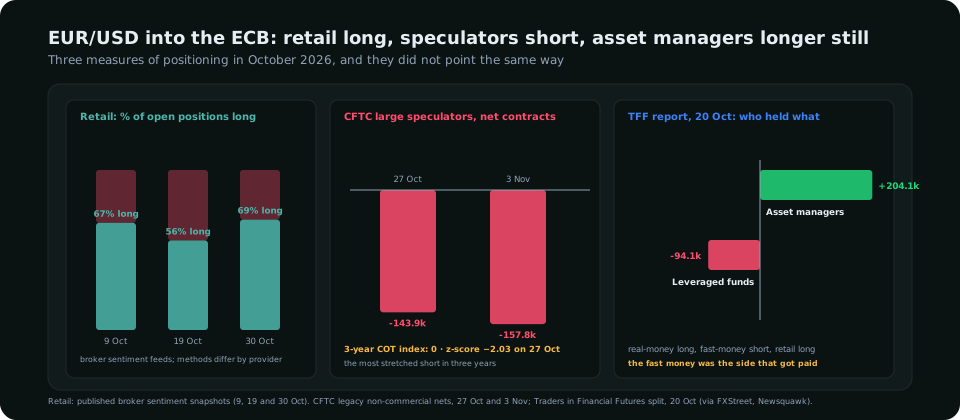
In the days before the European Central Bank's 29 October 2026 decision, a headline did the rounds that EUR/USD traders remained heavy buyers. It was true, for one definition of "traders". Broker sentiment feeds showed between 67% and 71% of open retail positions long the euro. At the same time the Commodity Futures Trading Commission's weekly report showed large speculators net short about 144,000 euro futures contracts, one of the most stretched readings in three years, and the Traders in Financial Futures breakdown showed asset managers long 204,000 contracts against leveraged funds short 94,000. Three groups, three different positions, one pair. The ECB held its deposit rate at 2.50%, President Lagarde announced she would leave in February, and EUR/USD bounced to 1.1167 the next day before falling to 1.1030 by 13 November, its lowest since April 2025. This guide explains what each positioning measure counts, why retail sentiment is read against the crowd and COT positioning with the trend, why a short described as "record" produced a one-day squeeze and nothing more, and how to use the two reads together before the next central-bank event. The COT report guide covers the mechanics of the CFTC data; this piece is about what happens when the measures disagree.
Three measures that did not agree
| Measure | Reading into the ECB | What it counts | How it is read |
|---|---|---|---|
| Retail sentiment | 67% long (9 Oct), 56% (19 Oct), 69% (30 Oct) | The share of open positions at one or several retail brokers that are long, by number of accounts or positions, not by size | Contrarian: the crowd is usually positioned against the trend and adds to losers |
| CFTC large speculators (legacy "non-commercial") | Net short 143,900 (27 Oct), 157,800 (3 Nov); long share 37%; COT index 0 of 100 | Hedge funds, CTAs and other reportable speculators in the CME euro futures, by contracts | Trend-following: they are usually right about direction and wrong only at extremes |
| Traders in Financial Futures | Asset managers long 204,100; leveraged funds short 94,100 (20 Oct) | The same market split by business type: real-money allocators against fast money | Asset managers hedge and allocate slowly; leveraged funds are the ones who move the price this week |
The groups are not measuring the same thing, which is why the headline was misleading rather than wrong. Retail accounts were long by count. Speculators were short by contracts. Asset managers were long by contracts but as part of portfolios that hold European assets and hedge or do not hedge the currency on a different clock. The sentiment guide covers the limits of each source; the managed-money guide explains the leveraged-fund category in detail.
Why retail was long
Retail sentiment leans long EUR/USD for the same reason it leans long most falling markets: the crowd buys dips. The pair had fallen from above 1.1200 to 1.1110 over October and held that level twice, on 14 October and again on 28 October, which looked like a double bottom to anyone drawing lines. The ECB had hiked twice this year and might signal a third. The dollar had slipped after the Fed's hold. Each of those is a reason, and together they are a story. But a 69% long reading in a downtrend is not information about the euro; it is information about the crowd. It says the stops under 1.1110 are retail stops, which makes 1.1110 a target rather than a floor.
Why speculators were short
Large speculators had been adding to euro shorts for weeks for reasons that were visible in the data: the Fed's policy rate 150 basis points above the ECB's with the gap not narrowing, French bond yields at their highest since 2002 on political and debt worries, euro-area inflation at 3.8% driven by energy that hurts European growth more than American, and a president about to leave. By 3 November the net short had reached 157,800 contracts, the three-year COT index read zero, and the z-score was past minus two. In the ordinary vocabulary that is "crowded" and "stretched", and a trader who reads the COT report only for extremes would have called it a contrarian buy. That is exactly the mistake the positioning extremes guide warns against: an extreme tells you the move is mature, not that it is over, and it reverses on a trigger, never on its own.
What the ECB did, and what the price did
| Date | EUR/USD | What happened |
|---|---|---|
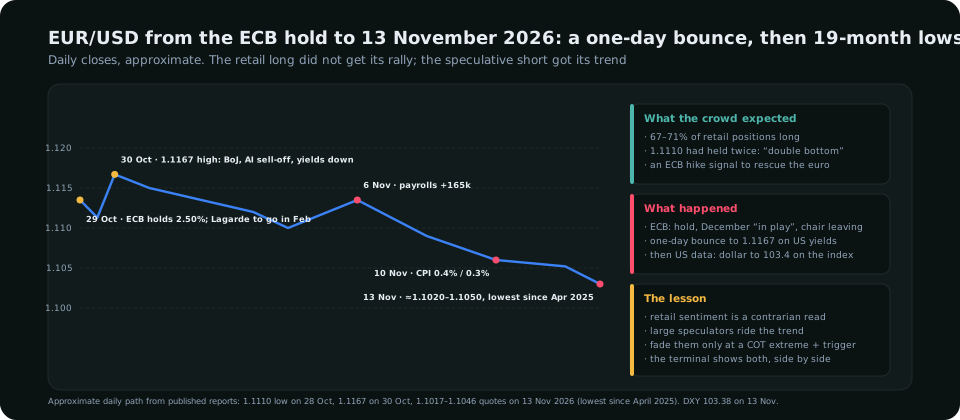
| 29 Oct, 13:15 UTC | 1.1135 before; 1.1113 low | ECB holds the deposit rate at 2.50% (refinancing 2.65%); December described as in play and priced near 82%; Lagarde to step down in February 2027; initial reaction minimal |
| 30 Oct | 1.1167 high | The squeeze: an AI-led equity sell-off rallied Treasuries, US yields and the dollar fell, the Bank of Japan held; the stretched short covered for one session |
| 3–6 Nov | Back under 1.1150 | The short grew to 157,800 contracts; October payrolls +165,000 restored December Fed hike odds |
| 10 Nov | Through 1.1100 | October CPI 0.4% m/m, core 0.3%; a December Fed hike fully priced |
| 13 Nov | ≈1.1020–1.1050 | Lowest since April 2025; the dollar index at 103.4, its highest since April 2025 |
The squeeze happened. It was worth about fifty pips and one day, because it was caused by US yields falling on a risk-off move rather than by anything that changed the euro's case. Once the US data resumed, the speculators who had covered re-sold at better levels and the retail longs who had been right for a day were under water again by the following week. The ECB preview had set out the three paths; the one that arrived was the middle one, where the US data decide, and they did.
The lesson, stated carefully
- Retail sentiment is a contrarian read, and it was. A 69% long crowd in a downtrend marked the stops to be run, and they were run on 10 November.
- Speculative positioning is a trend read, and it was. The large speculators were short, got shorter, and were paid. "Record short" was not a reason to buy; it was a reason to expect sharp, brief squeezes inside a continuing decline, which is what 30 October was.
- An extreme needs a trigger to reverse. The candidates were a firm ECB hike signal, a weak US payrolls number, or a soft CPI. None arrived. Without one, a COT index of zero is a description of the trend's maturity, and a mature trend can run for months.
- The real-money long is the slow money. Asset managers long 204,000 contracts is a structural position behind European assets; it does not defend 1.1110 on a Thursday afternoon. When the two institutional groups disagree, the leveraged funds set the week's price and the asset managers set the year's.
The COT strategy guide turns this into rules: trade with the large speculators while the price trend agrees, treat an extreme as a reason to tighten stops and take partial profit, and take the contrarian side only when the extreme coincides with a structural trigger on the chart, a change of character rather than a bounce. The EUR/USD range guide from the morning of the ECB shows what that looked like at the level: sell weakness through 1.1110 on a retest was the with-trend plan, and it was the one that paid.
What to watch next
The COT report for positions as of 10 November is released on Monday 16 November, delayed by the US holiday. The question it answers is whether the short grew again through the CPI week or whether some of it was taken off into the 1.1030 lows; a smaller short with a lower price would be the first sign that the fast money is finished selling, and that is a more reliable warning than any percentage from a sentiment feed. Beyond that, the December ECB meeting on 17 December is a week after the Fed's, and the two together decide whether the 150-basis-point gap widens to 175 or stays where it is.
What to read in the terminal
The Positioning module shows the large-speculator net position for the euro as a crowding percentile and a regime, with the three-year COT index beside it, and the Retail Sentiment read shows the broker crowd's long-short split with the contrarian scoring already applied; the two sit side by side in Symbol Analysis for EUR/USD, so the disagreement that made October's headline misleading is visible at a glance rather than reconstructed from three websites. Both reads are part of every plan on the pricing page, and the positioning data updates the evening each CFTC report is published. Creating an account opens the public shell of the dashboard before any payment.
Frequently asked
Were EUR/USD traders long or short before the October 2026 ECB meeting?
Both, depending on the group. Retail broker sentiment showed roughly 67–71% of open positions long. The CFTC's large speculators were net short about 143,900 euro futures contracts on 27 October and 157,800 on 3 November. Asset managers were long about 204,000 and leveraged funds short about 94,000 in the 20 October breakdown.
Why is retail sentiment used as a contrarian indicator?
Because retail positioning by count tends to lean against the prevailing trend, buying dips in a falling market and selling rallies in a rising one, and because the stops behind those positions sit at the obvious levels. A heavily long crowd in a downtrend marks where the stops are, which makes those levels targets rather than support.
Why did the record speculative short not squeeze EUR/USD higher?
It did, for one day: EUR/USD rose to 1.1167 on 30 October as US yields fell on an equity sell-off. The squeeze faded because nothing in the euro's case had changed, and the US data that followed, payrolls of +165,000 and CPI of 0.4%, restored the dollar's rate advantage. An extreme position needs a trigger to reverse; none arrived.
What is the COT index and what does zero mean?
The COT index places the current net position within its range over a lookback period, here three years, from 0 (the most short) to 100 (the most long). A reading of zero for the euro means large speculators are as short as at any point in three years. It signals a mature move, not an imminent reversal.
Everything on SMC Terminal is analysis and education, not a recommendation to buy or sell. Positioning figures are from published reports of broker sentiment and the CFTC's data through the week ending 3 November 2026; prices through 13 November. Trading carries a substantial risk of loss. Manage your risk.