How to Prepare for Nonfarm Payrolls: Volatility, Risk and Execution
An NFP trading strategy is mostly preparation: knowing what the market has priced, which component will move rates, how far the pairs typically travel, and what the spread and slippage do in the first minute. This guide works through the week before, the hour before, the release itself and the hour after, with the one trade that has a defined edge (the post-release pullback) and the two that do not (guessing the number, straddling the spike).
An NFP trading strategy is decided before Friday. The US employment report, released on the first Friday of the month at 12:30 UTC (13:30 in winter), is the most-watched scheduled event in forex, and it moves the dollar pairs and gold by 50 to 150 pips or 20 to 60 dollars inside a few minutes. The traders who make money from it are not the ones who predict the number; they are the ones who know what the market has priced, which of the three components will move rates this month, how far the move typically travels, and what the execution looks like in the first sixty seconds. This guide works through the preparation week by week and hour by hour, gives the one trade that has a repeatable edge, and names the two that do not.
What the report contains and which part matters
| Component | What it measures | Typical market weight | When it dominates |
|---|---|---|---|
| Headline payrolls | Net jobs added, thousands, with revisions to the prior two months | High; the revision can outweigh the headline | When the labour market's direction is the question |
| Unemployment rate | Share of the labour force without work | Medium; a rise of 0.2 points or more is a shock | When the Fed has tied policy to the rate (a threshold or rule) |
| Average hourly earnings | Wage growth, month on month and year on year | High in an inflation-focused cycle | When inflation is the Fed's concern; wages feed services inflation |
The market does not react to the headline alone; it reacts to the component the Federal Reserve is watching this cycle, and that changes. In a cycle where inflation is the worry, a soft headline with hot wages is a hawkish report and the dollar rises. In a cycle where the labour market is the worry, a strong headline with a rising unemployment rate is a confused report and the first move reverses. The week's preparation includes deciding which component is the hinge, from the Fed's recent statements and the rate-path logic.
The timeline
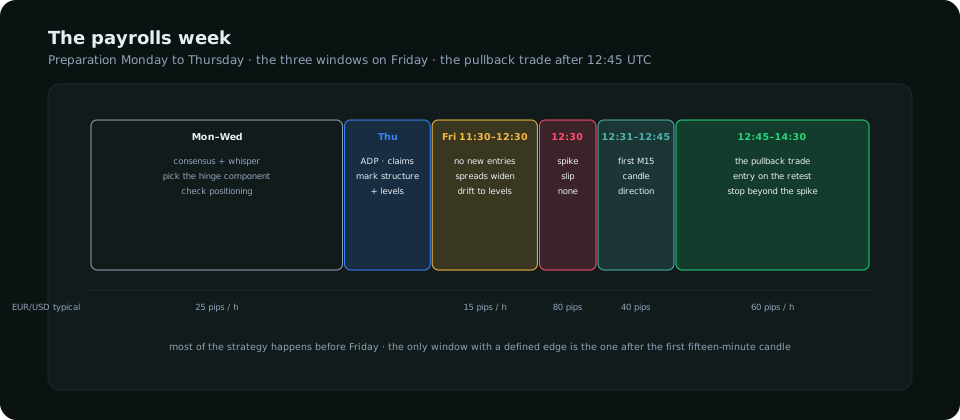
Monday to Wednesday
Record the consensus for all three components and, where available, the whisper number the market has actually positioned for. Decide the hinge component. Check the COT positioning in the dollar pairs and gold: a market crowded long the dollar reacts asymmetrically, falling more on a soft print than it rises on a strong one, because the crowd has more to unwind than to add. Note the current rate-path pricing: if three cuts are priced and the report is strong, the removal of one cut is a larger move than the same report would produce with no cuts priced.
Thursday
The ADP private payrolls estimate and weekly jobless claims print, and the whisper moves. Mark the structure on the daily and four-hour charts for the pairs you will trade: the last swing high and low, the nearest supply and demand zones, the previous week's extremes. Those are the levels the spike will test and the pullback will return to. Decide the maximum position, if any, you will hold through the release, and set its stop beyond the typical reaction plus a margin.
Friday, the hour before
Spreads widen from about 11:30 UTC; by 12:25 a 0.8-pip EUR/USD spread can be 3 pips and gold's 30 cents can be 1.50 dollars. Price tends to drift toward the nearest liquidity pool as participants square up. No new entries. The calendar guide sets out the same three-window structure for any red release; payrolls is the largest instance of it.
The release minute
At 12:30:00 the number prints; within two seconds algorithms have read the headline, the rate and the wages, and price has moved 30 to 80 pips. Within the first minute the move frequently reverses in part as the detail (revisions, the hinge component) is read against the headline. Slippage on a market order in that minute is 5 to 20 pips on a major and several dollars on gold; stop orders fill at the next available price, which can be well beyond the stop. A pending-order straddle (a buy stop above and a sell stop below) is the classic retail NFP trade and it loses on average: both orders can fill in the whipsaw, the fills are poor, and the first direction is reversed too often for the one that fills to be reliable. Nothing in this minute is a trade a retail account executes at the price it sees.
The trade: the post-release pullback
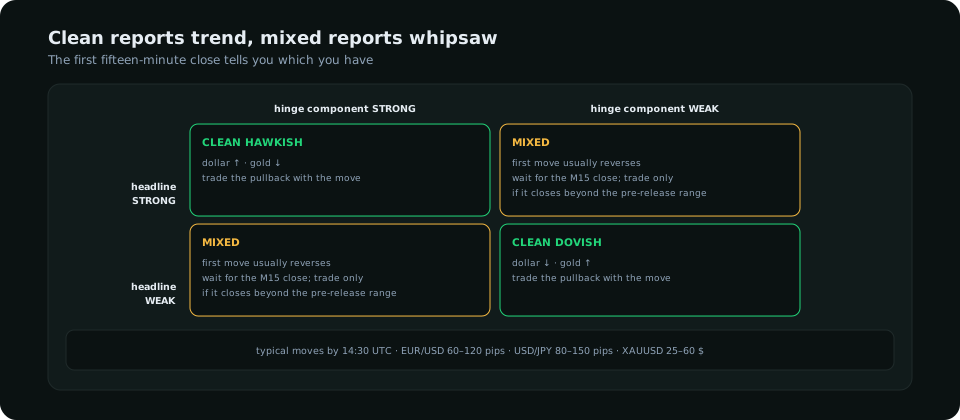
Once the 12:30–12:45 candle has closed, the direction that held is the information. The trade: price retraces toward the pre-release level, or toward the midpoint of the spike candle, rejects on the five- or fifteen-minute chart, and resumes. Entry on the rejection, stop beyond the spike's extreme (a defined, known distance), first target the next structural level marked on Thursday, usually the previous day's or week's extreme. The reward-to-risk is typically 1.5 to 3 because the stop is at a level the market has just proved it will not revisit quickly. On a mixed report, the first fifteen-minute candle often closes back inside the pre-release range; there is then no trade, and the correct action is to leave the day alone. The New York session guide places this trade inside the session; the stop placement article covers sizing the stop beyond the spike.
Sizing and the limits
Risk per trade on the pullback is the normal rule, 0.5–1% of equity, not more because the setup is "high conviction". The spread is still wide at 12:45; add it to the stop distance when sizing. One attempt. If the pullback entry is stopped, the report was not as clean as the first candle suggested, and the second attempt is the one that compounds the loss. Positions held through the release, if any, are sized so that the stop beyond the typical reaction is still within the per-trade limit; most traders are better served by being flat.
Gold on payrolls
Gold reacts to payrolls through real yields and the dollar, and its reaction is often cleaner than the currencies' because there is no second central bank in the pair. A strong report lifts yields and the dollar and gold falls; a weak one does the reverse. The magnitude is 20 to 60 dollars within the hour, and the pullback trade works the same way with the stop beyond the spike extreme in dollars. The gold sessions guide places the 12:30 candle as the hinge of the overlap; payrolls Friday is the largest version of that hinge each month.
Frequently asked
Should I trade during NFP?
Not during the release minute; execution is too poor and the first move reverses too often. Trade the pullback after the first fifteen-minute candle has established the direction that held, with a stop beyond the spike.
How much does EUR/USD move on NFP?
Typically 50 to 100 pips in the first minutes and 60 to 120 pips by two hours after, in either direction. Gold typically moves 25 to 60 dollars in the same window.
Which part of the NFP report matters most?
The component the Federal Reserve is watching that cycle: average hourly earnings when inflation is the concern, the unemployment rate and payroll revisions when the labour market is. Decide which it is before Friday.
Everything on SMC Terminal is analysis and education, not a recommendation to buy or sell. Figures in the example are illustrative. Trading carries a substantial risk of loss. Manage your risk.