Four Tankers, Then a Gas Carrier: What Iran's Mine Claims in the Strait of Hormuz Mean for Oil Supply, Brent and the Petro-Currencies
Iran's armed forces said on 12 November 2026 that four tankers had struck naval mines in the Strait of Hormuz after ignoring warnings, and the Revolutionary Guard added a liquefied-gas carrier the next day. Brent jumped 3.3% to $95.82 and then went nowhere, settling at $95.84 on 13 November with WTI at $88.56, both down about 2.5% on the week. Traffic through the strait is 65% below pre-war levels, yet US crude inventories just rose 4.7 million barrels, OPEC+ output is climbing and the IEA sees a fourth-quarter surplus. This guide explains how a mined strait and a falling oil price coexist, what the claims change for supply, and what it means for the Canadian dollar, the yen, the euro and the oil trade.
Written on 14 November 2026, with prices as of the 13 November settlements. Iran's claims described below have not been independently verified.
On Thursday 12 November 2026 Iran's armed forces said that four oil tankers had struck naval mines in the Strait of Hormuz, two in the morning and two in the afternoon in the eastern part of the strait, after ignoring warnings and switching off their radar. On Friday the Revolutionary Guard's navy said a liquefied-gas carrier had hit a mine and exploded on what it called an unauthorised route. None of the claims has been independently confirmed, and the UK Maritime Trade Operations centre, which logs incidents for shipping, recorded eight in the latest seven-day period alongside 139 outbound and 169 inbound transits, about 65% below the traffic the strait carried before the war. The oil price did what it has done after every such headline this autumn: Brent rose 3.3% to settle at $95.82 on Thursday, then settled at $95.84 on Friday, and finished the week down about 2.5%. WTI settled at $88.56. A strait that carries a fifth of the world's seaborne crude is being mined, and the benchmark is a third below where it stood in mid-October. This guide explains how those two facts coexist, what the mine claims change for global oil supply if they are true, where the risk premium now sits, and what all of it means for the currencies that trade oil. The October Hormuz guide covered the drone and tanker attacks that took Brent above $110; this is the next phase.
What was claimed, and what is known
| Date | Claim | Source | Verification |
|---|---|---|---|
| 12 Nov, morning | Two tankers exploded after hitting mines | Iranian state media, citing the army | Unverified; no shipping company has confirmed |
| 12 Nov, afternoon | Two more tankers hit mines in the eastern strait after ignoring warnings and disabling radar | Iran's army | Unverified |
| 13 Nov | A liquefied-gas carrier hit a mine and exploded on an "unauthorised and dangerous route"; an earlier statement described a gas carrier on fire east of the strait | IRGC navy | Unverified |
| Week to 13 Nov | Eight maritime incidents; 139 outbound and 169 inbound transits; traffic ≈65% below pre-war | UKMTO | The independent record |
Two features of the claims matter for the market regardless of their accuracy. The first is the word "mines". The October attacks were drones and boats, which hit a ship someone chose to hit; a minefield hits whoever sails through it, and it changes how insurers and charterers price every transit, not only the ones Iran objects to. The second is the phrase "ignored warnings", which casts the strikes as enforcement of a route Iran controls rather than as attacks. Both point the same way: the strait is not closing further, but it is not reopening either, and the US blockade on the other side of it stays in place.
How a mined strait and a $95 Brent coexist
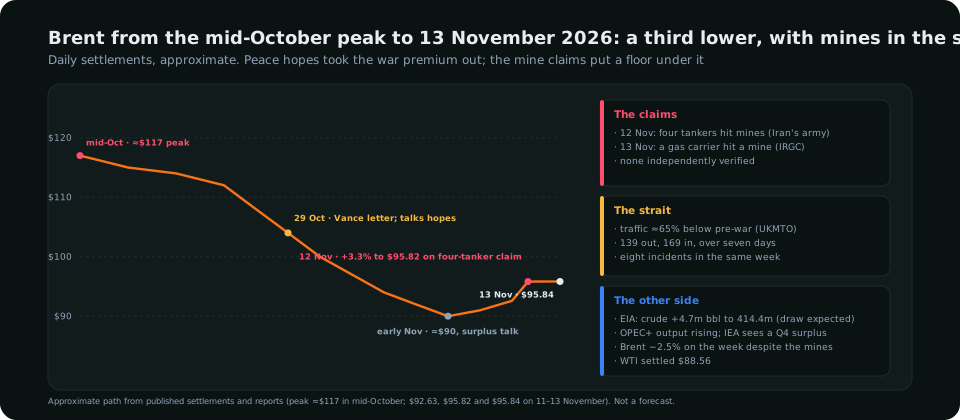
Brent peaked near $117 in mid-October and has fallen about a third since. The decline had three legs: the Vance letter to Mohsen Rezaei and the talks channel that followed, which took the premium for a wider war out of the price; a run of supply data that showed the world outside the Gulf producing more; and demand that has been dented by months above $100 and, this month, by an equity sell-off. The mine claims added $3 on Thursday and held it on Friday, which is a floor, not a trend. Set against them in the same week:
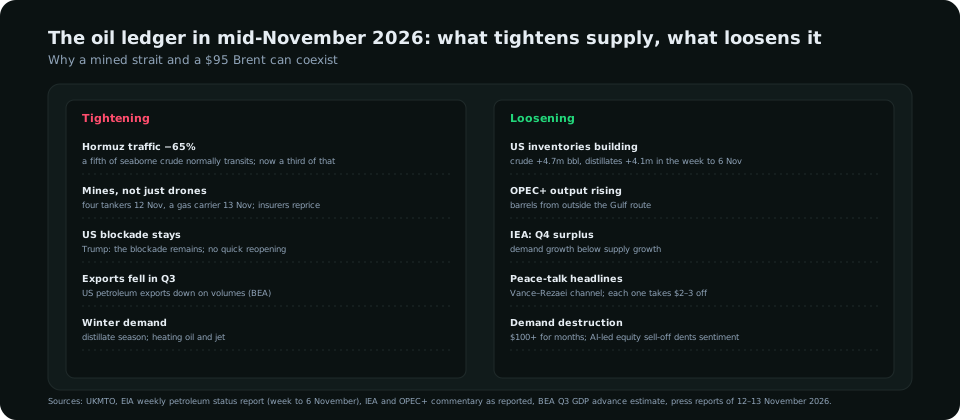
- US inventories built. The EIA reported commercial crude stocks up 4.7 million barrels to 414.4 million in the week to 6 November, against a Reuters poll expecting a 1.1 million draw; distillates rose 4.1 million to 103.3 million. A market that is short of oil does not build inventory at this pace.
- OPEC+ output is rising. Barrels from producers whose exports do not pass through Hormuz have been filling part of the gap all autumn, which is why the physical shortage the October headlines implied has been smaller than the price suggested.
- The IEA sees a fourth-quarter surplus. Demand growth below supply growth into year-end, which is the agency's way of saying that the price has done its work on consumption.
- The talks are still a channel. Vance is reported to be considering face-to-face talks with Rezaei; the US blockade stays. Each headline in either direction is worth two to three dollars, and this week produced both kinds.
The result is a market with a geopolitical floor and a fundamental ceiling. The floor is wherever the next mine or drone puts it; the ceiling is the inventory data. Between $88 and $100 on Brent is where those two forces have balanced for a fortnight, and the mine claims did not move the market out of that range.
What the mines change for supply, if they are real
Traffic at 35% of pre-war levels is already the supply shock; mines do not cut it further so much as make the remaining third more expensive and less certain. Three channels:
- Insurance and freight. War-risk premiums are set per transit and reprice on exactly this kind of claim. A higher cost per barrel delivered from the Gulf raises the price at which non-Gulf barrels become competitive, which supports the Brent–WTI spread (Brent $95.84 against WTI $88.56, about $7) rather than the outright level.
- Gas, not only oil. The 13 November claim was a liquefied-gas carrier. Qatar's LNG passes through the same water, and a mined strait is a European and Asian gas story as much as a crude one, with the euro and yen on the paying side.
- The reopening timeline. Mines take weeks to clear once a ceasefire is agreed, which lengthens the lag between any political settlement and a normal flow of tankers. The market's peace-talk discount assumes a quick reopening; the mine claims argue it will be slower.
What it means for the currencies
| Pair | Link to oil | Read now |
|---|---|---|
| USD/CAD | Canada exports crude; a higher oil price supports the loonie | Oil's slide from $117 to $90 removed a support for the Canadian dollar that the Bank of Canada's October hike had reinforced; the mine floor helps at the margin. The Bank of Canada guide covers the rate side |
| EUR/CAD | Importer against exporter; the cleanest oil cross without the Fed in it | The EUR/CAD guide from late October described a falling cross on $114 oil; the oil leg has since reversed, and the cross's next move depends on whether the mine floor holds |
| USD/JPY | Japan imports almost all its energy; a mined strait is yen-negative through the trade balance | Near 160 with intervention risk; oil is one of three forces holding it up, with the rate gap and risk the others |
| EUR/USD | Europe imports energy and the ECB hiked into the inflation it caused | At nineteen-month lows for rate reasons; a gas-carrier strike is a reminder that the energy shock has a European second act |
| NOK and the oil currencies | Direct | Follow Brent's floor, not its headlines |
The October oil-shock guide set out the transmission from a crude price to each pair; the direction of that transmission has reversed since, because the oil price has, and traders who were long the petro-currencies on $117 oil have been unwound. The mines are the first thing in a month to argue that the unwind has gone far enough.
How to trade it
- Oil: the range is the trade until it is not. Buy headline dips toward $90 Brent with a stop under $88 and sell headline spikes toward $100 with a stop above $102, as long as the inventory data keep building and the talks channel stays open. A verified sinking, as opposed to a claim, breaks the upper side; a signed ceasefire breaks the lower.
- Forex: fade the first move, not the second. A mine headline moves USD/CAD and USD/JPY within minutes and the first move has reversed every time this autumn when the claim stayed unverified. The second move, if confirmation arrives, is the one to be positioned for.
- Size for the gap risk. Oil-linked pairs gap on weekend headlines, and the strait produces headlines on weekends. The risk management rules cover holding size through a weekend, and the stop placement guide the distance.
What to read in the terminal
The Volume and Open Interest module reads the CME crude futures report session by session, and the pattern through the slide from $117 has been long liquidation rather than new selling: falling price with falling open interest, which is a position being closed, not a view being opened, and which usually ends when the holders who bought the October highs are out. The intermarket read in Symbol Analysis scores USD/CAD and USD/JPY against Brent and flags when the correlation is doing the work; both are part of every plan on the pricing page, and the live sessions cover the oil pairs when the strait is in the headlines.
Frequently asked
What did Iran say happened in the Strait of Hormuz?
On 12 November 2026 Iran's armed forces said four oil tankers struck naval mines in the eastern strait, two in the morning and two in the afternoon, after ignoring warnings and switching off their radar. On 13 November the Revolutionary Guard navy said a liquefied-gas carrier hit a mine and exploded. None of the claims has been independently verified; the UK Maritime Trade Operations centre recorded eight incidents in the latest week.
Why is the oil price falling if the strait is mined?
Because supply outside the Gulf is rising and demand has weakened: US crude inventories rose 4.7 million barrels in the week to 6 November against an expected draw, OPEC+ output is climbing, the IEA sees a fourth-quarter surplus, and peace-talk headlines removed the premium for a wider war. Brent has fallen about a third from its mid-October peak near $117 to $95.84; the mine claims added about $3 and put a floor under the price rather than reversing the trend.
How much shipping passes through the Strait of Hormuz now?
About 65% less than before the war, according to UKMTO: 139 outbound and 169 inbound transits in the latest seven-day period. Mines raise insurance and freight costs for the ships that still pass and lengthen the time a reopening would take once a ceasefire is agreed.
Which currencies are most affected?
The Canadian dollar and Norwegian krone as oil exporters, which lost support as crude fell from $117; the yen and the euro as energy importers, for which a mined strait and a gas-carrier strike are negatives through the trade balance; and EUR/CAD as the cleanest expression of the importer-against-exporter trade.
Everything on SMC Terminal is analysis and education, not a recommendation to buy or sell. Prices and data are from published reports through 13 November 2026; Iran's claims are reported as claims. Trading carries a substantial risk of loss. Manage your risk.