'Strong', Not 'Solid': The One Word the Fed Changed in October, and Why It Matters More Than the Hold
On 28 October 2026 the FOMC held the federal funds rate at 3.75–4.00% and changed one adjective: economic activity is now 'expanding at a strong pace', not the 'solid' pace of September. Inflation 'remains elevated', the vote was 10–2 with Lisa Cook and Beth Hammack preferring a quarter-point increase, and the chair offered no guidance. This guide explains what the Fed's growth adjectives mean, why an upgrade without a hike is a signal in itself, how the data since (GDP 3.4%, payrolls +165,000, CPI 0.4%) have confirmed it, and what 'strong growth, elevated inflation' implies for December and for the dollar.
Written on 14 November 2026. The statement discussed is the FOMC's of 28 October; the data that followed run to the 13 November producer-price report.
Central-bank statements are edited, not written, and the edits are the message. On 28 October 2026 the Federal Open Market Committee held the target range at 3.75% to 4.00%, repeated that inflation "remains elevated", and changed one word in its description of the economy: activity is "expanding at a strong pace", where September's statement had said "solid". The vote was 10–2. Governor Lisa Cook and Cleveland Fed President Beth Hammack both preferred to raise the rate by a quarter point immediately; it was Cook's first dissent since joining the Board in 2022 and Hammack's second of the year. The combination is unusual. A committee that upgrades its view of growth, keeps its warning on inflation and still does not move is telling you that the next move is up and that it has chosen the timing, not the direction. This guide explains what the adjective ladder means, why the upgrade matters more than the hold, how two weeks of data have confirmed it, and what "strong growth with elevated inflation" has historically meant for policy and for the dollar. The FOMC guide covers how a meeting works; this piece is about reading one.
The edit, line by line
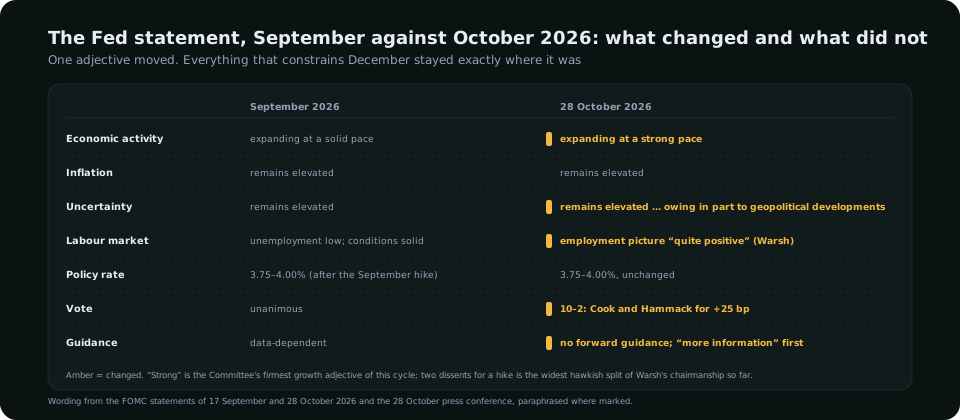
| Element | September | 28 October | Read |
|---|---|---|---|
| Economic activity | "expanding at a solid pace" | "expanding at a strong pace" | Upgrade; the firmest growth adjective of this cycle |
| Inflation | "remains elevated" | "remains elevated" | Unchanged; no "progress" language reintroduced |
| Uncertainty | elevated | elevated, "owing in part to geopolitical developments" | The energy shock named as a reason to wait, not a reason to ease |
| Policy rate | 3.75–4.00% after a hike | 3.75–4.00%, unchanged | A pause inside a hiking cycle |
| Vote | Unanimous | 10–2 for the hold; two for +25 bp | The hawkish wing is now two voters, one of them a governor |
| Guidance | Data-dependent | "Accumulation of more information" before the next step | No pre-commitment; December left open on purpose |
What the Fed's growth adjectives mean
The Committee uses a small, stable vocabulary for activity, and it moves one rung at a time. "Moderate" is the neutral word for an economy growing near trend. "Solid" is a step above it, used when growth is clearly above trend but not accelerating. "Strong" is the top of the ladder in ordinary use and is reserved for periods when output, spending and hiring are all running hot at once. The Committee does not reach for it lightly, because the word has policy consequences: an economy described as strong with inflation described as elevated is, in the Fed's own framework, an economy that needs tighter policy. The statement said so without saying so. Three things are worth noticing about the choice:
- It was made before the GDP number. The advance estimate of third-quarter GDP, 3.4% annualised against 2.2% in the second quarter, was published the following morning. The Committee had the components in hand and chose its adjective knowing what was coming.
- It was made with inflation rising, not falling. Core PCE for September, also published the next day, was 3.1% year on year after 3.0% in August. The September statement had been issued when the trend was ambiguous; the October one was issued when it was not.
- It was made alongside a hold. That is the signal. A committee that believed the upgrade required an immediate response would have hiked; two members thought so and said so. The majority upgraded the diagnosis and deferred the treatment, which is how a central bank tells the market that December is live without using the word.
Why upgrade and not hike?
The press conference gave the reasons, and they are about information rather than conviction. Chair Warsh said the Committee wanted the "accumulation of more information" before deciding the appropriate stance for returning inflation to 2%, described the employment picture as "quite positive", and said price stability remained the priority. He also announced that the Committee would meet seven times in 2027 and six in 2028 instead of eight, which is a structural statement about cadence rather than about this cycle, but which the front end of the bond market read as a slower path all the same. Three practical reasons stand behind the hold:
- December is a projection meeting. The Committee publishes its Summary of Economic Projections in December, and both of this year's moves have come with projections. A hike in October would have been a hike without a forecast to justify it.
- The October data were not yet in. The government shutdown of 2025 left gaps in the statistical record that still complicate year-on-year comparisons, and the Committee had a September CPI, a September PCE and no October payrolls when it met. It has all three now.
- The energy shock is a supply shock. Oil above $100 since the Strait of Hormuz attacks raises headline inflation and lowers real income at the same time. A central bank hikes into the second-round effects of such a shock, not into the first; "uncertainty … owing in part to geopolitical developments" is the Committee saying it wants to see which it is dealing with.
The data since have confirmed the adjective
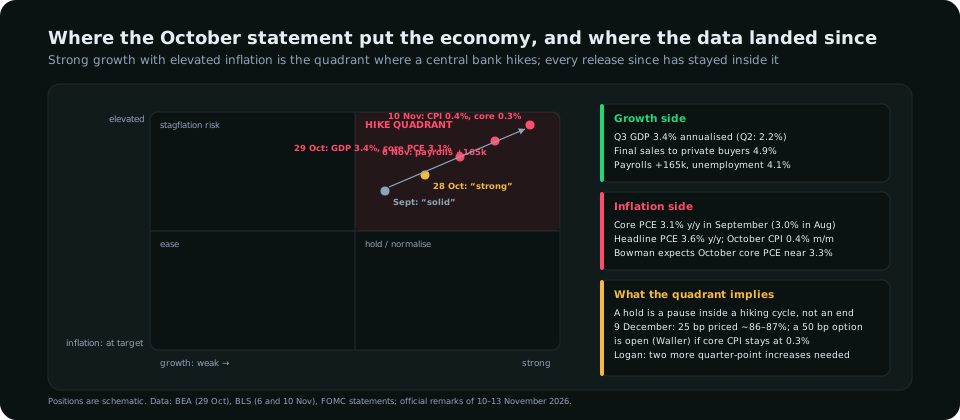
| Date | Release | Result | Side |
|---|---|---|---|
| 29 Oct | Q3 GDP, advance | +3.4% annualised; real final sales to private domestic purchasers +4.9% | Growth: strong |
| 29 Oct | September PCE | Core 3.1% y/y, headline 3.6% y/y; core +0.3% m/m | Inflation: elevated and rising |
| 6 Nov | October payrolls | +165,000 against roughly 60,000 expected; unemployment 4.1%; average hourly earnings +3.1% y/y | Growth: strong |
| 10 Nov | October CPI | +0.4% m/m; core +0.3% for a third straight month | Inflation: elevated |
| 10–13 Nov | Fed speakers | Logan: two more quarter-point increases; Waller: a half-point is open if core CPI stays at 0.3%; Bowman: October core PCE likely near 3.3% | Policy: tighter |
Every release since the statement has landed in the same corner of the quadrant: growth above trend, inflation above target and not falling. The GDP guide works through where the 3.4% came from, and the fundamentals guide explains why this combination, and not either half alone, is what moves a policy rate.
What "strong and elevated" means for December
The market has drawn the conclusion the statement invited. A quarter-point increase on 9 December, to 4.00–4.25%, is priced as close to certain as futures allow, and the live debate among Fed officials and in the futures curve has moved to whether it should be half a point. Three things follow for traders:
- The surprise is no longer the hike; it is the path. December brings new projections. A median that shows two more increases in 2027 against the market's one is a hawkish surprise even with the hike itself fully priced; a median that shows December as the last move is a dovish one.
- "Strong" raises the bar for stopping. A committee that has upgraded growth needs to see it downgraded before it pauses for good. The November and December payroll reports (4 December for November's) carry more weight than usual.
- The dollar's support is the combination, not the hike. Strong growth alone would lift equities and could weaken the dollar; elevated inflation alone could do the same if the Fed were seen as behind. Together they produce higher front-end yields with a Fed seen to be acting, which is the configuration the dollar index has risen on for three weeks to 103.4. The interest-rates guide covers the transmission pair by pair.
What to read in the terminal
The Macro Economics module classifies the US regime from the same four inputs the statement weighs, growth, inflation, labour and policy, and has shown "expansion with inflation" since the September PCE print; its red-events panel counts down to the 25 November GDP revision, the 4 December payrolls and the 9 December decision. Every Symbol Analysis verdict carries that regime as one of its reads, so a dollar pair's bias reflects the Fed's own adjective without a trader having to parse the statement. The module is included in every plan on the pricing page; creating an account opens the public shell before any payment.
Frequently asked
What did the Fed change in its October 2026 statement?
One substantive word: economic activity is "expanding at a strong pace" rather than the "solid pace" described in September. Inflation still "remains elevated", uncertainty is still elevated "owing in part to geopolitical developments", and the target range stayed at 3.75–4.00%.
Who dissented and why does it matter?
Governor Lisa Cook and Cleveland Fed President Beth Hammack voted against the hold, each preferring a quarter-point increase. It was Cook's first dissent since 2022 and Hammack's second this year. Two dissents for a hike, one from a governor, is the clearest sign yet that the Committee's centre of gravity has moved toward tightening.
Why did the Fed upgrade growth but not raise rates?
The chair said the Committee wanted more information before its next step. December is a projection meeting, the October data were not yet published, and the energy shock from the Middle East complicates the inflation read. The upgrade signalled direction; the hold reserved timing.
What does strong growth with elevated inflation mean for the dollar?
Higher front-end yields with a central bank seen to be acting, which is dollar-positive. The dollar index rose for three straight weeks to about 103.4 by 13 November, its highest since April 2025, as a December hike moved from likely to fully priced.
Everything on SMC Terminal is analysis and education, not a recommendation to buy or sell. Statement wording is quoted from the FOMC's releases; data are from the BEA, BLS and published market reports through 13 November 2026. Trading carries a substantial risk of loss. Manage your risk.