Managed Money Positioning: How to Read the COT Data
Managed money is the COT report's cleanest view of what hedge funds and CTAs are doing, because the disaggregated report separates them from the swap dealers and producers the legacy report lumps together. This guide explains who sits in the category, how its net differs from the legacy non-commercial line, how to read it against its own range and its weekly change, and the two markets where it changes the read entirely.
Managed money is the category in the CFTC's disaggregated Commitments of Traders report that holds the participants most traders actually mean when they say "the funds": hedge funds, commodity trading advisors and commodity pools, trading client money for return. The legacy report folds them into a broader non-commercial line together with other speculators; the disaggregated report pulls them out, and for the commodity markets that matter to forex and metals traders, gold and crude above all, the difference is not cosmetic. This guide explains who is in the category, how to read its net position and weekly change, the columns the report gives, and the markets where managed money is the line to watch.
The four groups of the disaggregated report
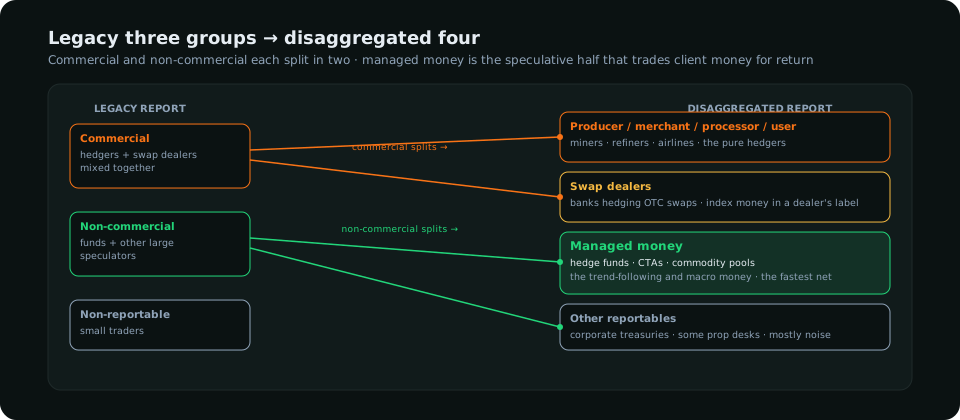
| Group | Who | Why they hold futures | Read as |
|---|---|---|---|
| Producer / merchant / processor / user | Miners, refiners, drillers, airlines, grain merchants | Hedging physical business | The pure hedgers; structurally one-sided |
| Swap dealers | Banks hedging over-the-counter swaps sold to clients | Offsetting index-fund and institutional swap exposure | Index money wearing a dealer's label; usually long commodities |
| Managed money | Hedge funds, CTAs, commodity pools | Profit; trend-following and discretionary macro | The speculative crowd; the fastest-moving net |
| Other reportables | Large traders not fitting the above: corporate treasuries, some proprietary desks | Mixed | Noise, mostly |
In the legacy report, "non-commercial" is managed money plus other reportables, and "commercial" is producers plus swap dealers. For currency futures the two reports read nearly the same, because swap dealers and other reportables are small; for gold and crude they diverge, because swap dealers carry large index-linked longs that inflate the legacy commercial line and other reportables can be a fifth of the open interest. The COT report guide covers the report formats; the commercial traders article covers the hedging side of this split.
The columns
For managed money the report gives long, short and spreading positions, plus the weekly change in each and the share of open interest. Net = long − short; spreading (holding both sides in different contract months) is excluded from the net and is mostly calendar-spread activity that says nothing about direction. Two things the gross columns tell you that the net hides: a net that fell because longs were cut is liquidation, which in a trend tends to continue; a net that fell because shorts were added is new positioning against the trend, which tends to be squeezed. The net positions article works through the mirror between this net and the hedgers'.
Reading the net against its range
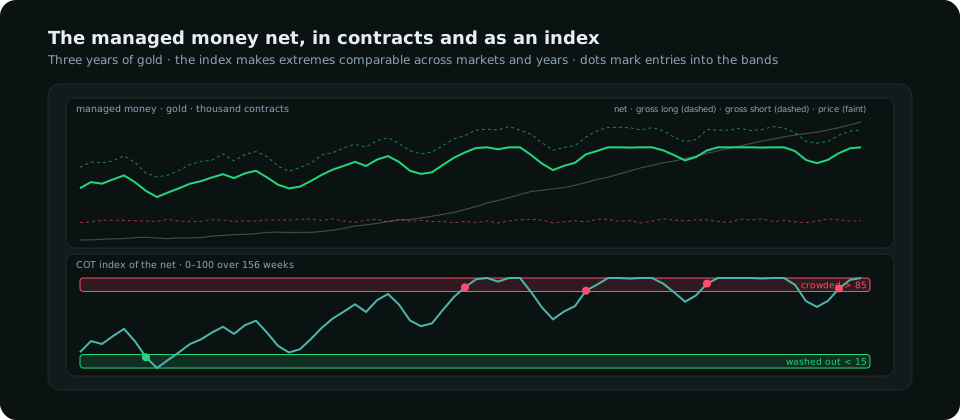
The absolute net means little on its own: 150,000 net long in gold is heavy in one year and ordinary in another as open interest grows. The COT index rescales the net over 156 weeks to 0–100. Above 85 is crowded: the trend-following money is mostly in, and good news stops moving price. Below 15 is washed out: little selling is left. Between, the level is unremarkable and the weekly change is the read. Managed money moves faster than any other group, so its index reaches extremes more often than the commercial index does and holds them for less time; a managed money index that has been above 85 for six weeks in a rising market is a market where the next sharp reduction is the event to prepare for.
The weekly change
- Net rising with price rising, longs added: trend-following money joining; healthy while the index is below 80.
- Net rising with price falling, shorts covered: a squeeze, not buying; usually short-lived.
- Net falling with price falling, longs cut: liquidation; the first two weeks of this tend to extend, not reverse.
- Net falling with price rising, shorts added: funds fading the move; if price keeps rising, the squeeze that follows is the strongest leg of the trend.
Judge a change against the market's own history: a 20,000-contract move in gold is a normal week; the same in silver or platinum is an event.
Gold and crude: where it changes the read
In gold, the legacy non-commercial net overstates speculative crowding because other reportables carry sizeable longs that are not trend money; the managed money net is the cleaner crowd gauge, and its extremes line up with gold's intermediate turns more tightly than the legacy line's do. In crude, swap dealers hold large index-linked longs that make the legacy commercial net look structurally long, which is backwards for a producer-hedged market; splitting them out restores the producer net as the hedging read and the managed money net as the speculative one. In the currencies the difference is small and the legacy non-commercial line is adequate. The gold COT article builds a full read on this basis.
A worked gold read
Friday's disaggregated report: managed money long 198,000, short 41,000, net 157,000, up 14,000 on the week with longs up 11,000 and shorts down 3,000. The three-year range of the net is 38,000 to 226,000, so the index is about 63. Open interest rose. Price was up 2.1% on the week. Read: trend-following money adding on strength with new longs, index mid-to-upper range with room. Not crowded; a long bias remains supported, and the level at which to start worrying is an index above 85, which at current open interest is a net near 200,000. The number to watch next Friday is the longs column: a week of longs cut while price rises would be the first sign of distribution. The extremes article has the history of what followed readings above 90.
Frequently asked
Is managed money the same as non-commercial?
Managed money is the larger part of non-commercial. The legacy non-commercial line adds other reportables, which in gold and crude can be a fifth of the open interest and are not trend money. Use managed money for commodities, non-commercial for currencies.
Where do I find managed money positions?
In the CFTC's disaggregated report, published every Friday at 15:30 Eastern for the previous Tuesday, for physical commodity futures. Currency futures are only in the legacy and Traders in Financial Futures reports, where the equivalent category is leveraged funds.
Should I follow managed money?
While the index is mid-range and the net is rising with price, yes: they are the trend. At an extreme, no: they are the crowd that the next move will be against. The index tells you which situation you are in.
Everything on SMC Terminal is analysis and education, not a recommendation to buy or sell. Figures in the example are illustrative. Trading carries a substantial risk of loss. Manage your risk.