ECB Meeting Preview: Why Lagarde Will Hold at 2.50% Today, and How She Can Point to a December Hike Without Promising One
The ECB announces its decision at 13:15 UTC on 29 October 2026 and is expected to leave the deposit rate at 2.50% after hikes in June and September. The market has about 21 basis points priced for 17 December and 64 of 73 economists expect a move then. This guide explains why the Council will wait, the three ways the statement and the 13:45 press conference can handle December, what France, energy and Friday's data do to the choice, and what each version means for EUR/USD, EUR/GBP and the euro crosses.
Written on the morning of 29 October 2026, before the 13:15 UTC decision and the 13:45 UTC press conference.
This ECB meeting preview can be summarised in one sentence: the Governing Council will leave the deposit rate at 2.50% today and spend the press conference deciding how loudly to say "December". The European Central Bank raised rates in June, from 2.00% to 2.25%, and again on 10 September, to 2.50%, in a unanimous vote President Lagarde tied to energy-driven inflation from the Middle East conflict. Since then she has described the appropriate path as a "measured response", which the market has taken to mean one move a quarter at most. Seventy of 73 economists expect no change today and 64 expect a hike at the 17 December meeting; the market has about 21 basis points priced for that date. The decision is published at 13:15 UTC, forty-five minutes after the US GDP and PCE data, and the press conference starts at 13:45. This guide explains why the Council waits, the three ways it can handle December, the language to listen for, what France and Friday's data do to the choice, and what each version means for the euro. Monday's super-week guide gave the schedule; today's EUR/USD range guide gives the levels.
Why the Council waits
| Argument | For a hike now | For waiting |
|---|---|---|
| Inflation | Above target on energy; the September hike was justified on exactly this | The energy component is a price level shock the ECB cannot reverse; core is the question and the October print lands tomorrow |
| Growth | — | Low; euro-area third-quarter GDP is published tomorrow and a weak number after a hike would look careless |
| Neutral rate | — | 2.50% is the top of the ECB's own 1.75–2.50% neutral range; the next move is the first into restrictive territory and the Council wants to take it with projections in hand |
| Projections | — | December is a projection meeting; October is not. The Council has hiked in projection months both times this year |
| France | — | Wider OAT–Bund spreads on debt and political risk ahead of next year's election; a hike widens them further |
| Communication | — | "Measured response" has been said too many times to break without warning |
Every entry in the right-hand column points the same way, which is why no one expects a move. The interesting question is the next one.
Three ways to say December
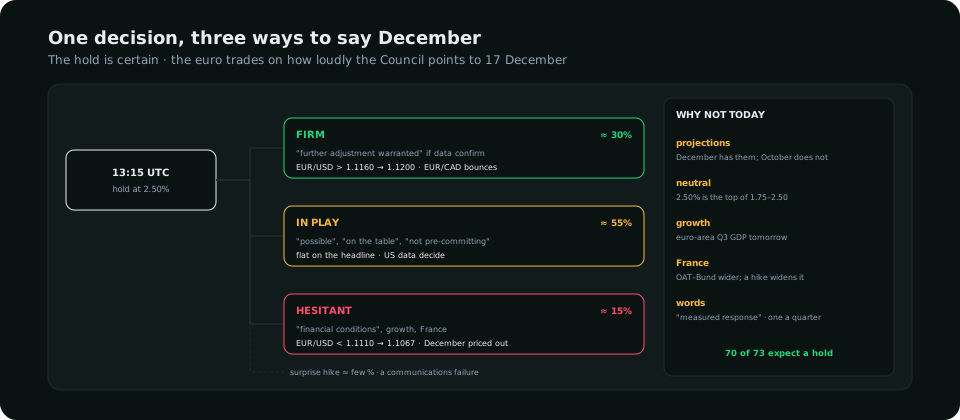
- Firm. The statement says the Council "expects" or "judges it likely" that a further adjustment will be warranted in December if the data confirm the outlook. This is as close to pre-commitment as an institution that refuses to pre-commit can get. The euro rallies: EUR/USD through 1.1160 toward 1.1200, EUR/CAD bounces off its seven-day low, EUR/GBP firms. Rough odds 30%.
- In play. Lagarde says a December increase is "possible", "on the table", that the Council is "not pre-committing" but "all options remain open". Analysts at the big houses expect exactly this, and the market has mostly priced it. The euro does little on the headline and the day's close is decided by the US data forty-five minutes earlier. Rough odds 55%.
- Hesitant. The statement leans on weak growth and "financial conditions", a phrase that in Frankfurt means French spreads, and Lagarde declines to characterise December at all. The 21 basis points priced for December come out, the euro falls through 1.1110 and the question becomes whether the hiking cycle is already over at two moves. Rough odds 15%.
A hike today sits at a few percent and would be a communications failure the Council has gone to some trouble to avoid.
The words to listen for
| Phrase | Where | Means |
|---|---|---|
| "Measured response" | Press conference | Still one move a quarter at most; neutral for December |
| "Data-dependent, meeting-by-meeting" | Statement | Boilerplate; ignore |
| "Not pre-committing to a particular path" | Statement | Boilerplate; ignore |
| "Further adjustment … warranted" | Statement | The firm signal; euro up |
| "Financial conditions", "fragmentation", "transmission" | Either | France is on the Council's mind; euro down |
| "Second-round effects", "wages" | Press conference | The hawkish case for December in the ECB's own vocabulary |
| "Energy", "supply shock", "look through" | Press conference | The dovish case; a Council that looks through energy does not hike into it |
The ECB and the Fed on one ladder
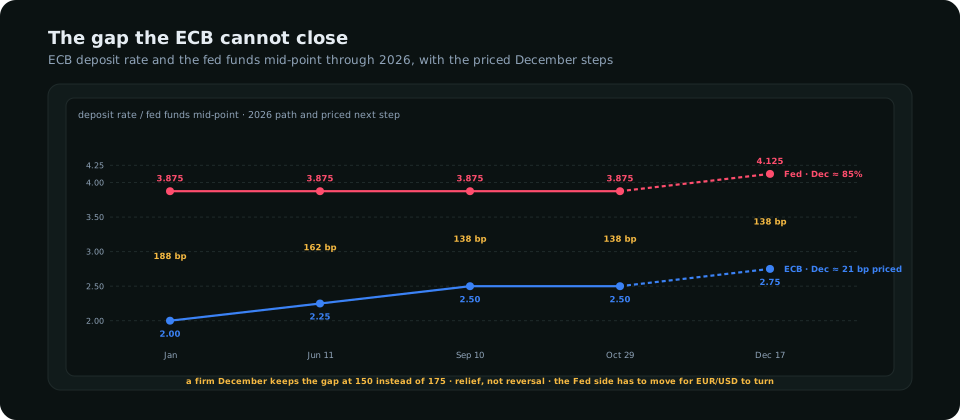
The chart is the reason the euro has fallen into a hiking cycle. Whatever the Council does today, the gap between the two deposit rates stays near 150 basis points; a firm December signal keeps it at 150 rather than letting it widen to 175, which is a relief, not a reversal. For EUR/USD to turn, the Fed side has to move, and the dollar-after-the-Fed guide explains why yesterday's press conference was the first small step in that direction.
Tomorrow matters too
Friday brings the preliminary estimate of euro-area third-quarter GDP and the first October inflation prints from France and Germany, all before the Bank of Japan has finished its own press conference. The Council knows these numbers are coming and will have had early sight of some of them; that is one more reason to say "December is possible" today and let the data say the rest tomorrow. A trader who positions for a firm signal today and gets an "in play" statement should not conclude the hike is off; the Council has simply chosen to let Friday speak.
The euro, pair by pair
- EUR/USD is inside a 1.1110–1.1160 box with the US data forty-five minutes before the decision. The range guide covers the break.
- EUR/CAD has fallen seven sessions to 1.5580 after the Bank of Canada hiked to a matching 2.50% yesterday; a firm ECB signal is the one outcome that ends the streak decisively. See the EUR/CAD guide.
- EUR/GBP has the Bank of England's own hike priced for 5 November; the cross is a race between two banks hiking into energy inflation, and the one that sounds more certain today wins the week.
- EUR/JPY carries the Bank of Japan on Friday on top of today; two decisions in eighteen hours make it the widest-ranging euro cross of the week and the hardest to hold.
The first candle after 13:15 UTC regularly covers forty pips in EUR/USD and more in the crosses, with the spread wide. The economic calendar guide covers how to be positioned before a scheduled release rather than during it, and the risk management rules set the size.
What to read in the terminal
The macro-regime panel decomposes EUR/USD's move into the rate differential, the OAT–Bund spread and energy; the differential has barely moved this month while the spread and oil have done the damage, which is why a firm December signal helps less than the textbook says. The Positioning dashboard shows the speculative euro position from Tuesday's CFTC report, much reduced from the summer; a firm signal would produce short-covering that runs out at the first resistance, and that is the size of bounce to expect.
Frequently asked
Will the ECB raise interest rates today?
Almost certainly not. The deposit rate is expected to stay at 2.50%, with the main refinancing rate at 2.65% and the marginal lending rate at 2.90%. Seventy of 73 economists expect a hold; the question is how clearly the Council points to a hike on 17 December.
What time is the ECB decision and press conference?
The decision is published at 13:15 UTC on Thursday 29 October 2026 (14:15 Frankfurt, 18:15 Pakistan). President Lagarde's press conference begins at 13:45 UTC and usually runs about an hour.
Why would the ECB hike in December but not October?
December is a projection meeting and October is not; both of this year's hikes came with new staff projections. The current 2.50% is the top of the ECB's neutral range, so the next move is the first into restrictive territory and the Council wants the forecasts to justify it. Weak growth, French bond spreads and tomorrow's GDP and inflation data all argue for waiting six weeks.
What does the ECB decision mean for EUR/USD?
A firm December signal lifts the pair through 1.1160 toward 1.1200; a non-committal "in play" message leaves it inside the 1.1110–1.1160 range with the US data deciding the close; a hesitant tone sends it through 1.1110 toward 1.1067. In every case the Fed's 150-basis-point lead over the ECB remains the pair's main weight.
Everything on SMC Terminal is analysis and education, not a recommendation to buy or sell. Pricing and levels are from the morning of 29 October 2026 and change continuously. Trading carries a substantial risk of loss. Manage your risk.