Forex Market Sentiment: Positioning Data, Price Action and Limitations
Forex market sentiment is measurable in three places, the COT report, retail positioning feeds and the chart itself, and each measures a different crowd with a different reliability. This guide explains what each source actually counts, how to read sentiment as a condition rather than a signal, the contrarian logic and when it fails, and the limitations that make sentiment the last input to consult rather than the first.
Forex market sentiment is the question "which way is the crowd leaning, and how hard?", and it has three measurable answers that are routinely confused with each other. The weekly COT report counts the futures positions of funds and hedgers; broker sentiment feeds count the open positions of one broker's retail clients; and the chart records, in sweeps and exhaustion candles, what the crowd did at the levels where it was most exposed. Each source describes a different crowd, updates at a different pace, and is reliable in a different way. This guide sets out what each one actually measures, how to read sentiment as a condition rather than a trigger, the contrarian logic that applies to one source and not the others, and the limitations that make sentiment the last input to consult.
Three sources, three crowds
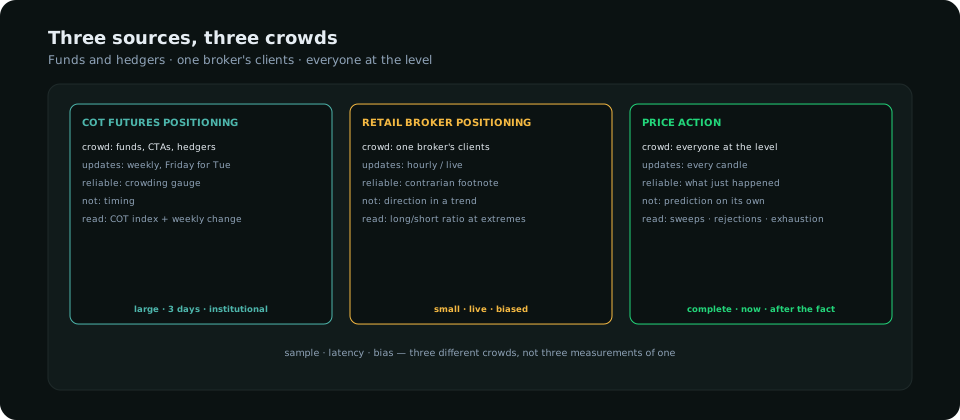
| Source | Who is counted | Updates | Reliable for | Not reliable for |
|---|---|---|---|---|
| COT report | Large speculators (funds, CTAs) and commercial hedgers in futures | Weekly; Friday for Tuesday | How crowded a trend is; the weekly change in the crowd | Timing; anything inside the week |
| Retail positioning feeds | Open positions of one broker's (or a few brokers') retail clients | Hourly or live | A contrarian footnote at extremes (above 75–80% one way) | Direction in a trend; anything representative of the market |
| Price action | Everyone who traded at the level | Every candle | What the crowd just did: a sweep, a rejection, exhaustion | What it will do next, on its own |
COT positioning: sentiment as a condition
The COT report is the only sentiment source with a large, institutional sample and a long history, and it is read as a condition, never a signal. The speculative net rescaled to a COT index over three years says where the crowd sits in its range: mid-range and rising is a trend with room; above 85 is crowded, where good news stops moving price; below 15 is washed out, where selling is exhausted. The weekly change says what the crowd did. The error is to trade the extremes directly: a crowded market stays crowded for months in a strong trend, and the trader who shorts at an index of 90 is early by a quarter. The correct use is to adjust conviction and size on trades the chart triggers, and to stop adding in the trend's direction once the crowd is full. The net positions guide and the managed money article cover the groups; the extremes article covers what followed historical readings above 90.
Retail positioning: the contrarian logic and where it breaks
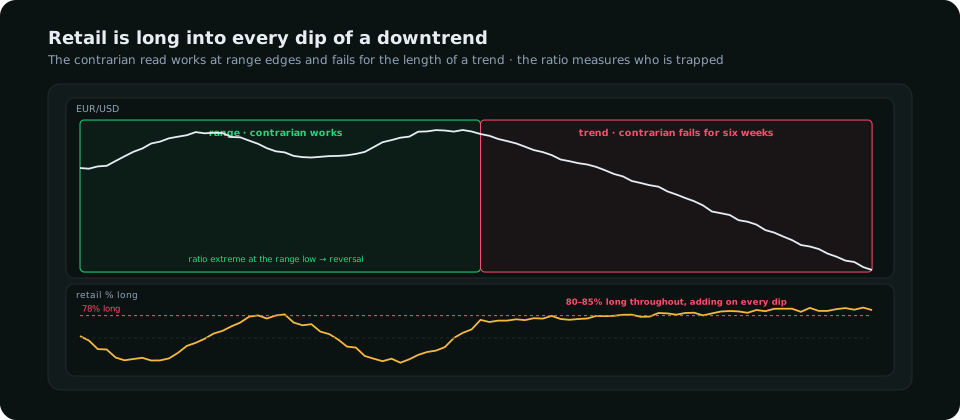
Retail positioning feeds publish the share of a broker's clients long or short each pair, and the contrarian logic is that retail traders fade trends, buy dips in downtrends and sell rallies in uptrends, so an extreme retail reading points the other way. The logic has real support at range edges: 75–80% of clients long near a range low is a crowd that will be stopped if the low breaks, and the sweep that follows is the mechanism. It fails in trends: retail is 80% long EUR/USD for the whole of a six-week decline, adding on every dip, and a trader fading them is fading the right crowd at the wrong time. The sample is also small and biased (one broker's clients in one region) and feeds from different brokers disagree. Use it as a footnote: an extreme retail reading at a marked level in the direction of a sweep adds a little weight; it decides nothing alone.
Sentiment on the chart
Price action records sentiment after the fact, which is its reliability and its limit. A sweep of equal lows that closes back above is the crowd's stops being taken and the crowd being wrong; it is the most concrete sentiment reading there is, because it shows what the trapped side just did. An exhaustion candle, a wide range on a spike with a close back near the open at the end of a long move, is the last of the crowd arriving. A gap or an impulsive candle against the trend is a change of participation. None of these predicts; all of them describe the state of the crowd at a specific level at a specific time, which is what the other two sources only approximate. The liquidity grab article reads the sweep in detail.
Reading the three together
- COT sets the condition for the week: building, crowded or washed out, per market.
- The chart supplies the event: a sweep at a marked level, a rejection, a structure break.
- Retail positioning adds a footnote when it is at an extreme at that level.
A long is strongest when COT says building, the chart shows a sweep of a demand zone with a close back above, and retail is extremely short at that low. It is weakest when COT says crowded long, the chart shows a stall at supply, and retail is extremely long; that is not a short signal, but it is the condition in which longs are reduced. Sentiment adjusts conviction on a trade the structure and the macro read have already allowed; it does not originate the trade. The forex COT guide covers how the weekly condition is set.
Limitations
- Latency. COT is three days old on release and describes futures; retail feeds describe a sample; the chart describes the past. None sees this morning's institutional flow.
- Persistence. Crowded stays crowded; extreme retail readings persist through trends. Sentiment extremes are conditions, and conditions last.
- Sample. Futures are a fraction of spot forex; one broker's clients are a fraction of retail. Both are representative enough for a condition and not enough for a signal.
- Self-reference. Enough traders watching the same sentiment feed make its contrarian reading a crowd of its own.
- No stop, no target. Sentiment never gives a level; structure does. A trade needs both, and only one of them comes from here.
Frequently asked
What is the best forex sentiment indicator?
The COT report's speculative net, read as an index over three years, for the weekly condition. Retail positioning ratios are a contrarian footnote at extremes; the chart's sweeps are the most concrete record of what the crowd just did.
Should I trade against retail sentiment?
Only at range edges and at marked levels, as a footnote to a structural trigger. In a trend, retail is on the wrong side for weeks, and fading them is fading the trend.
How is market sentiment different from positioning?
Positioning is the measurable part of sentiment: who holds what. Sentiment used loosely also includes mood, which is not measurable. Trade the measurable part and read it as a condition.
Everything on SMC Terminal is analysis and education, not a recommendation to buy or sell. Figures in the example are illustrative. Trading carries a substantial risk of loss. Manage your risk.