EUR/USD Forecast Today: Stuck Between 1.1110 and 1.1160 Before the ECB Decision, and How to Trade the Break
EUR/USD is trading near 1.1135 on 29 October 2026, back inside a fifty-pip box after bouncing from 1.1110, the lowest since May 2025, to 1.1160 while Chair Warsh spoke. The ECB publishes its decision at 13:15 UTC, forty-five minutes after US GDP and PCE. This guide maps the range, explains why the euro has fallen even though a December ECB hike is priced, sets out three reaction paths for the afternoon, and gives a plan for trading the break rather than guessing it.
Written on the morning of 29 October 2026, before the US data at 12:30 UTC and the ECB decision at 13:15 UTC. Levels are from the European session.
This EUR/USD forecast is about a box. The pair is trading near 1.1135 in the European morning of 29 October 2026, after a day that saw it touch 1.1110, the lowest since May 2025, and then bounce to 1.1160 while Chair Warsh told the press conference that the Fed would not be giving forward guidance. Fifty pips, both edges tested in the same session, and now the market is sitting in the middle waiting for two events forty-five minutes apart: the US third-quarter GDP and September PCE release at 12:30 UTC and the European Central Bank decision at 13:15 UTC. The ECB is expected to hold its deposit rate at 2.50% and leave December open. That is priced. What is not priced is the tone, and tone is what moves a pair that has already fallen through every level analysts drew for it this month. This guide maps the range, explains why the euro keeps falling with a hike still on the table, sets out the three paths the afternoon can take, and gives a plan for trading the break rather than guessing its direction. The super-week guide from Monday covers the full calendar; this one is today's price.
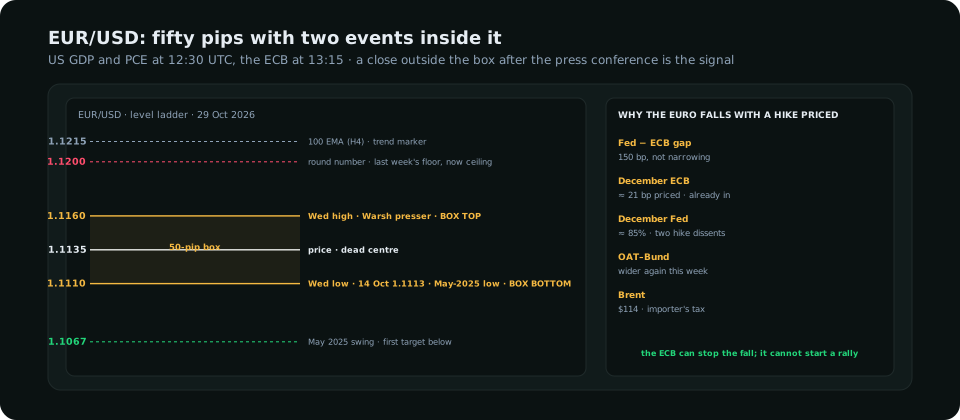
Where EUR/USD is
| Level | What it is | Why it matters today |
|---|---|---|
| 1.1215 | 100-period EMA on the four-hour chart | The pair has not closed a four-hour candle above it since mid-October; the first sign the trend has changed |
| 1.1200 | Round number, last week's consolidation floor turned ceiling | Where sellers who missed the move are waiting |
| 1.1160 | Wednesday's high, set during the Warsh press conference | The top of the box; a close above it on ECB day is the bullish trigger |
| 1.1135 | Where the pair is as this is written | Dead centre, which is why there is no trade yet |
| 1.1115–1.1110 | Wednesday's low and the 14 October low of 1.1113; lowest since May 2025 | The bottom of the box, tested twice in two weeks and held both times |
| 1.1067 | Swing level from May 2025 that technicians flagged this week | The first target if 1.1110 breaks |
Why the euro is falling with a hike still priced
The ECB raised rates in June and again on 10 September, to a 2.50% deposit rate, and the market has about 21 basis points priced for the 17 December meeting. By the textbook that should be euro-positive. The euro has fallen anyway, and it is worth being clear about why, because the answer decides what the ECB can do about it this afternoon.
- The Fed is further along. The Fed held at 3.75–4.00% yesterday, but two voters wanted a hike and the market prices December at better than 80%. A 150-basis-point gap between the two deposit rates that is not narrowing is the single largest weight on the pair, and nothing Lagarde says at 13:45 changes the American half of it.
- France. The spread between French and German ten-year bonds has widened again this week, with debt levels and gridlock ahead of next year's election back in the headlines. A wider OAT–Bund spread is a euro-negative that has nothing to do with the policy rate; it is why some analysts are asking whether France could "wake up the doves" and make the Council hesitate on December.
- Energy. Brent at $114 is a tax on an importer. The euro area's inflation is energy-driven, which is why the ECB hiked, but the same energy bill weakens its growth, which is why the ECB's hikes do not help the currency the way the Fed's do.
The practical consequence: a hold that confirms December is the base case and the pair fell into it. For the euro to rally the ECB has to deliver more than "December is possible", and for the euro to break down the ECB has to deliver less. Anything in between hands the decision to the US data that landed forty-five minutes earlier.
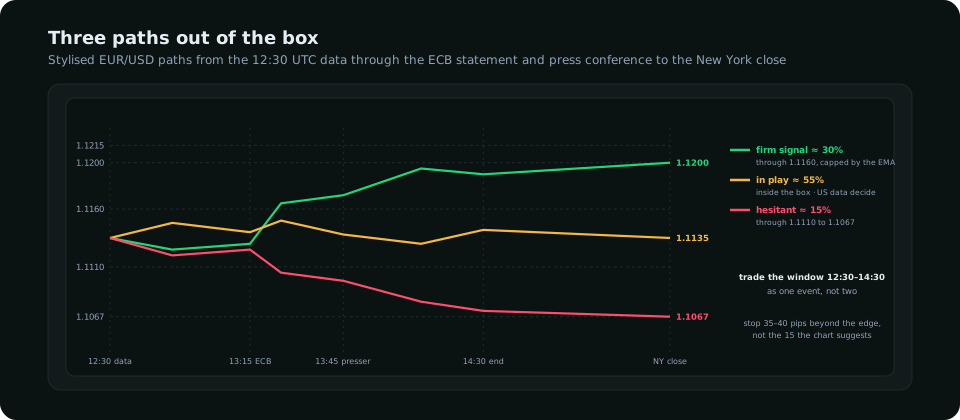
Three paths for the afternoon
| Path | What the ECB says | Rough odds | EUR/USD |
|---|---|---|---|
| Firm signal | Hold; statement or Lagarde says a December increase is the Council's expectation if the data hold | ≈ 30% | Through 1.1160, test 1.1200; the 1.1215 EMA caps it unless PCE was soft |
| In play | Hold; December "possible", "on the table", no commitment | ≈ 55% | Stays inside 1.1110–1.1160 on the headline; the US data decide the close |
| Hesitant | Hold; growth and France are cited, the hiking bias is softened | ≈ 15% | Through 1.1110 quickly, 1.1067 inside the session |
The middle row is the most likely and the least tradeable from the headline alone. In that case the 12:30 UTC release has already set the direction: a core PCE print of 0.4% month on month or a GDP number above 3.5% lifts the dollar and the ECB's non-answer lets EUR/USD drift to the bottom of the box; a 0.2% core PCE does the opposite. The GDP and PCE preview sets out the combinations.
How to trade the break
- Do not trade the 12:30 print and the 13:15 decision as two events. Forty-five minutes is not enough for the first move to complete. Treat the window from 12:30 to 14:30 UTC, when the press conference ends, as one event with one position.
- Buy strength through 1.1160 only on a close. An hourly close above 1.1160 after the press conference has started, not a wick during the statement, is the trigger. Target 1.1200, stop below 1.1130. The reward is modest because the EMA at 1.1215 is near; that is the price of trading against a trend.
- Sell weakness through 1.1110 on a retest. The level has been tested twice and held, so the first break will attract buyers who remember that. Wait for the pullback to 1.1110–1.1120 and sell it, target 1.1067, stop above 1.1145. This is the with-trend trade and it earns the better ratio.
- If the pair is still inside the box at 14:30 UTC, stand down. Friday brings euro-area third-quarter GDP, French and German October inflation and the Bank of Japan. The box will resolve; it does not have to resolve today.
Spreads on EUR/USD at 13:15 UTC on ECB day widen to two or three times normal for a few minutes and the first candle after the statement regularly covers forty pips in both directions. A stop placed at the box edge gets taken by the wick, not the move; the stop placement guide covers how far beyond structure to sit on a news day. Size for a stop of 35–40 pips, not the 15 the chart suggests, and the lot follows from the risk management rules.
What to read in the terminal
The Positioning dashboard shows the speculative euro position from Tuesday's CFTC report. It has been cut back sharply since the summer, which is why the 1.1110 level has held so far: the easy selling is done. A bounce on a firm ECB signal would be covering, not new buying, and covering runs out at the first resistance. The intermarket panel scores EUR/USD against the OAT–Bund spread and Brent; both have been pointing down for a fortnight and neither is on the ECB's agenda.
Frequently asked
What time is the ECB decision today?
The decision is published at 13:15 UTC on Thursday 29 October 2026 (14:15 Frankfurt, 18:15 Pakistan) and President Lagarde's press conference starts at 13:45 UTC. The US GDP and PCE release lands at 12:30 UTC, forty-five minutes earlier.
Will the ECB raise rates today?
Almost certainly not. Seventy of 73 economists polled expect the deposit rate to stay at 2.50% and the market prices no change. The question is whether the statement or the press conference points to a hike at the 17 December meeting, where the market has about 21 basis points priced.
Why is EUR/USD at its lowest since May 2025?
The Fed's policy rate is 150 basis points above the ECB's and the gap is not narrowing, French bond spreads have widened on political and debt worries, and the energy shock hurts Europe's growth more than America's. The pair touched 1.1110 on 28 October, the lowest since May 2025, and bounced to 1.1160 during the Fed press conference.
What are the key EUR/USD levels for today?
Support is 1.1115–1.1110 and then 1.1067. Resistance is 1.1160, 1.1200 and the four-hour 100 EMA at 1.1215. A close outside the 1.1110–1.1160 box after the press conference is the signal; the middle of it is not.
Everything on SMC Terminal is analysis and education, not a recommendation to buy or sell. Levels are from the European morning of 29 October 2026 and change continuously. Trading carries a substantial risk of loss. Manage your risk.