ECB Decision October 2026 and EUR/USD at 2026 Lows: The Central Bank Super Week
Five central banks and one inflation print in three days: the RBNZ, Bank of Canada and Fed on 28 October 2026, the ECB on the 29th, the Bank of Japan on the 30th, with Australia's third-quarter CPI opening the week. The ECB is expected to hold its deposit rate at 2.50% after September's hike and signal December, while EUR/USD sits a figure above its 2026 low of 1.1113. This guide gives the full schedule in UTC and Pakistan time with what is priced for each, the drivers behind the euro's weakness, the EUR/USD levels, and a plan for a week in which every session has a decision in it.
Written on 27 October 2026. Pricing and levels are as of the 26 October session.
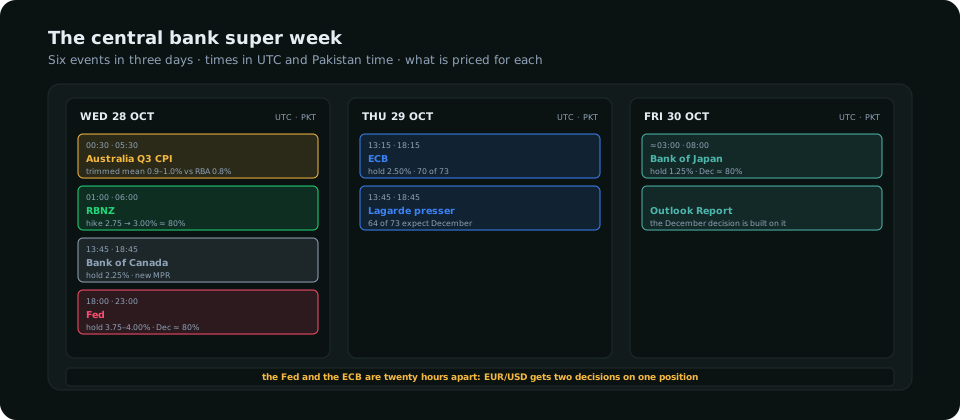
The ECB decision on 29 October 2026 is the middle of what the market is calling a central bank super week: five rate decisions and one major inflation print in three days. Australia's third-quarter CPI opens Wednesday; the Reserve Bank of New Zealand, the Bank of Canada and the Federal Reserve decide the same day; the European Central Bank decides Thursday; the Bank of Japan closes the week on Friday. For the euro the stakes are specific. The ECB raised its deposit rate to 2.50% on 10 September and is expected to hold now and move again in December, and EUR/USD is trading about a figure above its 2026 low of 1.1113, set on 14 October. This guide gives the full schedule with what is priced for each decision, explains why the euro has been the weakest major this month, maps the EUR/USD levels, and sets out a plan for a week in which every session has something in it.
The schedule
| When (UTC / PKT) | Event | Rate now | Priced | Pair |
|---|---|---|---|---|
| Wed 00:30 / 05:30 | Australia Q3 CPI | RBA cash rate 4.60% | Trimmed mean 0.9–1.0% q/q against the RBA's 0.8%; a November hike priced somewhere between 45% and 70% depending on the day | AUD/USD |
| Wed 01:00 / 06:00 | RBNZ | 2.75% | Hike to 3.00% about 80–85% | NZD/USD |
| Wed 13:45 / 18:45 | Bank of Canada | 2.25% | Hold; new Monetary Policy Report | USD/CAD |
| Wed 18:00 / 23:00 | Federal Reserve | 3.75–4.00% | Hold about 90%; December hike about 80% | Everything |
| Thu 13:15 / 18:15 | ECB | Deposit 2.50% | Hold (70 of 73 economists); December hike expected by 64 of 73 | EUR/USD |
| Fri ~03:00 / 08:00 | Bank of Japan | 1.25% | Hold; December hike about 80% | USD/JPY |
The Fed is covered in the Fed decision guide and the BoJ in the yen intervention guide. The Australian CPI is the week's sleeper: the big four banks are split on November, the trimmed mean is forecast above the RBA's own number, and AUD/USD is near 0.70 with speculative positioning at an extreme, which the AUD/USD analysis covers. A print of 1.0% or more on the trimmed mean makes a November hike close to certain and is the cleanest single trade of the week; 0.8% or less unwinds it.
The ECB: a hold that has to say December
The ECB raised all three key rates by 25 basis points on 10 September, taking the deposit rate to 2.50%, in response to inflation that had drifted back above target on energy. Seventy of 73 economists polled expect no change on Thursday, and 64 expect a hike in December. President Lagarde has described the appropriate path as a "measured response", which the market reads as one move a quarter. The decision is published at 13:15 UTC (18:15 Pakistan time) and the press conference begins at 13:45. The euro's problem is that a hold which confirms December is already priced and the currency has fallen anyway, which tells you the ECB is not what is driving it.
Why the euro is the weakest major
Three reasons, none of them the ECB. France. French government bond yields have risen on fiscal and political concerns, and a wider spread between French and German yields is read by the market as a euro-area stress signal; it has been the single most cited driver in October. Growth. Euro-area PMIs have been soft, and the oil shock lands on a region that imports its energy and was barely growing before it; the oil shock guide explains why the euro sits on the wrong side of that trade. The rate gap. A Fed at 3.75–4.00% and heading to 4.25% against an ECB at 2.50% heading to 2.75% is a differential of 150 basis points that is not narrowing; the rate path guide explains why the gap, not the level, sets the direction. The pair's weakness is, in the words of one analyst note, driven more by France and slowing growth than by dollar strength, and the dollar index at 102 is only at the top of its range, not breaking out.
EUR/USD levels
| Level | Meaning |
|---|---|
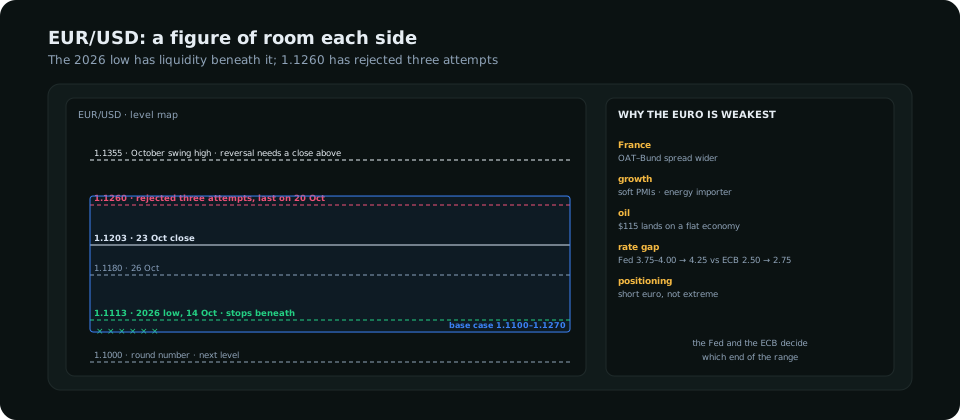
| 1.1355 | October swing high; a close above it ends the downtrend on the daily chart |
| 1.1260 | Resistance that has rejected three attempts, most recently on 20 October |
| 1.1180–1.1205 | The current area; the 23 October close was 1.1203 |
| 1.1113 | 2026 low, 14 October; stops beneath it |
| 1.1000 | Round number and the next structural level below |
The base case for the week is 1.1100–1.1270, with the Fed and the ECB deciding which end. The setup that matters is at the low: a sweep of 1.1113 on a hawkish Fed Wednesday night, followed by an ECB on Thursday that confirms December, is the classic two-day reversal, a liquidity grab below the year's low and a close back above it with the second central bank as the catalyst. The liquidity grab guide covers how to tell that from a genuine break; the difference is the close. A daily close below 1.1113 with the ECB cautious is the break, and it targets 1.1000.
A plan for the week
- One position per pair, sized for two decisions. A EUR/USD position opened Wednesday carries the Fed and the ECB. The stop has to be beyond the Fed's clean-day move, about 100 pips, which means half the normal lot. The risk management guide sets out the arithmetic.
- Trade the Australian CPI, not the RBNZ. The RBNZ hike is 80% priced and the New Zealand dollar is thin; the CPI is a genuine two-sided event with a clear threshold at 1.0% on the trimmed mean.
- Do nothing in EUR/USD between the Fed statement and the ECB press conference unless the Fed produces a sweep of 1.1113. A position taken on Wednesday's hawkish spike is a position that meets Lagarde twenty hours later.
- Friday is the BoJ, with month-end flows on top of it. USD/JPY has a central bank on each side of it; the yen guide explains why long USD/JPY has no edge above 159 this week.
- Write Monday's levels before the week starts. The calendar guide's before-during-after structure applies six times this week; it only works if the "before" was done.
What to read in the terminal
The macro regime read puts each currency's two-year yield against the dollar's, which is the differential the whole week is about; the euro's reads at a 150 basis point disadvantage, the Australian dollar's at a premium that a hot CPI would widen. The Positioning dashboard shows the euro short is meaningful but not at the extremes that produce squeezes, which is why a sweep of 1.1113 is more likely to extend than to reverse unless the ECB gives it a reason. The COT index guide explains that distinction.
Frequently asked
What time is the ECB decision on 29 October 2026?
14:15 Central European time, which is 13:15 UTC and 18:15 Pakistan time, with Lagarde's press conference at 13:45 UTC. Europe is still on summer time until 25 October, so from this meeting the UTC time is an hour earlier than it was in September.
Will the ECB raise rates in October 2026?
Seventy of 73 economists polled expect a hold at the 2.50% deposit rate, with 64 expecting the next hike in December. The market is positioned for a hold that confirms December; the surprise would be a hold that does not.
Why is EUR/USD falling if the ECB is hiking?
Because the Fed is hiking faster from a higher level, the gap is 150 basis points and not closing, and the euro has its own problems in French yields, soft PMIs and an oil shock on an energy-importing economy. A central bank raising rates slower than its counterpart does not support its currency.
Everything on SMC Terminal is analysis and education, not a recommendation to buy or sell. Prices, pricing and survey figures are as of 26–27 October 2026 and change continuously. Trading carries a substantial risk of loss. Manage your risk.