USD/JPY Near 160 Again: Yen Intervention Watch and the BoJ Decision, October 2026
USD/JPY is trading near 158 into the Bank of Japan's 30 October 2026 decision, back inside the zone where Japan's Ministry of Finance spent a record ¥15.4 trillion in July and August and the United States joined the first coordinated yen-buying operation in almost three decades. 'Yen intervention' is back at the top of forex searches. This guide covers what happened in the summer, what the authorities have said since, what the BoJ is expected to do, where the intervention risk actually starts, and how to trade a pair with a central bank on one side of it.
Written on 27 October 2026, before the Bank of Japan's 30 October decision. Levels are from the 26 October session.
USD/JPY is near 160 again, and "yen intervention" is back near the top of forex searches for the first time since August. The pair traded around 157.5–158 on 26 October, inside the range the Ministry of Finance defended in the summer and within two figures of the level Finance Minister Satsuki Katayama has called an "extremely weak yen". The Bank of Japan decides on Friday 30 October, with a hold at 1.25% almost fully priced and a December hike priced near 80%, and the Fed decides two days before it. The pair therefore has a US central bank pushing it up, a Japanese central bank that may push it down in December, and a finance ministry that can push it down at any hour. This guide covers what happened in July and August, what has been said since, where the risk actually starts, the signs that precede an operation, and how to trade a pair with a ceiling on it.
What happened in the summer
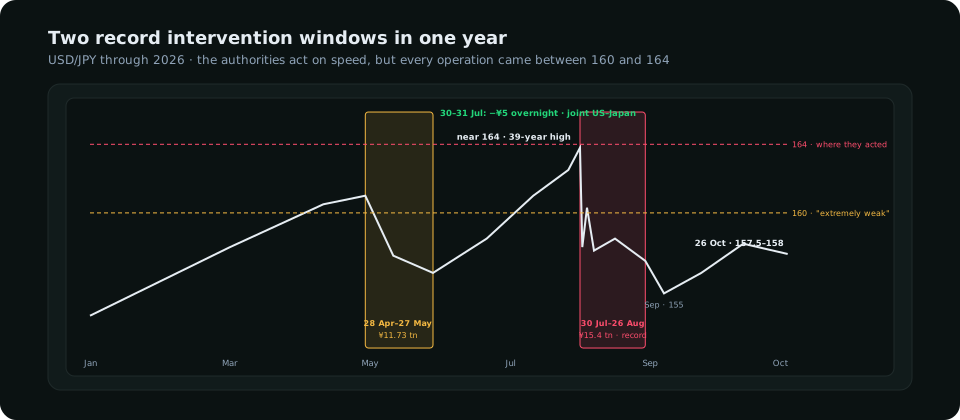
| Date | Event |
|---|---|
| 28 April – 27 May | Ministry of Finance spends ¥11.73 trillion, then a monthly record |
| Late July | USD/JPY approaches 164, the dollar's highest against the yen in about 39 years |
| 30 July | The pair drops about ¥5 in a night to below 158 on Japanese intervention |
| 31 July | Joint US–Japan yen-buying, dollar-selling operation; announced on 3 August by Katayama and US Treasury Secretary Scott Bessent, the first such joint action in roughly 28 years |
| 30 July – 26 August | Total intervention ¥15,399.3 billion, the largest monthly amount on record |
| September | The yen reaches a one-month high near 155 as traders weigh further action; the BoJ holds |
| Mid-October | USD/JPY back in a 156–160 range; Katayama repeats that above 160 is extremely weak |
| 2–9 November | The detailed quarterly release will show the exact days and amounts of the summer operations |
Two things about the summer episode matter for now. The US side was small, estimated at a few billion dollars against Japan's tens of billions, and Goldman Sachs called it symbolic; what it bought was the signal that Washington would not object to a yen defence, which removes the political constraint that limited earlier operations. And the effect decayed: the pair was back above 160 within a day and back near 158 within weeks, which is the pattern of every intervention since 2022. Intervention buys time. What changes the trend is the rate gap, and the interest rates guide explains why.
The BoJ on 30 October
The policy rate is 1.25%. Swaps price a hike at this meeting at under 5% and a hike at the 18 December meeting at about 80%, and the meeting publishes the quarterly Outlook Report that the December decision will be built on. The decision lands around midday Tokyo time, which is roughly 03:00 UTC and 08:00 in Pakistan, and the governor's press conference follows in the Tokyo afternoon. A hold that upgrades the inflation forecast and keeps December live is the base case and is mildly yen-positive. A hold that sounds cautious about the oil shock's effect on growth would push December below 60% and send USD/JPY toward 160, which is where the other authority steps in. The uncomfortable scenario for the pair is a hawkish Fed on Wednesday followed by a cautious BoJ on Friday: it is the combination that produced July.
Where the risk starts, and the signs before an operation
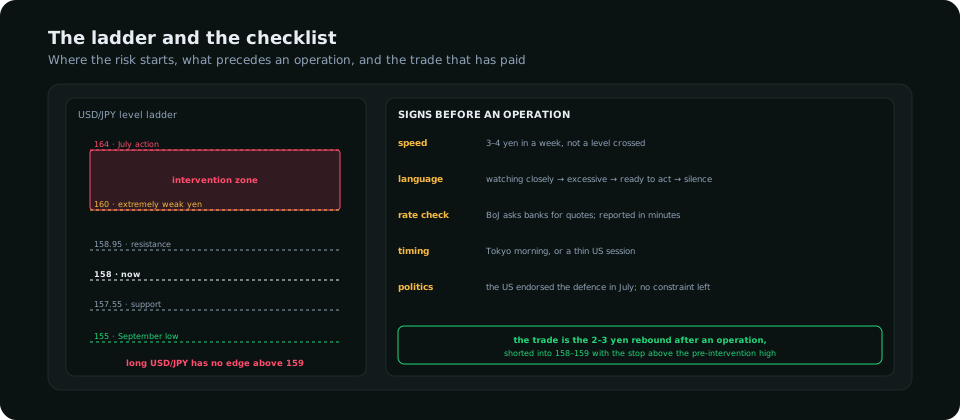
| Sign | What it looks like | What to do |
|---|---|---|
| Speed | Three to four yen in a week rather than a level crossed | Reduce long USD/JPY exposure regardless of the chart |
| Language | "Watching closely" becomes "excessive moves" becomes "ready to take decisive action"; silence after that | The last rung is the one that precedes action |
| Rate check | The BoJ asks banks for dollar-yen quotes on the ministry's behalf; reported within minutes | Flat, or short with a wide stop; the operation usually follows within days |
| Timing | Tokyo morning, or a thin US session such as a holiday; the summer operation came late in the New York day | Do not hold a USD/JPY long through a thin session above 159 |
How to trade USD/JPY under a ceiling
- Long USD/JPY has no edge above 159. The carry is real, roughly 2.5–2.75 points of rate differential, but a ¥5 drop in a night is two years of carry. Above 159 the risk-reward of the long is wrong whatever the chart says.
- Shorts need the trigger, not the level. Selling 160 because it is 160 has lost money repeatedly this year, including the day after the July operation when the pair went back through it. Short on the rate check, the "decisive action" language, or a displacement candle down from 159–160 that closes below the prior day's low, with the stop above the spike high.
- The pullback after an operation is the trade. Every intervention this cycle has been followed by a rebound of 2–3 yen within days. The short that pays is entered on that rebound, into the 158–159 area, with a stop above the pre-intervention high, targeting the intervention low; the interest rates guide explains who is on the other side of it.
- Size for the gap. Weekend and Tokyo-morning gaps of 100–200 pips are normal in this regime. A 0.5% risk with a stop beyond daily structure plus a yen is the limit; the position size guide turns that into lots.
What to read in the terminal
The Positioning dashboard shows the speculative yen position from the CFTC report; the summer operation hit a market that was heavily short yen, which is why the drop was ¥5 rather than ¥2, and the size of the current short is the best single guide to how far the next one would travel. The Seasonality module shows that the yen's year-end strength, when Japanese institutions repatriate, begins in late November; a December BoJ hike into that window is the setup the market is pricing. The managed money guide covers the positioning read.
Frequently asked
At what level will Japan intervene in USD/JPY?
Officials say they act on the speed and disorder of a move, not a level, but every operation this cycle has come between 160 and 164, and the Finance Minister has called anything above 160 extremely weak. Treat 160 as the start of the zone and 164 as the proven line.
Did the United States really intervene with Japan?
Yes. The joint yen-buying operation of 31 July was announced by Japan's Finance Minister and the US Treasury Secretary on 3 August. The US amount was not disclosed and was estimated at a few billion dollars against Japan's record ¥15.4 trillion for the window; its significance was political rather than financial.
Will the Bank of Japan raise rates on 30 October 2026?
Markets price it at under 5%. The rate is 1.25% and a hike at the 18 December meeting is priced at about 80%. The October meeting's Outlook Report is what the December decision will be built on, so its inflation forecast matters more than the hold.
Everything on SMC Terminal is analysis and education, not a recommendation to buy or sell. Prices and pricing are as of 26–27 October 2026 and change continuously. Trading carries a substantial risk of loss. Manage your risk.