Fed Rate Decision October 2026: A Hold Is Priced, December Is the Trade
The Fed rate decision on 28 October 2026 is the most searched event in forex this week, and the decision itself is close to settled: a hold at 3.75–4.00% is priced at around 90%. What is not settled is December, where a second hike of the year is priced near 80%, and that is what Chair Kevin Warsh's press conference will move. This guide covers what has changed since the September hike, what the market has priced, the four scenarios for the dollar, gold and NAS100, and a plan for the 18:00 UTC release.
Written on 27 October 2026, the day before the decision. Figures are the market's pricing as of the weekend and will have moved by the time you read this; the framework will not.
The Fed rate decision in October 2026 lands on Wednesday 28 October at 14:00 Eastern time (18:00 UTC, 23:00 in Pakistan), with Chair Kevin Warsh's press conference half an hour later. It is the most searched forex event of the week for a reason that is slightly misleading: the decision itself is close to settled. Futures price a hold at the current 3.75–4.00% target range at roughly 90%, down from a coin-flip on a hike only a week earlier after a bond rally took the odds out. What is live is December. A second hike of the year at the 8–9 December meeting is priced near 80%, and that probability, not Wednesday's number, is what the statement and the press conference will move. This guide covers what has changed since September, what is priced, the scenarios for the dollar, gold and NAS100, and a plan that trades the second move rather than the first.
Where the Fed is, and how it got here
| Item | Status going into 28 October |
|---|---|
| Target range | 3.75–4.00%, after September's 25 basis point hike, the first increase in three years, passed 12–0 |
| Chair | Kevin Warsh; after September he said "inflation is too high and has been for too long" |
| September projections | The committee's median path implied one more hike this year, to about 4.1% |
| Inflation | September CPI reported at 3.7% year on year, with core near 2.6%; oil above $100 is the new upside risk |
| Labour market | Described by the Fed as resilient; no sign yet of the weakness that would stop a December move |
| Pricing, this meeting | Hold about 90%, hike about 10% |
| Pricing, December | Hike about 78–90%, depending on the day the futures are read |
| Treasury yields | Ten-year near 5%, the highest of the cycle, pulled up by oil and the hike path |
The sequence matters. The Fed hiked in September into an economy that was still growing, with the explicit message that inflation had stayed above target for too long. The October meeting was briefly priced as a follow-up hike when oil broke above $110 and pushed inflation expectations up; a rally in bonds in the week of 19–23 October took that back out and left December as the consensus date for the second move. The FOMC guide explains the general mechanics of a decision day; this piece is about this one.
What the market has priced
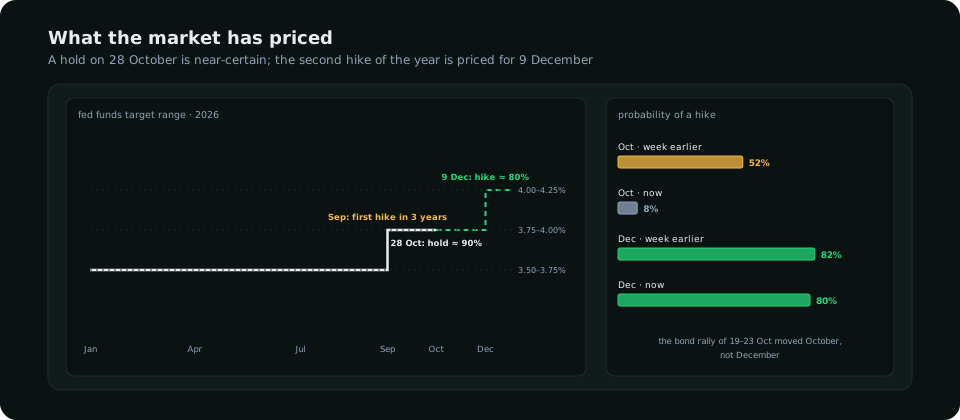
The thing to understand about a priced hold is that the hold itself cannot move the dollar. What moves it is the distance between what Warsh says about December and the 80% the market already assumes. If the statement keeps September's language and the press conference repeats that inflation is too high, December moves toward 95% and the dollar firms modestly: the market was most of the way there. If Warsh emphasises the oil shock as a growth risk rather than an inflation risk, or leans on the labour market, December drops toward 50–60% and the dollar falls hard, because a lot of positioning assumes the hike. The asymmetry is the trade: the hawkish surprise is small, the dovish surprise is large.
Four scenarios
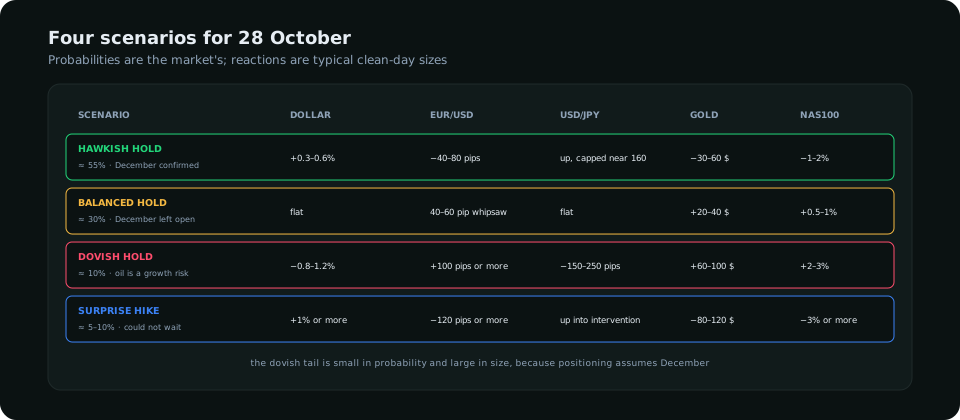
| Scenario | What Warsh says | Dollar | Gold | NAS100 |
|---|---|---|---|---|
| Hawkish hold (base case) | Inflation too high, December live, oil is an inflation risk | Up 0.3–0.6% | Down 30–60 dollars | Down 1–2% |
| Balanced hold | Data-dependent, December neither promised nor ruled out | Whipsaw, flat | Up 20–40 | Up 0.5–1% |
| Dovish hold | Oil is a tax on growth, the labour market is softening | Down 0.8–1.2% | Up 60–100 | Up 2–3% |
| Surprise hike | Could not wait for December | Up 1%+ | Down 80–120 | Down 3%+ |
The pairs that react most are USD/JPY and gold, through the rate path and real yields, with one caveat on the yen: USD/JPY is already near 158, inside the zone where Japan's Ministry of Finance intervened in July and August, so a hawkish outcome that pushes it toward 160 runs into a second central bank. The yen intervention guide covers that ceiling. Gold's reaction is amplified this time because it has just had its worst week in four months on the same oil-and-yields story; the gold pullback guide sets out where the buyers are.
A plan for Wednesday
- Before 18:00 UTC: no new dollar positions. FOMC days range at a third of normal until the release. Mark the week's high and low on EUR/USD, USD/JPY and gold, and the nearest liquidity above and below; that is where the first spike goes.
- 18:00–19:15 UTC: watch. The statement moves the market in seconds; the press conference at 18:30 frequently reverses it. Nothing is known until Warsh has answered the December question directly, which usually happens in the first fifteen minutes of questions.
- After 19:15: if the statement and the press conference agreed, trade the pullback to the pre-release level in the direction that held, stop beyond the spike's extreme, target the next liquidity. If they disagreed and price is back inside the morning's range, there is no trade.
- Thursday morning: the ECB decides at 13:15 UTC, so the Fed's move in EUR/USD may be extended or reversed within twenty hours. The ECB guide covers the second half of that trade.
Size for the clean-day moves in the table, not the whipsaw. A 150-pip move in EUR/USD against a 20-pip stop is not a reason to trade it at normal size; the position size guide sets out how to cut the lot when the stop has to widen.
What to read in the terminal
Two things in SMC Terminal frame this meeting. The Positioning dashboard shows how crowded the dollar long is going in; a crowded long falls further on a dovish outcome than it rises on a hawkish one, which is the asymmetry above expressed in contracts. And the macro regime read tracks the two-year and ten-year yields against the dollar, which is where the December pricing actually lives; a two-year that fails to make a new high on a hawkish statement is the earliest sign the market is not buying the December hike. The yields guide explains that read.
Frequently asked
What time is the Fed decision on 28 October 2026?
14:00 Eastern, which is 18:00 UTC and 23:00 Pakistan time, with the press conference at 18:30 UTC. The United States is still on daylight saving time until 1 November, so the December meeting will be an hour later in UTC.
Will the Fed raise rates in October 2026?
The market prices about a 90% chance of no change. The second hike of the year is priced for December at roughly 80%. The decision that matters on Wednesday is what the Fed signals about December, not what it does in October.
Why would the dollar fall after a hawkish Fed?
Because the hawkishness was already priced. If Warsh confirms December exactly as expected, the dollar has little new to rally on and often drifts lower into the close as positions are squared. The dollar rises on a hawkish outcome only if it is more hawkish than the 80% already assumed.
Everything on SMC Terminal is analysis and education, not a recommendation to buy or sell. Probabilities and price levels are the market's as of 27 October 2026 and change continuously. Trading carries a substantial risk of loss. Manage your risk.