Bank of Canada Interest Rate Decision October 2026: A Hike to 2.50% Into Falling Jobs, and USD/CAD
The Bank of Canada decides today, 28 October 2026, at 13:45 UTC with its Monetary Policy Report, and the market has swung from a cut to a hike in three weeks: swaps price a move from 2.25% to 2.50% at roughly 75–85% after headline inflation rose to 3.1% on gasoline, even though core measures eased to 1.8–1.9% and the economy lost 68,000 jobs in September. This guide explains the dilemma, what the MPR will say about oil, the scenarios for USD/CAD with the Fed four hours later, and the levels that matter.
Written on the morning of 28 October 2026, before the 13:45 UTC decision. Pricing is from the 27 October close.
The Bank of Canada interest rate decision today is the week's most genuinely two-sided central bank event, and the Canadian dollar is the currency with the most to reprice. The overnight rate is 2.25%. In early October the market priced a cut after two months of job losses; by 27 October overnight index swaps priced a 25 basis point hike to 2.50% at about 74%, with some readings in the previous week near 87%, after headline inflation rose to 3.1% and three of the big banks (BMO, RBC and Desjardins) flipped their calls. The decision lands at 09:45 Eastern, 13:45 UTC, 18:45 in Pakistan, with the quarterly Monetary Policy Report and a press conference; the Fed follows four hours later. This guide sets out the dilemma, what the report will say about oil, the scenarios for USD/CAD, and the levels.
The dilemma in one table
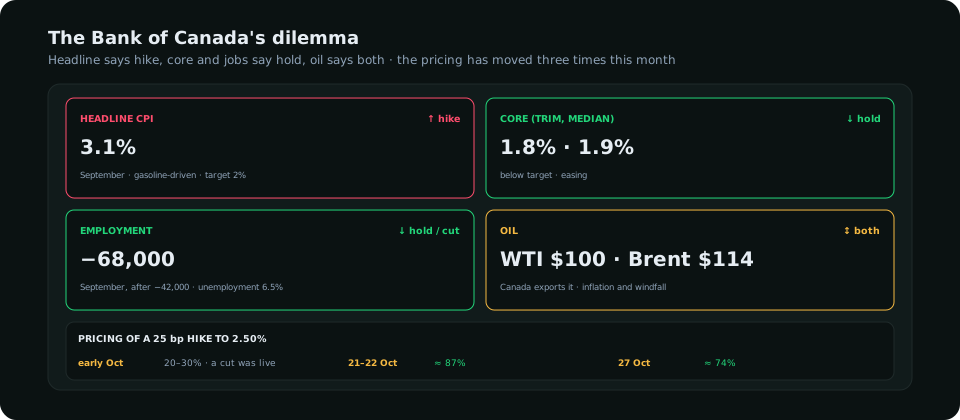
| Indicator | Latest | Pulls toward |
|---|---|---|
| Headline CPI | 3.1% in September, driven by gasoline; reported below one survey's expectation | Hike |
| Core (trim and median) | Eased to 1.8% and 1.9%, below the 2% target | Hold |
| Employment | −42,000 in August, −68,000 in September; unemployment 6.5% | Hold or cut |
| Oil | WTI near $100, Brent near $114; Canada is a net exporter | Both: inflation up, but a terms-of-trade windfall |
| Business surveys | The Bank's own autumn surveys shifted the big banks to a hike call | Hike |
| The Fed | Holding at 3.75–4.00% with December priced; the gap to Canada is 150 basis points | Hike, to defend the currency and the gap |
The honest summary is that the Bank is being asked to hike into a labour market that has shed 110,000 jobs in two months because the energy component of the price index has risen. A Bank that targets core would hold; a Bank worried about expectations and a 150 basis point gap to the Fed would hike once and stop. The market's 75% says the second Bank is the one in the room, and the Monetary Policy Report is where it will explain itself. The rate path guide explains why the explanation matters more than the move.
What the Monetary Policy Report will say about oil
The MPR is the quarterly forecast document, and this one has to reconcile an oil price assumption that was about $85 in July with a market near $100 since mid-October. Three things to read in it. The oil assumption: the Bank conventionally uses recent averages, so the new number will be well above the last one and will mechanically raise the headline inflation forecast for the next two quarters. The output gap: if the Bank judges the economy has moved into excess supply on the jobs data, a hike is described as a one-off adjustment rather than the start of a cycle. The terms-of-trade line: Canada earns more from exports when oil rises, and the MPR will say how much of that offsets the consumer squeeze. A hike described as insurance against expectations, with the output gap widening, is a hawkish move with a dovish report, and the Canadian dollar's gain fades within days. The oil shock guide covers the exporter channel in detail.
USD/CAD scenarios, with the Fed four hours later
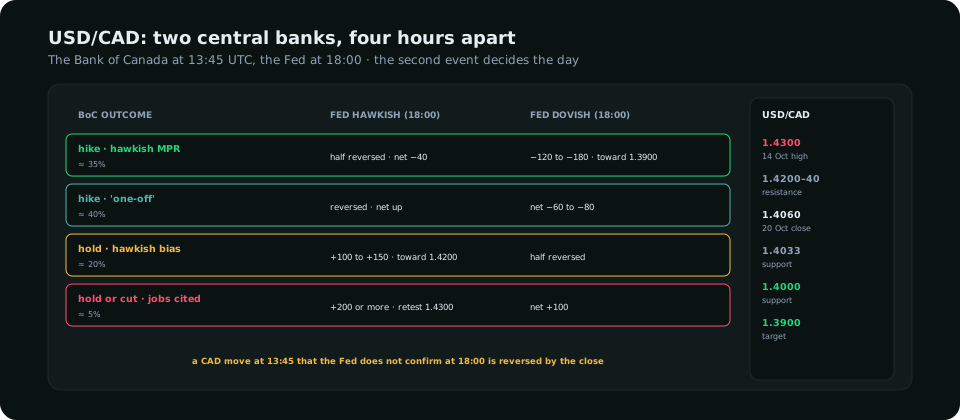
| BoC outcome | Probability | USD/CAD on the release | With a hawkish Fed | With a dovish Fed |
|---|---|---|---|---|
| Hike, hawkish MPR | About 35% | Down 60–100 pips | Half reversed; net −40 | Extended; −120 to −180, toward 1.3900 |
| Hike, "one-off" | About 40% | Down 30–60, then fades | Reversed; net up | Net −60 to −80 |
| Hold, hawkish bias | About 20% | Up 80–120 | Extended toward 1.4200 | Half reversed |
| Hold or cut, jobs cited | About 5% | Up 150–200+ | Retest of 1.4300 | Net +100 |
The pair's levels: 1.4300 is the 2026 high from 14 October, 1.4200–1.4240 the resistance above, 1.4060 the 20 October close and the area the pair has held since, 1.4033 and 1.4000 the supports beneath, and 1.3900 the target of a clean hike plus a dovish Fed. The pair fell about 240 pips from its October high as oil rose; a hike that the MPR describes as a one-off is already in that price. The calendar guide's rule applies with force today: the second event in a session decides the day, and the second event is the Fed.
A plan for the session
- No USD/CAD position between 13:45 and 18:00 UTC unless the BoC produces a clean sweep of 1.4000 or 1.4240 with a close back through it. Everything else is waiting for the Fed to confirm.
- CAD/JPY is the cleaner expression of a hawkish BoC on a day the Fed is uncertain: it carries the Canadian decision and the oil channel without the Fed's noise. Its ceiling is the yen intervention zone covered in the yen guide.
- After 19:15 UTC, if the BoC hiked and the Fed was dovish, the short USD/CAD pullback toward 1.4060 is the trade, stop above the day's high, target 1.3900. If the BoC held and the Fed was hawkish, the long pullback toward 1.4060 targets 1.4240.
- Size for 200 pips. The two decisions can add; the risk management guide sets out the lot for a stop that has to sit beyond both.
What to read in the terminal
The Positioning dashboard shows the speculative Canadian dollar position, which was being rebuilt long through October as oil rose; a long that is already crowded makes the "hike but one-off" fade sharper. The intermarket panel scores oil against USD/CAD, and the pair's failure to fall further as WTI held $100 this week is the first sign the oil channel is saturated. The net positions guide covers the read.
Frequently asked
What time is the Bank of Canada decision today?
09:45 Eastern, which is 13:45 UTC and 18:45 Pakistan time, with the Monetary Policy Report at the same time and the press conference at 10:30 Eastern.
Will the Bank of Canada raise rates in October 2026?
Swaps price a hike from 2.25% to 2.50% at roughly 75–85%, after headline inflation rose to 3.1% and the big banks shifted their calls. The case against is that core inflation is below target and the economy lost 110,000 jobs in two months, so a hold is a real possibility and a hike is likely to be described as a one-off.
What does a BoC hike mean for USD/CAD?
Lower, by 60–100 pips on the release if the guidance is hawkish; the move holds only if the Fed four hours later does not strengthen the dollar more. The 2026 range is 1.4000 to 1.4300, and the pair is near the lower half after oil's rise.
Everything on SMC Terminal is analysis and education, not a recommendation to buy or sell. Pricing and data are as of 27–28 October 2026 and change continuously. Trading carries a substantial risk of loss. Manage your risk.