Why the US Dollar Fell After the Fed Held: Warsh's Caution, the 10–2 Vote and an 85% December Hike That Did Not Help
The Fed held at 3.75–4.00% on 28 October 2026 with two dissenters voting for a hike, December odds rose to about 85%, and the dollar fell anyway. This guide explains the sequence: a muted reaction to the statement, a dip to 101.90 on the dollar index, then a slide through the press conference as Chair Warsh declined to guide, cut the number of future meetings and called the outlook uncertain. What the market was positioned for, what it heard instead, and what the dollar needs from today's GDP and PCE data to resume the move.
Written on the morning of 29 October 2026. Market levels are from the New York close on 28 October and the Asian and European sessions that followed.
The US dollar after the Fed did the thing that confuses people most about central bank days: it fell on hawkish news. The Federal Reserve held its target range at 3.75–4.00% on 28 October 2026, as expected, but the vote was 10–2 with Governor Lisa Cook and Cleveland's Beth Hammack both wanting a quarter-point increase, the statement described activity as expanding with "robust" capital investment and strong productivity, and the probability of a December hike on CME FedWatch rose to about 85%. The dollar index was flat on the statement, dipped to just above 101.90, recovered to 102.00 and then lost ground through the whole of Chair Kevin Warsh's press conference, with EUR/USD up a third of a percent at 1.1160 and the two-year Treasury yield lower by the time he finished. This guide explains why. The short version is that the market had already paid for December and was hoping to be paid for January; Warsh declined to sell it. The longer version is below, with what the dollar needs from today's GDP and PCE release to pick the move back up. Yesterday's Fed pause guide set out the skip-versus-terminal framework; this piece is about what actually happened.
The sequence, hour by hour
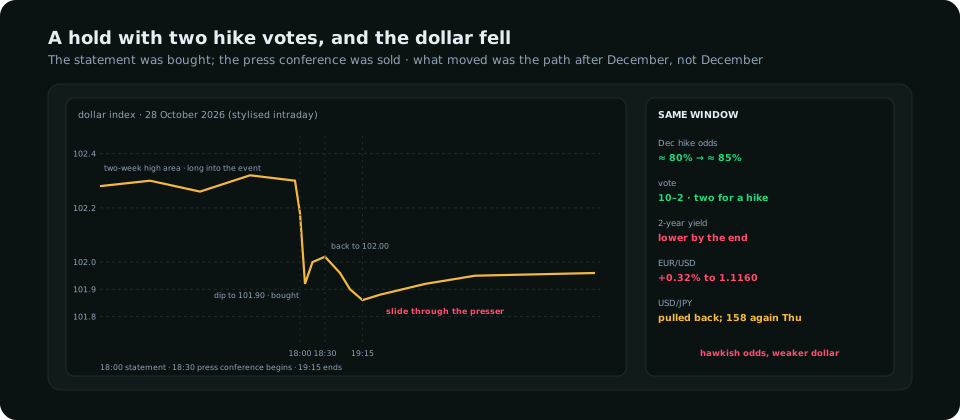
| Time (UTC) | Event | Dollar index | Note |
|---|---|---|---|
| Before 18:00 | Positioning | Near a two-week high | The market was long dollars into the decision after the 14 October high at 102.94 |
| 18:00 | Statement: hold at 3.75–4.00%, 10–2, two hike dissents | Dip to ~101.90, back to 102.00 | Hawkish on paper; the dip was the "sell the fact" reflex, quickly bought |
| 18:30–19:15 | Press conference | Steady decline | Warsh: no forward guidance, outlook uncertain, fewer meetings from 2027 |
| By the close | EUR/USD 1.1160 (+0.32%); 2-year yield lower | Below the pre-meeting level | Hike odds for December up, dollar down: the market priced the end, not the start |
| Asia, 29 October | USD/JPY back above 158.00 | Recovered part of the pullback | Dip-buyers returned; the European session has it near 102.25 |
Why hawkish news produced a weaker dollar
Three things the market heard, in descending order of importance.
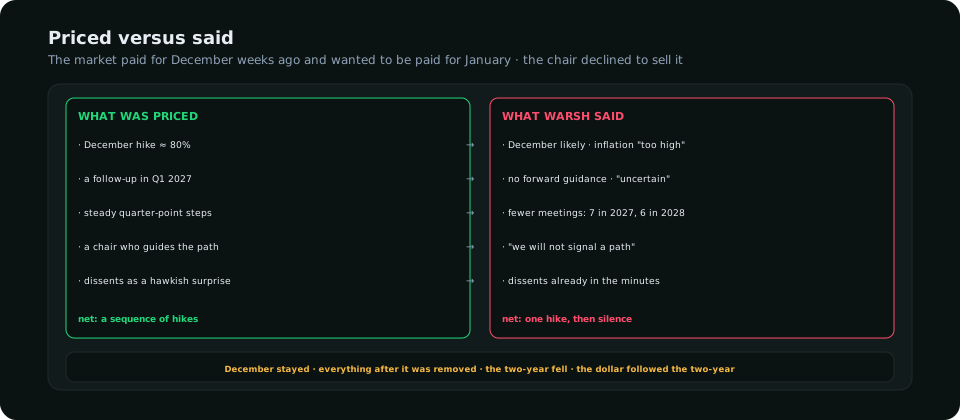
- "No forward guidance" means no January. The dollar's rally this month was built on the idea of a sequence: December, then another in the first quarter, then a third. Warsh said the committee would not be signalling a path and gave little hint about December itself. When the chair declines to guide, the market removes the moves it cannot see. December survived because the data support it; the moves after it were priced on hope, and hope was what was sold.
- Fewer meetings is a slower reaction function. Warsh announced that the committee will meet seven times in 2027 and six in 2028, down from eight. Whatever the operational logic, the market read it in one way: fewer decision points means fewer hikes per year, and a chair who wants to make policy in bigger, rarer steps rather than steady quarter-points. That is a flatter path, and a flatter path is a lower dollar.
- The dissents were already in the price. Two hike votes sound dramatic. The market had expected at least one, and the minutes had already shown that most participants saw another increase as likely. A dissent confirms what is known; it does not add to it.
Put the three together and you have a committee that is clearly going to hike in December, clearly uncomfortable with inflation at 3.7%, and clearly unwilling to tell you what happens after. For the dollar that is a ceiling, not a floor. The yields guide explains why the two-year, not the policy rate, is what the currency follows, and the two-year fell during the press conference.
What was priced versus what was said
What the dollar needs today
The GDP and PCE release at 12:30 UTC is the first chance for the data to do what the chair would not. The consensus is third-quarter growth of 3.2% annualised, up from 2.2%, and core PCE at 0.3% month on month and 3.1% year on year, up from 3.0%.
| Outcome | Reading | Dollar |
|---|---|---|
| Core PCE 0.4% m/m or 3.2% y/y | Inflation re-accelerating; a January hike comes back into the price without the Fed saying a word | Dollar index back through 102.60, EUR/USD retests 1.1110 |
| Core PCE 0.3%, GDP near 3.2% | As expected; December stays at 85% and nothing is added | Range; 102.00–102.60; the ECB at 13:15 decides EUR/USD |
| Core PCE 0.2% or GDP below 2.5% | The "caution" case gains support; December odds slip toward 70% | Dollar index tests 101.50; EUR/USD through 1.1160, USD/JPY back under 158 |
The asymmetry is worth noting. A strong print adds to the price what Warsh took out, and that is a large move because the removal was recent. A weak print confirms what Warsh implied, and that is a smaller move because the market has already half-done it. The GDP and PCE guide works through the combinations in detail.
Pairs
- EUR/USD has its own event at 13:15 UTC and is covered in today's range guide. The post-Fed high at 1.1160 is the level the dollar bears need to clear.
- USD/JPY is the cleanest expression of the dollar's rates story and the most dangerous. It is back above 158 with the Bank of Japan deciding on Friday and the intervention zone close; the yen guide covers the levels.
- GBP/USD has a Bank of England hike fully priced for 5 November and has still fallen for four days. It is the pair where the dollar story is weakest, because the UK's own rate path is steeper; today's cable guide maps it.
- Gold has been the mirror of the two-year yield for a month. A dollar that falls because the Fed's path flattens is the first genuinely good news gold has had since the pullback below $4,000.
What to read in the terminal
The macro-regime panel scores the dollar against the two-year yield, the ten-year real yield and the Fed path. The score fell yesterday evening, driven by the two-year rather than the policy rate: that is the "caution cools upside" story in one number. The Positioning dashboard shows the speculative dollar long from Tuesday's CFTC report, built up through October's rally. A crowded long into a chair who will not guide is why a hold with two hike dissents produced a lower dollar, and it is why today's data matter more than they normally would.
Frequently asked
Why did the dollar fall when the Fed was hawkish?
Because the hawkish part, a December hike, was already priced at about 80% before the meeting, and the part the market wanted, a signal about what follows December, was refused. Chair Warsh said the Fed would not give forward guidance, called the outlook uncertain and announced fewer meetings from 2027, which the market read as a flatter path. Fewer future hikes means a lower dollar even when the next one is more certain.
What did the Fed decide on 28 October 2026?
It held the federal funds target range at 3.75–4.00% in a 10–2 vote. Governor Lisa Cook and Cleveland Fed President Beth Hammack dissented in favour of a quarter-point hike. The next meeting is on 9 December, where the market prices a hike at roughly 85%.
Will the Fed raise rates in December 2026?
The market says about 85% yes, two voters already wanted it in October, and the chair said inflation is too high. A hike is the base case; the open question is whether anything follows it, and the chair deliberately did not answer that.
What does "fewer Fed meetings" mean for the dollar?
The committee will hold seven policy meetings in 2027 and six in 2028 instead of eight. Fewer scheduled decisions mean fewer opportunities to move, so the market trims the number of hikes it expects per year. All else equal that is a lower expected rate path and a weaker dollar, which is how it traded.
Everything on SMC Terminal is analysis and education, not a recommendation to buy or sell. Levels are from 28–29 October 2026 and change continuously. Trading carries a substantial risk of loss. Manage your risk.