EUR/CAD Falls to 1.5580 for a Seventh Straight Day: The Loonie's Hike, the Euro's Politics and a Rate Gap That Just Closed
EUR/CAD is trading near 1.5580 on 29 October 2026, its seventh consecutive daily decline since the slide began on 16 October, after the Bank of Canada raised its policy rate to 2.50% and the ECB prepares to hold its deposit rate at the same 2.50% at 13:15 UTC. For the first time this cycle the two rates are equal. This guide explains what has driven the cross down 300 pips in two weeks, why the ECB decision can stop the fall or extend it, the levels that matter and how oil fits into a pair that most traders ignore until it trends.
Written on 29 October 2026 in the European session, before the ECB decision at 13:15 UTC. Levels are from the daily chart.
EUR/CAD is the pair nobody writes about until it moves, and it has moved. The euro is trading near 1.5580 against the Canadian dollar on 29 October 2026, its seventh consecutive daily decline, after the Bank of Canada raised its policy rate to 2.50% yesterday and said further increases may be needed. In a few hours the ECB will, in all likelihood, hold its own deposit rate at exactly the same 2.50%. For the first time in this cycle the two central banks sit at the same number, and the cross has fallen every session since the slide began pricing that in. This guide explains what has driven the slide, why today's ECB decision is the event that either stops it or extends it, where the levels are, and how oil at $114 fits into a cross that has an exporter on one side and an importer on the other. Yesterday's Bank of Canada guide covers the loonie's half; today's ECB preview the euro's.
Seven days down
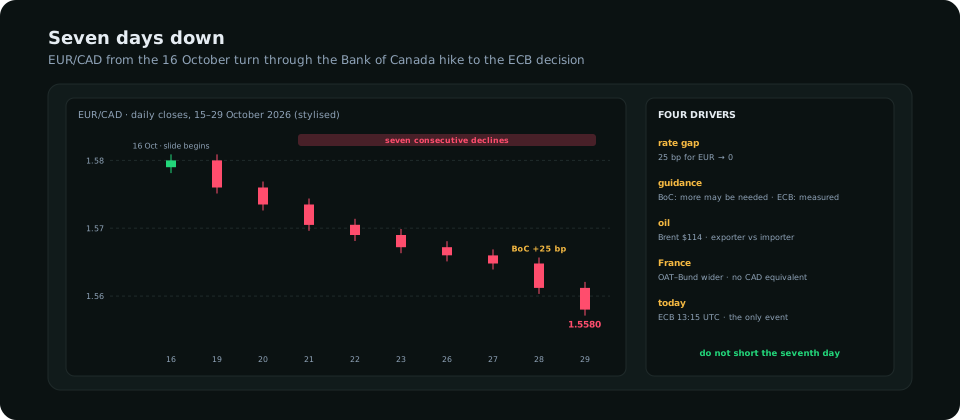
| Date | EUR/CAD | What happened |
|---|---|---|
| 16 October | The recent high | Slide begins; Canadian hike odds start to rise on the 3.1% CPI |
| 21–22 October | Lower each day | BoC hike priced near 87%; the euro hits its 2026 low against the dollar |
| 28 October, 13:45 UTC | ≈ 1.5640 before, lower after | Bank of Canada hikes 25 bp to 2.50%; Macklem says more may be needed, cautiously |
| 29 October | ≈ 1.5580 | Seventh day down; ECB expected to hold at 2.50% at 13:15 UTC |
What is driving it
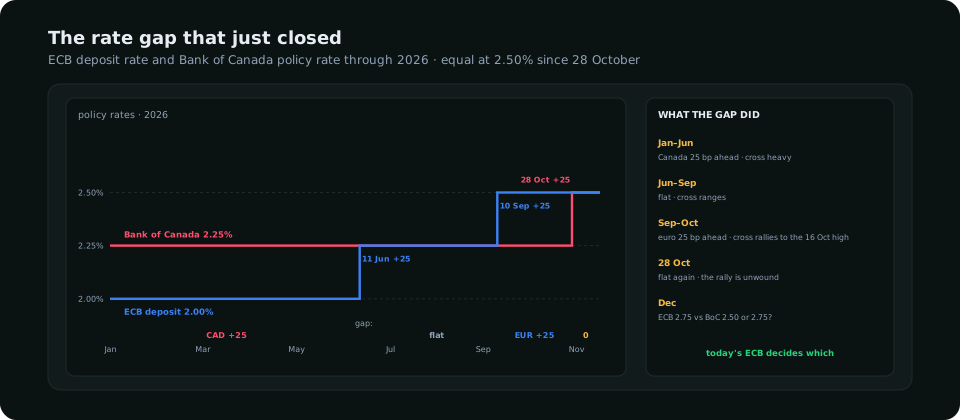
- The rate gap closed. At the start of the year the ECB deposit rate was 2.00% and the Bank of Canada's was 2.25%: Canada paid 25 basis points more. The ECB's June and September hikes took the euro 25 points ahead; yesterday's Canadian hike closed that to zero. A cross whose carry has swung from one side to the other and back to flat has no reason to hold the level it reached when the carry favoured the euro.
- Guidance diverged. Governor Macklem said further hikes may be needed. President Lagarde has described the ECB's path as a "measured response", one move a quarter at most, and the market has only 21 basis points priced for December. The Canadian path is now the steeper one.
- Oil. Canada exports it; Europe imports it. Brent at $114 is a terms-of-trade transfer from Frankfurt to Calgary every single day, and the cross is the cleanest way to trade that transfer without the Fed in the middle. The Hormuz guide covers why the oil price is where it is.
- France. Wider spreads between French and German bonds on debt and political worries weigh on the euro against everything, and Canada has no equivalent.
The levels
| Level | What it is | Read |
|---|---|---|
| 1.5700 | Round number inside the slide | The target for a genuine ECB surprise; the first level a reversal would need to reclaim |
| 1.5640 | Wednesday's level before the BoC | First resistance; a close back above it says the hike was sold too hard |
| 1.5600 | Round number | Broken on Thursday morning; the intraday pivot |
| 1.5580 | Price | Seventh day down; the RSI is approaching oversold on the daily chart |
| 1.5550 | Midpoint to the round number | The next level; a seven-day streak often ends at the first level that holds |
| 1.5500 | Round number | Where the cross traded when Canada's rate was last above the euro's |
What the ECB does to the cross
EUR/CAD has one event today and it is not Canadian. The three ECB paths, and what each does to a cross that has fallen seven days in a row:
- Firm December signal. The ECB matches the Bank of Canada's bias and the rate gap is expected to reopen in the euro's favour by December. After seven down days this is the outcome that produces the sharpest bounce: 1.5640 inside the session, 1.5700 over the following week. It is also the least likely outcome.
- "In play", no commitment. The most likely. The cross bounces on the headline because it is oversold, not because anything changed, and the bounce stalls at 1.5600–1.5640. The seventh day becomes the eighth or the streak ends with a doji; either way nothing is resolved.
- Hesitant Council. Growth and France are cited and the hiking bias is softened. The Canadian path is now clearly the steeper one, the carry argument reverses, and the cross goes through 1.5550 toward 1.5500 within days.
Whatever the outcome, the pair will also move with EUR/USD at 13:15 UTC, and today's EUR/USD range guide gives the levels there; a Canadian dollar that barely moved on its own hike will not be the active side this afternoon.
A plan
- Do not short the seventh day. A cross that has fallen seven sessions into an event is a cross where the sellers are already in. The risk-reward of a new short at 1.5580 with a stop above 1.5640 and a target at 1.5550 is poor.
- Sell the ECB bounce if it stalls under 1.5640. A rally on an "in play" statement that fails at the pre-BoC level is the with-trend entry; stop above 1.5660, target 1.5550 and then 1.5500. That is the trade the streak offers.
- Buy only on a firm signal and a close above 1.5640. Then the target is 1.5700, and the stop sits under 1.5580.
- Oil is the override. A genuine Iran headline that takes $5 off Brent is worth 50–80 pips of EUR/CAD upside on its own and would end the streak regardless of the ECB. Today's WTI guide covers the talks.
EUR/CAD's spread is two to three times EUR/USD's and widens further at 13:15 UTC. Sizing follows the risk management rules, with a stop that sits beyond the round number rather than on it.
What to read in the terminal
The Positioning dashboard shows the speculative euro and Canadian dollar positions from the CFTC report; the euro position has been cut back since the summer and the Canadian dollar short has been covered as the hike was priced, which is the cross's seven-day decline in positioning form. The intermarket panel scores the pair against Brent and the ECB–BoC two-year spread; both lines turned down on 16 October, the day the streak began. When one of them turns, the streak is over.
Frequently asked
Why is EUR/CAD falling?
The Bank of Canada raised its policy rate to 2.50% on 28 October 2026 and said more may be needed, closing the gap with the ECB's 2.50% deposit rate; oil at $114 favours Canada as an exporter over Europe as an importer; and French bond spreads have weighed on the euro. The cross has fallen seven straight sessions to 1.5580.
What did the Bank of Canada decide?
A 25-basis-point increase to 2.50%, its first hike since July 2023, with the Bank Rate at 2.75% and the deposit rate at 2.45%. Governor Macklem said further increases may be needed but policy would move cautiously. The next decision is on 9 December.
What are the key EUR/CAD levels?
Resistance at 1.5600, 1.5640 and 1.5700; support at 1.5550 and 1.5500. A close back above 1.5640 would say the Canadian hike was oversold; a close below 1.5550 extends the streak toward 1.5500.
How does the ECB decision affect EUR/CAD?
A firm signal of a December hike reopens the rate gap in the euro's favour and would produce a sharp bounce after seven down days. A non-committal hold produces a bounce that stalls at 1.5600–1.5640. A hesitant Council leaves Canada with the steeper path and the cross falls further.
Everything on SMC Terminal is analysis and education, not a recommendation to buy or sell. Levels are from the European session of 29 October 2026 and change continuously. Trading carries a substantial risk of loss. Manage your risk.