Dow Futures Up, Nasdaq Futures Down: Alphabet's 10% Drop, Microsoft's Beat and the PCE Report at 12:30 UTC Explained
Dow Jones futures are up about 0.4% near 52,890 on the morning of 29 October 2026 while Nasdaq 100 futures are down 1.2% near 29,620 and S&P 500 futures are off 0.4% near 7,750. The split is earnings: Alphabet fell about 10% after hours on a revenue miss and worries about AI spending, Microsoft rose nearly 4% on Azure growth. The September PCE report and third-quarter GDP land at 12:30 UTC with the Fed's December hike priced at 85%. This guide explains why the indices have come apart, what the inflation data do to each, the levels that matter and how the session is likely to trade.
Written in the European session of 29 October 2026, before the 12:30 UTC data and the 13:30 UTC cash open. Futures levels are from the morning.
Dow Jones futures and Nasdaq futures are pointing in opposite directions on 29 October 2026, and the gap between them is the story of the session. Dow futures are up about 0.4% near 52,890 in European trading; S&P 500 futures are down 0.4% near 7,750; Nasdaq 100 futures are down 1.2% near 29,620. The cause is earnings, not the economy. Alphabet fell roughly 10% in after-hours trading after third-quarter revenue missed across most of its core businesses and investors balked at the cost of its AI build-out; Microsoft rose nearly 4% on better-than-expected results led by Azure. One is a large weight in the Nasdaq 100 and the S&P 500 and absent from the price-weighted Dow; the other is in all three. At 12:30 UTC the September PCE inflation report and the first estimate of third-quarter GDP arrive, a day after the Fed held rates with two members voting to hike and the market pricing a December increase at 85%. Amazon and Intel report after the close. This guide explains why the indices have come apart, what the data do to each, the levels that matter and how the day is likely to trade. The Nasdaq 100 guide covers the index mechanics; this piece is today.
The split in one table
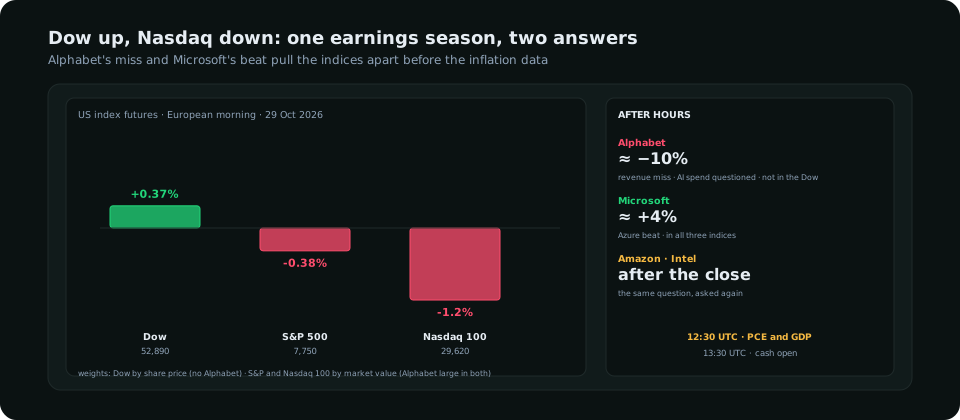
| Contract | Level | Change | Why |
|---|---|---|---|
| Dow Jones futures | ≈ 52,890 | +0.4% | Price-weighted; no Alphabet; Microsoft and the cyclicals carry it; third day up after the Fed |
| S&P 500 futures | ≈ 7,750 | −0.4% | Alphabet is one of its largest weights; Microsoft offsets part of it |
| Nasdaq 100 futures | ≈ 29,620 | −1.2% | Alphabet's weight is larger still and the AI-spending worry spreads to the group |
| Alphabet | — | ≈ −10% after hours | Revenue miss across most core businesses; capital spending questioned |
| Microsoft | — | ≈ +4% after hours | Azure growth beat; the AI spend is being paid for |
| After the close | Amazon, Intel | — | The next test of the same question |
Why the Dow is up when the Nasdaq is down
- Construction. The Dow is thirty stocks weighted by share price. Alphabet is not one of them. Microsoft is, and a 4% move in a high-priced share is worth a meaningful number of Dow points on its own. The Nasdaq 100 and the S&P 500 are weighted by market value, and Alphabet is among the largest companies in the world, so a 10% move is a drag on the whole index before any other share has traded.
- The question being asked. The market is not asking whether AI is real. It is asking whether the companies spending the most on it are being paid back, and this quarter it got one "yes" and one "not yet". The Nasdaq 100 is where that question is concentrated; the Dow's banks, industrials, health care and consumer names are not being asked it.
- The Fed. Yesterday's hold with two hike dissents and a chair who would not guide was mildly positive for equities, because it took the possibility of a faster hiking path off the table without taking December off. The S&P 500 and Dow rose for a third straight day. That tailwind is still there this morning; it is simply smaller than Alphabet.
What the PCE report does to each index
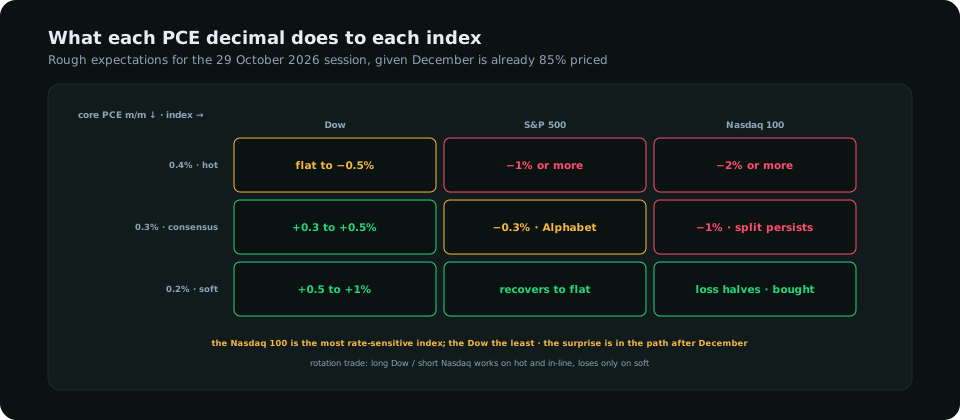
| Core PCE (m/m) | Yields, Fed | Dow | S&P 500 | Nasdaq 100 |
|---|---|---|---|---|
| 0.4% | Two-year up; January hike back in play | Gives up the gain; flat to −0.5% | −1% or more | −2% or more; the Alphabet drop becomes a sector drop |
| 0.3% (consensus) | Little change; December stays at 85% | Holds +0.3 to +0.5% | −0.3% on Alphabet alone | −1%; the split persists into the close |
| 0.2% | Two-year down; December odds slip toward 70% | +0.5 to +1% | Recovers to flat | Halves the loss; Alphabet is bought as a "rates" trade |
The pattern is the same one that has run all month: the Nasdaq 100 is the most rate-sensitive index because its valuations are the longest-dated, so it gets the biggest move from any surprise in either direction. The Dow is the least sensitive and the most sensitive to growth; a strong GDP print with in-line inflation is the Dow's best outcome and roughly neutral for the Nasdaq. The GDP and PCE guide works through the combinations, and the yields guide explains the chain from the two-year to the index.
Levels
| Index | Above | Below |
|---|---|---|
| Dow futures | 53,000, the round number just above | 52,500; 52,000 |
| S&P 500 futures | 7,800, the round number just above | 7,700; 7,650 |
| Nasdaq 100 futures | 30,000, the round number given back overnight | 29,500; 29,000 |
How the session is likely to trade
- 12:30 UTC: the data. Futures move on the core PCE line within seconds. An in-line print is a non-event and the morning's split survives; a 0.4% print turns the Nasdaq's stock-specific drop into an index-wide one.
- 13:30 UTC: the open. Alphabet prints its first cash trade and the after-hours move is either confirmed or faded in the first fifteen minutes. The S&P 500's day depends on which. The New York session guide covers how the first half-hour sets the tone.
- 13:15 UTC, in between: the ECB. European equities take their cue from Frankfurt, and a hawkish ECB is a mild negative for US futures through the dollar and yields. It is a second-order effect today.
- After the close: Amazon and Intel. Amazon is the next of the large cloud providers to report and the market will read its capital spending the same way it read Alphabet's. Whatever the cash session does, the futures will reopen the question the moment the numbers print after 20:00 UTC.
For an index trader the rotation is the trade: long Dow against short Nasdaq is the position the morning offers, and it works on an in-line or hot print and loses only on a soft one. For a forex trader the equity split matters through the yen: a Nasdaq sell-off on a hot PCE is risk-off and yen-positive, which brings the USD/JPY intervention zone into play from the other side. Size follows the risk management rules, and on an earnings-and-data day the first candle after each event is the stop-hunting range, not the trend.
What to read in the terminal
The intermarket panel scores the Nasdaq 100 against the two-year Treasury yield and the dollar; the correlation with yields has been tight all month, which is why a core PCE decimal moves the index more than a $100-billion company's earnings do. The macro-regime panel's risk score fell overnight on the Alphabet headline and will be reset by the 12:30 UTC print.
Frequently asked
Why are Dow futures up while Nasdaq futures are down?
Earnings. Alphabet fell about 10% after hours on a third-quarter revenue miss and worries about AI spending; it is a large weight in the Nasdaq 100 and the S&P 500 and is not in the Dow. Microsoft rose nearly 4% on Azure growth and is in all three indices. The result on the morning of 29 October 2026 is Dow futures +0.4%, S&P 500 futures −0.4% and Nasdaq 100 futures −1.2%.
What time is the PCE report and what is expected?
12:30 UTC on 29 October 2026, together with the advance estimate of third-quarter GDP. Consensus is core PCE 0.3% month on month and 3.1% year on year, headline PCE 0.5% on the month, and GDP growth of 3.2% annualised.
How does PCE inflation affect the stock market?
Through the Fed. A hotter core PCE print raises the chance of a January hike after December's, lifts the two-year yield and hurts long-duration growth stocks most, so the Nasdaq 100 falls more than the Dow. A softer print does the reverse. With December already priced at 85%, the surprise is in the direction after December, which is why a single decimal moves the index.
Which earnings are due after the close today?
Amazon and Intel. Amazon's cloud and capital-spending figures will be read against Alphabet's miss and Microsoft's beat, and the futures will react as soon as the numbers print after 20:00 UTC.
Everything on SMC Terminal is analysis and education, not a recommendation to buy or sell. Levels are from the European session of 29 October 2026 and change continuously. Trading carries a substantial risk of loss. Manage your risk.