New York Forex Session: How to Prepare a Structured Trading Plan
The New York session carries the day's largest ranges, its scheduled data, and the only hours when the two biggest FX centres are open at once. Here is the session's shape hour by hour, what to prepare before 07:00, the three setups it produces, and a written plan you can fill in each morning.
The New York session is where the forex day is decided. London sets the first direction; New York either confirms it with the largest volume of the day or reverses it in the only hours when both centres are open. It is also where the scheduled data lands — the 08:30 releases that move every dollar pair at once — and where gold and the indices trade their real volume. A trader with a written plan for these hours has an edge over one reacting to them; a trader without one is trading the most volatile part of the day on instinct.
This guide is the plan. For the session before it, the London session guide covers the morning; for the clock as it reads from Asia and the Gulf, the killzone article converts every window.
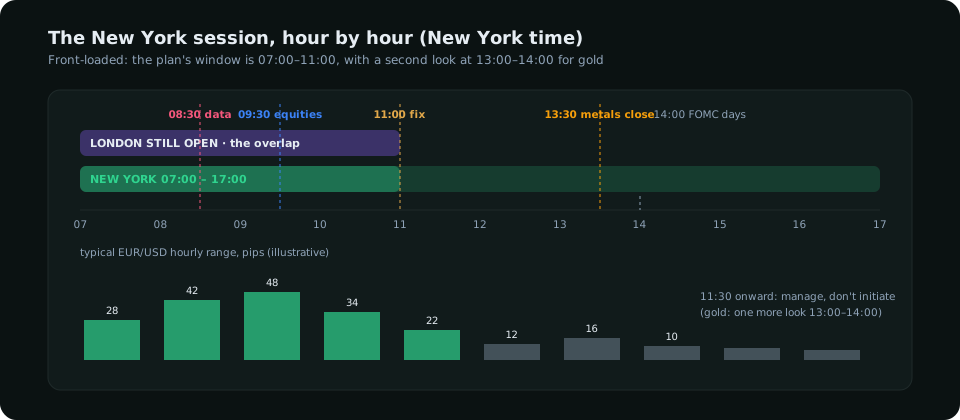
The session's shape
| New York time | What happens | For the plan |
|---|---|---|
| 07:00–08:30 | New York desks arrive while London is fully open; the overnight and London range is reassessed | Mark London's high and low; the first setups form here |
| 08:30 | The main US data window — payrolls, CPI, retail sales, claims | No entries 20 minutes either side on a red-folder day |
| 09:30 | US equities open; risk sentiment resets; gold and indices get their volume | Expect a second impulse; the 09:30–10:30 hour is often the day's largest |
| 10:00 | Secondary data (ISM, consumer sentiment, home sales) | Smaller than 08:30 but the same rule applies |
| 11:00 | The London fix; European desks close their books | Reversals of the morning move cluster here |
| 11:00–13:30 | The overlap ends; volume thins | Manage, do not initiate — unless the plan's reversal setup is live |
| 13:30 | CME metals and energy pits close; options expiries | Gold often makes a last move into the close |
| 14:00–17:00 | Afternoon drift; FOMC on decision days at 14:00 | Flat unless it is an FOMC day |
The practical consequence: the New York session for a plan is 07:00 to 11:00, with a possible second window at 13:00–14:00 for gold. Everything after is management.
What to prepare before 07:00
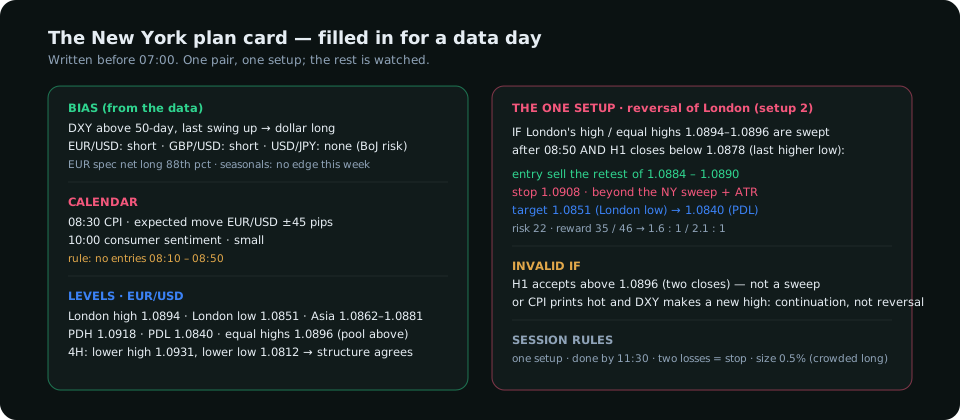
- The bias. From the data, not the chart: the dollar's direction (the DXY against its 50-day and last swing), the pair's positioning, and whether the week's seasonal and macro reads agree. Written as one word per pair: long, short, or none.
- The calendar. Every release between 08:30 and 10:00 with its expected move for the pair. A red-folder release at 08:30 restructures the whole morning; the plan has a "data day" and a "no data day" version.
- The levels. London's high and low, the Asian range, the previous day's high and low, and the nearest pool of liquidity on each side — equal highs or lows within reach. These are the places where the session's setups happen; nothing happens in between.
- The structure. The 4-hour chart's direction and its last swing; the hourly chart's position relative to it. If the two disagree, the bias is "none" for the session regardless of the data.
Ten minutes, the same ten minutes every day. The plan's quality is set here, before the first candle of the session prints.
The three setups New York produces
1. Continuation of London
London has established a direction that agrees with the bias and price is pulling back into a zone as New York opens. Entry: the pullback holds the zone and the hourly chart prints a close back in the direction — the standard retest entry. Stop: beyond the zone. Target: the next pool in the direction, usually the previous day's high or low. The highest-probability setup of the three because every participant is already leaning the same way.
2. Reversal of London
London has run a pool — the Asian high, say — against the bias, and the move has no structure behind it on the 4-hour chart. Entry: New York sweeps London's extreme by a few pips, then prints a structure shift on the hourly chart back toward the bias. Stop: beyond the New York sweep. Target: the opposite side of London's range, then the day's open. The reversal clusters around 08:30 (data gives the excuse) and 11:00 (the fix gives the flow).
3. The data retrace
A release spikes price. The spike is untradeable; the retrace is not. Entry: after fifteen minutes, if the spike has left a clean zone and the direction agrees with the bias, the retrace into the zone and a rejection. Stop: beyond the zone, sized for the widened spread. Target: the spike extreme. If the spike was against the bias, the setup is to wait for the full retrace and trade the resumption, not to fade the number.
Typical ranges, so the stops are honest
The session's hourly ranges differ by pair more than traders size for. Illustrative averages for the 08:00–11:00 hours: EUR/USD 25–35 pips, GBP/USD 35–50, USD/JPY 30–45, gold $12–20, with a red-folder 08:30 doubling the hour it lands in. A stop inside these ranges is a stop placed to be hit. The risk-reward guide covers sizing from the stop; the session's job is to make sure the stop is outside the noise the session itself generates.
Session rules that keep the plan a plan
- One pair, one setup per morning, chosen before 07:00. The others are watched, not traded.
- No entries 08:10–08:50 on a red-folder day. Spreads widen, stops are run, and the move that counts starts after the dust settles.
- Done by 11:30 unless a position is open. The best trade of the afternoon is usually the one not taken.
- Two losses, stop. The session's edge is in the first setup; the third attempt is revenge.
- The journal entry is the plan card, with the result added. Fifty cards later you know which of the three setups is yours.
The New York session rewards preparation precisely because it punishes reaction: it is fast, data-driven and crowded. A trader with the bias, the calendar, the levels and one chosen setup written down before 07:00 is doing something most participants in those hours are not, and that is where the session's edge comes from.
Everything on SMC Terminal is analysis and education, not a recommendation to buy or sell. Session times are New York local time and shift against UTC with daylight saving; ranges are illustrative. Trading carries a substantial risk of loss. Manage your risk.