WTI Slips From $103 on Iran Talk Headlines but Holds $100: Why the Peace Premium Is Worth $3 a Barrel, Not $30
WTI crude is trading near $100.80 on 29 October 2026, off Wednesday's high around $103, after reports that Vice President Vance wrote to Iran's Security Council chief to revive negotiations. President Trump said the contact was about medical supplies, Tehran's foreign minister said it remains in touch with mediators on a plan to reopen the Strait of Hormuz, and a senior Iranian official called the latest Qatari draft unacceptable. This guide explains why a talks headline is worth about $3 and a signed deal $30, what is inside the $114 Brent price, the levels that matter and which currencies move with each.
Written on 29 October 2026 during the European session. Prices are from the morning; the headlines are from reporting dated 28–29 October.
The WTI oil price today is a story about a letter. US crude is trading near $100.80 a barrel on 29 October 2026, down from a Wednesday high around $103, after reports that Vice President Vance had written to the head of Iran's Supreme National Security Council, Mohsen Rezaei, to restart negotiations. President Trump denied that the letter was about peace and said the contact concerned Iran's need for medical supplies. Iran's foreign minister said Tehran remains in close contact with mediators on a plan to reopen the Strait of Hormuz, while a senior Iranian official dismissed the latest Qatari draft as unacceptable. Brent is near $114.20. In other words: talks have been offered, nobody has accepted them, and oil fell $2 anyway. This guide explains why that is the right size for the move, what is inside the price, which levels matter from here, and which currencies trade each outcome. Yesterday's Hormuz guide covers the strait, the attacks and the Brent–WTI spread; this one is about the diplomacy and the premium.
The week in WTI
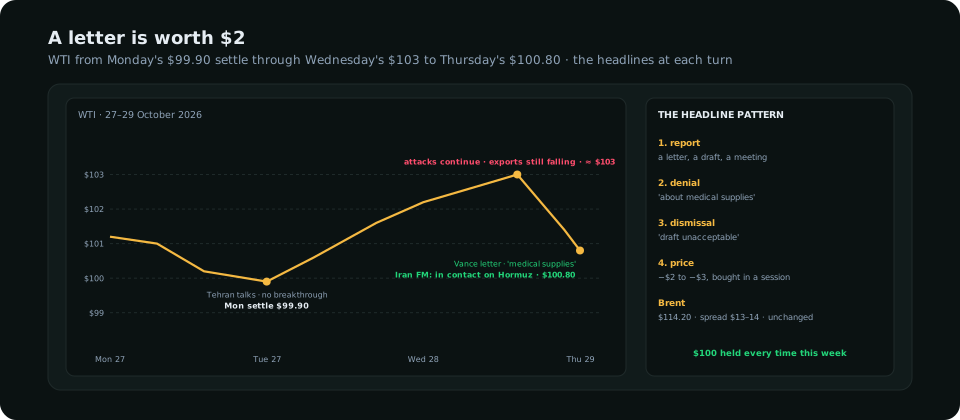
| Day | WTI | Headline | Move |
|---|---|---|---|
| Monday 27 Oct | $99.90 settle | Tehran talks (Iran, Saudi Arabia, Pakistan, Turkey) produce no breakthrough | −$1.86 on the day after a $101 Asian high |
| Tuesday–Wednesday | Up to ≈ $103 | Attacks continue; Houthi strikes; Gulf exports still falling | +$3 as the Monday dip is bought |
| Thursday 29 Oct | ≈ $100.80 | Vance letter reported; Trump says medical supplies; Iran FM in contact with mediators on Hormuz plan | −$2 from the high, holding $100 |
| Brent | ≈ $114.20 | Same headlines | Spread to WTI still $13–14 |
What is inside $114
To know how far oil can fall on good news you have to know what the price is made of. A rough decomposition, which the market more or less agrees on, has three layers.
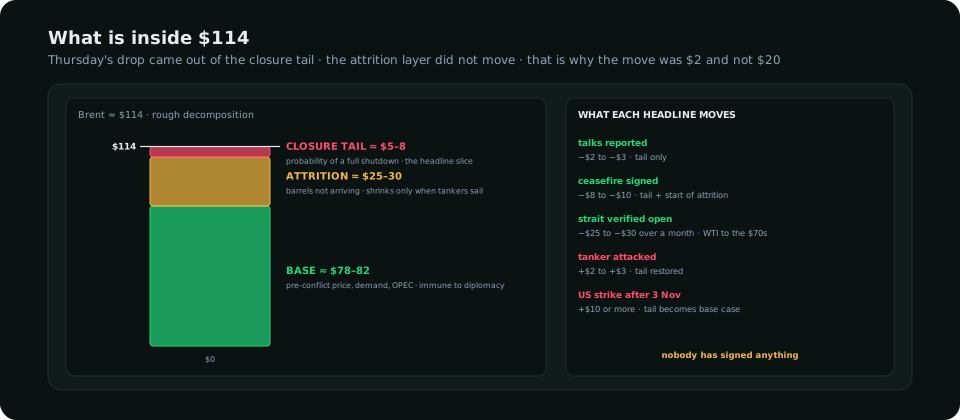
- The base, roughly $78–82. Where Brent traded before the conflict, adjusted for demand and OPEC policy since. This layer does not move on diplomacy.
- The attrition premium, roughly $25–30. The price of the barrels that are not arriving: Gulf exports down for four consecutive weeks and counting, strait transits near 60% of normal, the Saudi bypass pipeline hit. This layer only shrinks when tankers actually sail, which requires a ceasefire that holds, escorts that work and insurers who return. It is weeks of good news, not one letter.
- The closure tail, roughly $5–8. The market's price for the probability that the strait is shut entirely. This is the headline-sensitive slice. A talks report trims it; an attack restores it.
Thursday's $2 drop came out of the tail. That is why the move was $2 and not $20, and why "oil eases on peace hopes" and "oil remains above $100" are the same sentence: the hope is real and it is small. A signed, verified reopening of the strait would take $25–30 out of the attrition layer over a month and bring WTI into the $70s. Nobody has signed anything.
The levels
| WTI | What it is | Read |
|---|---|---|
| $103.00 | Wednesday's high | Above it the letter is forgotten and the attack count is back in charge; $105 next |
| $101.40–101.90 | Thursday's European range | Where the market sits while it decides whether the letter means anything |
| $100.00 | The round number | Options strikes and headlines; swept both ways three times this week |
| $99.60–99.90 | Monday's settle and the technical support flagged on Thursday | The level that has to hold for the bulls; a daily close below it is the first real crack |
| $96 | Early October consolidation | Where a genuine ceasefire headline would take it in a session |
The calendar risk
One date frames the next week. The US midterm elections are on 3 November, and there is open talk of US military action against Iran after them; the market cannot price that and does not try to, which is why the closure tail is only $5–8 and not $20. Until then, every headline from Doha, Islamabad or Tehran is a $2–3 move, and the Thursday pattern of a diplomatic report followed by a denial and a dismissal is the template. Trade the levels and let the headlines come to you.
The forex read
- USD/CAD. Oil down is loonie down, but the Bank of Canada hiked yesterday and said more may be needed, so the pair has two forces this week. A talks headline that takes $3 off oil is worth about 40 pips of USD/CAD upside; a signed deal would be worth 150, and the BoC's hike would not stop it. Yesterday's BoC guide covers the levels.
- USD/JPY. Japan imports almost all its oil; a peace headline is yen-positive and oil at $114 is part of why the pair is at 158 rather than 152. With the Bank of Japan deciding on Friday and intervention near, this is the pair most sensitive to a genuine de-escalation.
- EUR/USD and GBP/USD. Europe is the importer that hurts most. A falling oil price is a quiet euro-positive, which matters today with the ECB at 13:15 UTC; see the EUR/USD range guide.
- Gold. The relationship has broken this month; gold fell with oil up because real yields rose. A peace headline that lowers oil and inflation expectations lowers the Fed path and is, strangely, gold-positive. The gold pullback guide explains the chain.
Whatever the pair, the size of the stop is set by the headline, not the chart. The risk management guide covers the arithmetic for a market where $3 arrives in a minute.
What to read in the terminal
The intermarket panel scores WTI against Brent, the dollar and the commodity currencies. The Brent–WTI divergence line is the attrition premium in real time: it did not narrow on Thursday's letter, which tells you the market moved the tail and left the attrition layer alone. The Positioning dashboard shows the speculative crude long, crowded since September; a crowded long is why diplomatic headlines produce $3 drops rather than $1, and why they are bought within a session when nothing follows.
Frequently asked
Why did oil fall today?
Reports that Vice President Vance wrote to Iran's Security Council chief to revive negotiations, and a statement from Iran's foreign minister that Tehran is in contact with mediators on a plan to reopen the Strait of Hormuz. WTI fell from about $103 to $100.80. President Trump said the letter concerned medical supplies and an Iranian official called the latest draft unacceptable, which is why the drop was limited.
Is WTI still above $100?
Yes, near $100.80 in the European session on 29 October 2026, with Brent near $114.20. The $99.60–99.90 area, Monday's settle, is the support that has to hold.
How far would oil fall if the US and Iran reached a deal?
A verified reopening of the strait, with tankers sailing and insurers back, would remove most of the $25–30 attrition premium over about a month and bring WTI into the $70s. A headline about talks removes only part of the $5–8 closure tail, which is why Thursday's move was $2.
What dates matter for oil next week?
The US midterm elections on 3 November, after which there is open discussion of US military action against Iran. That is unpriceable, which is why the market trades the levels between headlines.
Everything on SMC Terminal is analysis and education, not a recommendation to buy or sell. Prices are from the European session of 29 October 2026 and change continuously. Trading carries a substantial risk of loss. Manage your risk.