Prop Firms: How to Choose the Best Forex Prop Firms, Pass a Challenge and Understand Futures Prop Firms
A prop firm sells an evaluation: hit a profit target without breaching a drawdown limit and trade a funded account for a profit split. This guide explains how the model works, the five rules that decide whether a firm is worth paying, the arithmetic that makes most challenges fail (the daily drawdown, not the profit target), a sizing plan built to pass, and how futures prop firms differ from forex ones.
A prop firm, in the retail sense the term has taken on, sells an evaluation: pay a fee, trade a simulated account to a profit target without breaching a drawdown limit, and receive a funded account whose profits are split, typically 80% to the trader. The appeal is obvious, trading a 100,000-dollar account for a few hundred dollars of risk, and so is the business model: most traders fail the evaluation and the fees are the firm's revenue. Neither fact makes prop firms a scam, and neither makes them a shortcut. This guide covers how the model works, how to judge the best forex prop firms against each other, the arithmetic that fails most challenges, a plan built to pass, and how futures prop firms differ.
How the model works
| Stage | What happens | Typical terms |
|---|---|---|
| Evaluation (phase 1) | Simulated account; hit a profit target within the rules | 8–10% target; 5% daily loss limit; 10% overall drawdown; no or 30-day time limit |
| Verification (phase 2) | A second, easier round to confirm consistency | 5% target; same limits |
| Funded | A live or simulated account the firm pays out from | Same drawdown rules; payouts every 14–30 days; 80–90% split |
| Scaling | Account size increases after consistent profitable periods | +25% every 3–4 months of profit, to a cap |
Two things are worth knowing before paying. Most "funded" accounts remain simulated: the firm pays the trader's share from its own revenue and may or may not copy the trades to a real market. That is legal and disclosed in the terms, and it means the firm's solvency depends on its fee income exceeding its payouts, which is why payout track record is the first thing to check. And the fee is the trader's real risk: a 500-dollar fee for a 100,000-dollar evaluation with a 10% drawdown limit is, economically, a 500-dollar option on 10,000 dollars of simulated loss capacity. Treat it as a cost of doing business, not as "only 500 dollars".
Choosing a firm: five rules
- Drawdown type. A static overall drawdown (measured from the starting balance) is far easier to trade than a trailing one (measured from the highest equity, including open profit). Trailing drawdowns that follow equity in real time punish any trade that moves in your favour and comes back; prefer static, or trailing on closed balance only.
- Payout record. Public, verifiable, regular payouts over at least two years. A firm younger than that, or one whose payout proof is screenshots on its own site, is a firm whose fee you may not see a return on.
- Rules on news, weekends and holding. Some firms forbid trades two minutes either side of red releases, forbid holding over the weekend, or forbid holding overnight at all. Each one removes a strategy. Read the rules against yours before paying, not after a breach.
- Consistency rules. Some firms require that no single day exceeds a share (often 30–40%) of total profit, or cap lot sizes. These are fine for a trader with a steady strategy and fatal for one who makes the month in two trades.
- Price versus terms. The cheapest evaluation usually has the tightest drawdown or the most rules. A fee 30% higher for a static drawdown and no news rule is worth it.
Firms change terms often and the ranking changes with them, which is why this guide gives the rules rather than a list of names. Any current list is out of date within a quarter.
Why most challenges fail: the daily drawdown
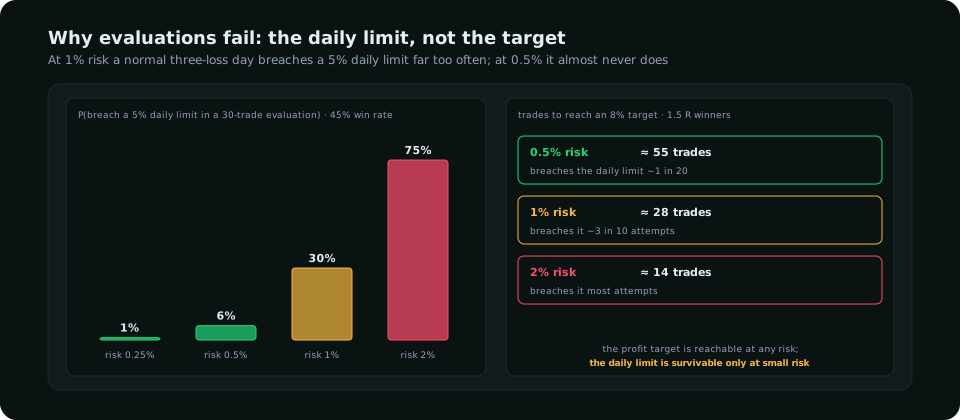
An 8% profit target sounds hard and a 5% daily loss limit sounds generous; it is the other way round. Three losses in a day at 1% risk is 3%, and with the overnight floating loss some firms count, a fourth trade or a gap takes it to 5%. Over a thirty-trade evaluation, a strategy with a 45% win rate at 1% risk breaches a 5% daily limit around 30% of the time; at 2% risk, most of the time. At 0.5% risk, the breach probability falls to a few percent and the target is still reachable in fifty to sixty trades. The drawdown guide works through the same arithmetic for a personal account; the prop firm version is harsher because the limit is a hard stop, not a number to recover from.
A plan built to pass
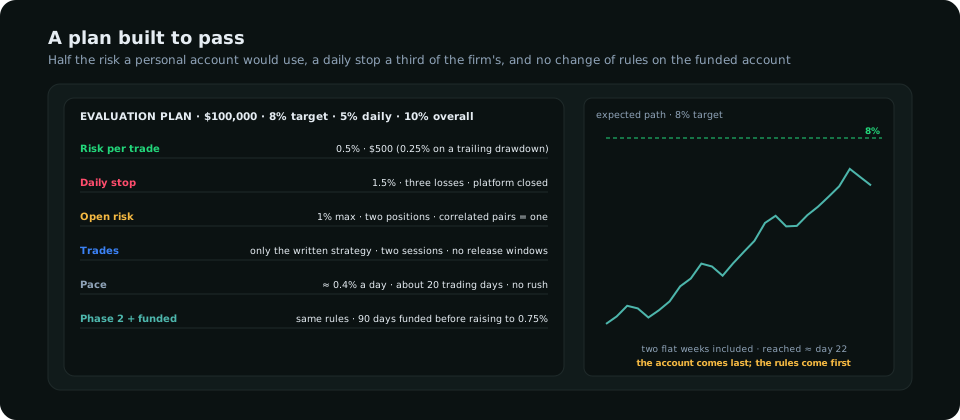
- Risk per trade 0.5% (0.25% for a trailing-drawdown firm). The risk per trade guide explains why the limit and the win rate set the number, not the target.
- Daily stop at 1.5%: three losses and the platform closes. The firm's 5% is the wall; your limit is where you stop before reaching it.
- Open risk capped at 1% across all positions, with correlated pairs counted as one.
- Only the written strategy, in its sessions, with its filters. The evaluation is not the place to try a new setup, and the fee is the tuition if you do.
- No time pressure. Choose a firm without a time limit or with a generous one; a trader who needs 8% in two weeks is a trader who will raise risk in week two.
- Phase 2 and funded: the same rules. The trader who passes at 0.5% and then trades the funded account at 2% is the trader the firm's model is built around.
At 0.5% risk, a 45% win rate and 1.5 R average winners, the expectancy is about 0.12% of the account per trade; 8% takes roughly sixty to seventy trades, which at three a day is about a month. That is slower than the marketing suggests and it is the pace that passes. The expectancy guide covers how to know your own numbers before paying a fee against them.
Futures prop firms
Futures prop firms run the same model on CME futures (the E-mini and micro indices, crude, gold, the currency futures) instead of spot forex CFDs, and four things differ. The drawdown is almost always trailing on unrealised equity, which is the hardest version and the main reason futures evaluations fail. Size is in contracts, with a maximum (say, five minis or fifty micros), so the position-size rule is in contracts per trade and the risk per trade follows from the stop in ticks. Market data is real exchange data with a monthly fee the trader usually pays. And there is no weekend gap risk on the account because the firms require flat positions at the session close. The trading edge is the same; the sizing arithmetic has to be redone in ticks and contracts, and the trailing drawdown argues for even smaller risk, around 0.25% per trade, until the drawdown has locked in at the starting balance. The lot size guide covers the forex conversion; for futures, risk in dollars equals contracts times ticks times tick value.
What a prop firm cannot do
It cannot supply an edge. A trader without a tested, positive-expectancy strategy fails evaluations at the same rate they would lose a personal account, and pays a fee each time. The evaluation is a test of discipline under a drawdown rule, which is a useful test; it is not a source of capital for someone who has not yet shown they can keep it. The right order is: a hundred logged trades with positive expectancy on a small personal account or a demo kept to live rules, then the cheapest evaluation whose rules fit the strategy, then the plan above. The backtesting guide is where that order starts.
Frequently asked
Are prop firms legit?
The established ones pay out as promised and disclose that funded accounts are usually simulated. The risk is the fee, which is lost on a failed evaluation, and the counterparty risk that a young firm stops paying. Check the payout record and read the terms.
What is the easiest prop firm challenge to pass?
One with a static drawdown, no time limit, no news rules that conflict with your strategy, and a daily limit you treat as a wall you never approach. The firm's name matters less than those terms.
How much should I risk per trade in a prop firm challenge?
About 0.5% of the account on a static-drawdown evaluation and 0.25% on a trailing one. The daily loss limit, not the profit target, is what decides the outcome, and it is survivable only at small risk.
Everything on SMC Terminal is analysis and education, not a recommendation to buy or sell, or to use any particular firm. Figures in the example are illustrative. Trading carries a substantial risk of loss. Manage your risk.