Gold Day Trading: Building an Intraday Plan for XAUUSD
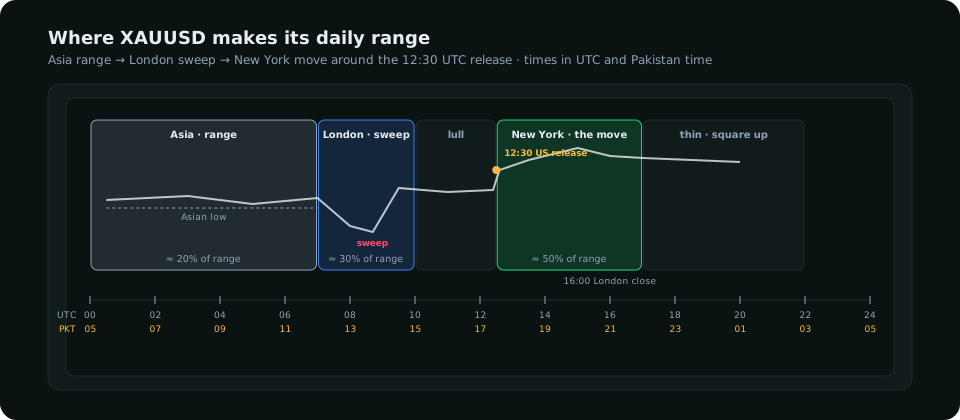
A gold day trading strategy has to respect how XAUUSD actually moves: a quiet Asian range, a London sweep of it, and a New York session that delivers most of the day's distance, often around a US release. This guide builds the intraday plan around that rhythm: the pre-session bias, the levels to mark, the two setups worth taking, stop and target rules in dollars and ATR, and the hours to leave alone.
A gold day trading strategy that works on EUR/USD does not transfer unchanged to XAUUSD. Gold moves two to three times as far in a day, it reacts to US yields and the dollar within seconds of a release, and its intraday rhythm is unusually consistent: a narrow Asian range, a London-open sweep of one side of it, and a New York session that travels most of the day's distance. A plan built around that rhythm needs the bias settled before London, the levels marked before the sweep, and the trade taken in the window where the move actually happens. This guide builds that plan step by step, in dollars and ATR so the numbers scale when volatility changes.
The session rhythm
| Window (UTC / PKT) | Behaviour | Role in the plan |
|---|---|---|
| 00:00–07:00 / 05:00–12:00 | Narrow range; Shanghai fix influence | Defines the Asian high and low, the day's first liquidity |
| 07:00–10:00 / 12:00–15:00 | London open; a sweep of the Asian range, then reversal or expansion | Setup 1 window |
| 10:00–12:30 / 15:00–17:30 | Lull; London lunch | No new entries; manage |
| 12:30–17:00 / 17:30–22:00 | New York; US data at 12:30, the largest moves, the 15:00 options expiry effect, London close at 16:00 | Setup 2 window; the main event |
| 17:00–22:00 / 22:00–03:00 | Thin; positions square | Flat by 20:00 UTC |
The killzone guide has these windows on a session clock for Gulf and Pakistan time, which matter for gold since much of its retail trade comes from those zones.
Before London: the bias
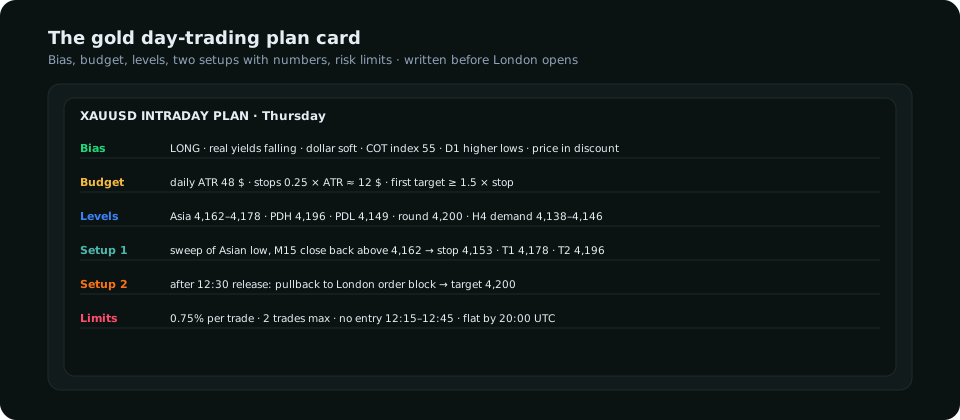
Three reads, done once, before 07:00 UTC. The 10-year real yield and the dollar index over the past week: both falling is a tailwind for gold, both rising a headwind, and the pair fighting (yields up, dollar down) means a two-way day. The weekly COT read: speculators crowded long (COT index above 80) makes the long side fragile on any rally into supply, mid-range leaves room both ways. And the daily structure: the direction of the last daily break and whether price is in the premium or discount half of the daily range. Combine them into one line, for example "bias long: real yields falling, dollar soft, COT 55, daily higher lows, price in discount". The gold technical analysis guide covers the structure read; the XAUUSD strategy article sets the weekly frame this daily plan sits inside.
Levels to mark each morning
- Asian high and low, the day's first liquidity pools.
- Previous day's high and low and the previous week's extremes if within a day's range.
- Round numbers at 50-dollar increments; gold respects them more than most markets because options are struck there.
- The nearest four-hour supply and demand zones in the bias direction and against it.
- The daily ATR (14-period): the budget for the day. If it is 45 dollars, a plan that needs 70 dollars of movement is a plan for a different day.
Setup 1: the London sweep and reversal
Between 07:00 and 09:00 UTC, price takes out the Asian high or low, usually the side against the bias, and then closes back inside the range on the fifteen-minute chart with a displacement candle. Entry on that close or its retest. Stop beyond the sweep's extreme plus 0.1 × daily ATR. First target the opposite side of the Asian range; second target the previous day's extreme in the bias direction. The sweep with the bias (Asian low taken on a bias-long day) is the higher-probability version; a sweep against the bias (Asian high taken on a bias-long day) is a smaller, faster trade back to the range's midpoint. If London opens and simply expands through the range without a sweep, there is no setup 1; wait for New York.
Setup 2: the New York continuation or reversal
From 12:30 UTC, gold's biggest moves cluster around US data. The rule is to never hold a new position into a 12:30 release, and to plan the trade for after it. Two shapes recur. Continuation: London established a direction, the release confirms it, and price pulls back to the four-hour zone or the fifteen-minute order block that started the London move; enter on the lower-timeframe break of structure out of the pullback, stop beyond the zone, target the next liquidity pool, often the previous week's extreme. Reversal: the release reverses London's move with displacement; the London extreme becomes the sweep, and the trade is the same reclaim logic as setup 1 in the other direction. The 15:00 UTC window, when options expire and the London fix approaches, frequently produces the day's final push; the 16:00 London close often marks its end.
The plan card
Stops, targets and size in dollars
Gold's tick is 0.01 and a standard lot is 100 ounces, so one dollar of movement is 100 dollars per lot. Stops that are sensible in pips on a currency pair are far too tight here. Express every distance as a fraction of the daily ATR: stops of 0.2–0.3 × ATR (around 10–15 dollars on a 48-dollar ATR day), first targets of at least 1.5 × the stop, second targets at the next liquidity. Then convert the stop into lots from the account risk: 0.75% of a 20,000-dollar account is 150 dollars; with a 12-dollar stop that is 0.125 lots. The stop placement and ATR guides cover the mechanics; the discipline is to never widen a stop because gold "always comes back". It does, until the day it does not.
What to leave alone
- FOMC days until the statement and press conference are over; the first move is reversed more often than not.
- The lull from 10:00 to 12:30 UTC; moves started there rarely carry.
- A day that has already travelled its ATR by the New York open; the remaining distance is small and the reversal risk is high.
- Friday afternoons after the London close, when positioning squares into the weekend.
- A third trade. Two attempts a day. If both lose, the read was wrong, and the fix is tomorrow's analysis, not a third attempt today.
Frequently asked
What is the best time to day trade gold?
The London open (07:00–09:00 UTC) and the New York session from 12:30 to 16:00 UTC. Together they produce most of the day's range; the hours between and after are for managing, not entering.
How much does gold move in a day?
The 14-day ATR, typically 1–1.5% of price, which is 40–60 dollars at a 4,000-dollar gold price. Check it every morning; the plan's stop and target distances scale with it.
Can I day trade gold with a small account?
Yes, with micro lots (0.01 lots is one ounce, so one dollar of movement is one dollar). The sizing rule is the same: account risk divided by the stop in dollars gives the ounces.
Everything on SMC Terminal is analysis and education, not a recommendation to buy or sell. Figures in the example are illustrative. Trading carries a substantial risk of loss. Manage your risk.