How to Determine XAUUSD Daily Bias Before the Trading Session
An XAUUSD daily bias is a one-word answer, long, short or neutral, reached before the session from inputs that do not depend on the session's own candles: the previous day's structure, real yields and the dollar, positioning, and the calendar. This guide builds it as a scorecard you can fill in ten minutes, explains what each input contributes, and shows what to do when the inputs disagree, which is most days.
The XAUUSD daily bias is the single decision that makes a gold day trade survivable: before the session opens, is today a day to buy dips, sell rallies, or stand aside? Taken after the session starts it is contaminated by the candles you are about to trade; taken from a feeling it is a guess with a vocabulary. Taken from five inputs that each exist before the open, it is a repeatable ten-minute routine that most days produces a clear answer and, on the days it does not, tells you so. This guide builds the scorecard, explains what each input contributes, and sets out how the bias then shapes the London and New York plans.
The five inputs
| Input | Read before the open | Long if | Short if | Weight |
|---|---|---|---|---|
| Daily structure | Last three swings; the previous day's close vs the last swing | Higher highs and higher lows intact | Lower highs and lower lows intact | 2 |
| Previous day | Range, close location, whether a prior-day extreme was swept | Close in the top third; prior low swept and reclaimed | Close in the bottom third; prior high swept and rejected | 1 |
| Real yields & dollar | 10-year real yield and DXY, 5-day change | Both falling | Both rising | 2 |
| Positioning | Speculative COT index and weekly change | Mid-range or washed out, adding | Crowded above 85, stalling or reducing | 1 |
| Calendar | Red USD releases today; FOMC | A red release in the session halves the score's confidence; FOMC day is neutral until the statement | gate | |
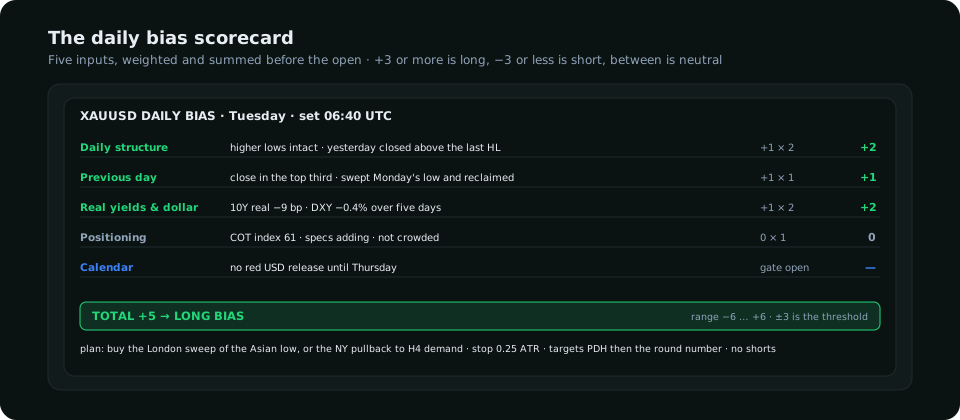
Score each input +1 for long, −1 for short, 0 for neutral, multiply by its weight, and sum. The range is −6 to +6. A total of +3 or more is a long bias, −3 or less a short bias, and anything between is neutral: a day to trade only the London sweep for a small target, or not at all. The weights reflect what has actually driven gold intraday: structure and the macro pair carry it, the previous day refines it, positioning warns about crowding.
Input by input
Daily structure
Read from the daily candles only, as in the gold technical analysis guide: the last three swing highs and lows, and whether yesterday's close broke any of them. Gold trends cleanly on the daily chart and the swing read is right more often than any other single input. A structure that broke yesterday (a close below the last higher low) does not just flip the score; it resets it, because the first day after a break is usually a retest, not a continuation.
The previous day
Three facts: where the close sat in the day's range (top third is bullish, bottom third bearish, middle neutral), whether the day swept a prior day's high or low and reclaimed it (a sweep-and-reclaim of the low is bullish, of the high bearish), and the range relative to the ATR (a day that travelled twice its ATR is usually followed by a quieter one, which lowers the target, not the bias).
Real yields and the dollar
Gold's macro driver is the 10-year real yield, with the dollar as the second. Take each one's five-day change: both down is +1 × 2, both up −1 × 2, mixed 0. The real yields guide explains why the real component and not the headline yield is the input, and why this input has been less reliable since 2022; if gold has been ignoring a rising real yield for a fortnight, weight it 1 instead of 2.
Positioning
From Friday's COT report: the speculative net's COT index and its weekly change. This input is asymmetric. Mid-range positioning is mildly bullish in an uptrend because there is room; crowded positioning (index above 85) does not flip the bias to short but subtracts a point, since the long side is fragile into any rally. Washed-out positioning after a fall (index below 20) adds a point to a long read. The dollar and gold article covers the case where positioning in the dollar itself is the cleaner read.
The calendar
Not a score but a gate. A red USD release at 12:30 UTC means no new entries from 12:15 to 12:45 and a plan for the post-release trade rather than the pre-release one. FOMC day is neutral until the statement whatever the score says; the first move after the statement is reversed more often than it extends.
The scorecard
When the inputs disagree
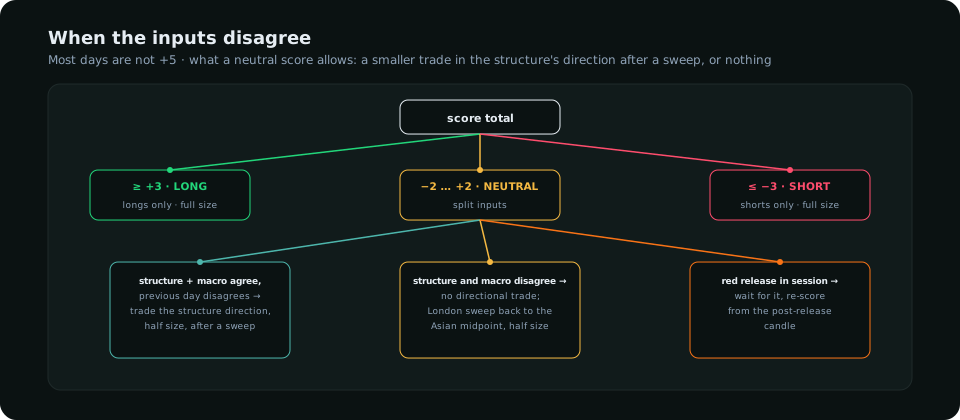
A score between −2 and +2 is the common case, and it does not mean "no opinion"; it means the inputs are split and the trade has to be smaller and shorter. The rule that resolves most splits: when structure and the macro pair agree, trade their direction at half size and only after a sweep; when they disagree, the day is two-way and the only trade is the London reversal back to the Asian range's midpoint. A trader who takes full-size directional trades on neutral days is using the scorecard as decoration.
How the bias shapes the session
With a long bias, the London plan is to buy the sweep of the Asian low (not to sell the sweep of the Asian high), and the New York plan is to buy the pullback to the four-hour demand zone after the 12:30 release, with targets at the previous day's high and the next round number. With a short bias, the mirror. With neutral, the London sweep is traded in either direction back to the midpoint, at half size, and New York is left alone unless the release produces a displacement that re-scores the day. The gold day trading guide has the session plan in full; the bias is its first line. On SMC Terminal the structure, macro and positioning inputs are composed into the pair's bias automatically, and the AI chart read states its own bias and confidence from the same inputs four times a day, so the scorecard's inputs are on one screen before London.
Frequently asked
What time should I set the XAUUSD daily bias?
After the daily close (21:00 UTC) or before the London open (07:00 UTC), using only inputs that exist by then. Setting it mid-session from the session's own candles defeats the purpose.
Can the daily bias change during the day?
Only on a structural event: a daily-timeframe level breaking with displacement, or a release that moves real yields sharply. A few hourly candles against the bias are the pullback the bias expects, not a reason to flip.
How accurate is a daily bias?
On strong-score days (±3 or more) the direction of the day's close matches the bias well over half the time, and more importantly the trades taken with it have a structural reason to work. On neutral days the bias is right about as often as a coin, which is why the tree limits what those days allow.
Everything on SMC Terminal is analysis and education, not a recommendation to buy or sell. Figures in the example are illustrative. Trading carries a substantial risk of loss. Manage your risk.