Forex Lot Size Calculator: Convert Account Risk Into Trade Size
A lot size calculator answers one question — how many lots does this trade get — from three inputs: the account, the risk you accept, and the stop. This guide gives the formula, a conversion table between standard, mini and micro lots and units, worked examples for USD pairs, yen pairs, crosses and gold, the rounding and broker rules, and a one-line check you can do in your head.
Every forex platform asks for a lot size on the order ticket, and most beginners type a round number. A lot size calculator replaces the guess with arithmetic: given how much you are willing to lose and how far away the stop is, there is exactly one size that fits. This guide is that arithmetic, laid out so you can run it by hand, check any online calculator against it, and never again discover after the fact that "0.5 lots" was 8% of the account.
The formula
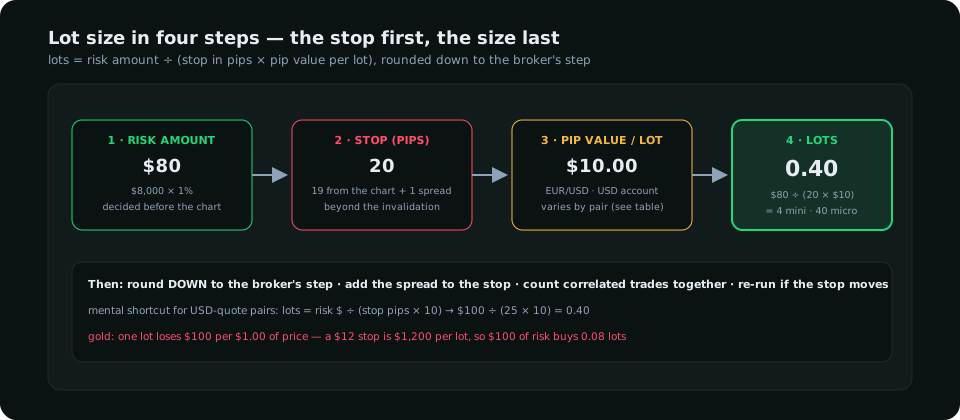
Lots = risk amount ÷ (stop in pips × pip value per standard lot)
| Input | Where it comes from | Example |
|---|---|---|
| Risk amount | Account balance × the percentage you risk per trade (decided in advance) | $8,000 × 1% = $80 |
| Stop in pips | The chart — beyond the invalidation, with ATR room — plus the spread | 19 pips + 1 pip spread = 20 |
| Pip value per standard lot | The pair and your account currency (table below) | EUR/USD, USD account: $10 |
| Lots | $80 ÷ (20 × $10) | 0.40 lots |
Lot conversions
| Name | Lots | Units of base currency | Pip value, USD-quote pair |
|---|---|---|---|
| Standard | 1.00 | 100,000 | $10.00 |
| Mini | 0.10 | 10,000 | $1.00 |
| Micro | 0.01 | 1,000 | $0.10 |
| Nano (some brokers) | 0.001 | 100 | $0.01 |
So 0.40 lots is 4 mini lots, 40 micro lots, 40,000 units — the same position expressed four ways. Brokers usually accept sizes in steps of 0.01; some accept 0.001. The calculator's output is rounded down to the nearest step, never up.
Pip value by pair type
The pip value is the only input that varies with the instrument, and getting it wrong is the common way a calculator gives a wrong answer.
| Pair type (USD account) | Pip value per standard lot | Example |
|---|---|---|
| USD is the quote (EUR/USD, GBP/USD, AUD/USD, NZD/USD) | $10.00, fixed | — |
| USD is the base (USD/JPY, USD/CAD, USD/CHF) | Pip in quote currency ÷ the pair's rate | USD/JPY at 150.00: ¥1,000 ÷ 150 = $6.67 |
| Cross (EUR/GBP, GBP/JPY, EUR/AUD) | Pip in quote currency × quote-to-USD rate | EUR/GBP: £10 × 1.27 (GBP/USD) = $12.70 |
| Gold (XAU/USD) | $100 per $1.00 of price (100-oz lot); a $0.10 move = $10 | $12 stop = $1,200 per lot |
| Index CFD | Per the broker's contract: often $1 per point per contract | 22-point stop = $22 per contract |
Gold is the one that hurts. A trader who sizes XAU/USD like a currency pair — 0.5 lots with a $12 stop — is risking $600, not the $100 they intended. The position size guide covers the gold and index cases in more depth.
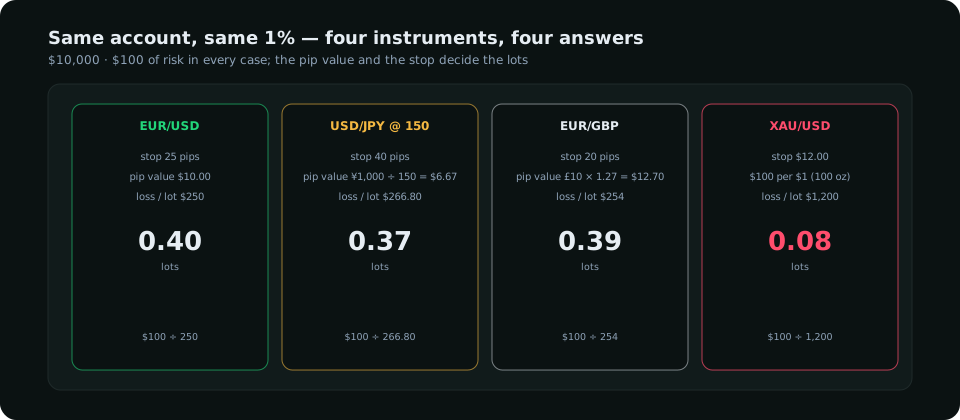
Worked examples ($10,000 account, 1% = $100 risk)
| Trade | Stop | Pip / point value per lot | Loss per lot | Lots (rounded down) |
|---|---|---|---|---|
| EUR/USD long | 25 pips | $10.00 | $250 | 0.40 |
| USD/JPY short at 150.00 | 40 pips | $6.67 | $266.80 | 0.37 |
| EUR/GBP long (GBP/USD 1.27) | 20 pips | $12.70 | $254 | 0.39 |
| XAU/USD long | $12.00 | $100 per $1 | $1,200 | 0.08 |
| GBP/USD long, 0.5% risk | 60 pips | $10.00 | $600 | 0.08 |
The mental shortcut
For any USD-quote pair, lots = risk in dollars ÷ (stop in pips × 10). Risk $100 with a 25-pip stop → 100 ÷ 250 = 0.4 lots. Risk $50 with a 40-pip stop → 50 ÷ 400 = 0.125 → 0.12 lots. It takes five seconds and catches a mis-typed order before it is sent. For yen pairs and crosses, use the calculator; for gold, remember that one lot loses $100 per dollar of price.
Rules that make the number real
- Stop first, size last. A stop placed to suit a size you already chose is in the wrong place.
- Add the spread to the stop distance. On short stops it is a large share of the risk.
- Round down, always. 0.125 is 0.12, not 0.13.
- Count correlated positions together. Three 1% longs against the dollar are one 3% position.
- Re-run it if the stop moves. Widening a stop without cutting the size doubles the risk silently.
- Ignore leverage. It tells you the maximum you can buy, which is never the question.
Choosing the risk percentage
The formula works for any percentage; survival depends on which. Ten losses in a row at 1% leaves 90% of the account; at 5% it leaves 60%, and recovering from that needs a 67% gain. For a method that is still being proven, 0.5% per trade is sensible; 1% is the common ceiling for discretionary trading; 2% is for a strategy with a long, documented record. The risk management guide has the full drawdown table.
Checklist on the order ticket
- Risk amount decided before the chart was opened
- Stop beyond the invalidation, in pips, spread included
- Pip value for this pair in my account currency, today
- Lots = risk ÷ (stop × pip value), rounded down to the broker's step
- The "volume" field on the ticket matches that number
Thirty seconds. It is the only step in trading that guarantees anything: that the worst case of this trade is a number you chose.
Everything on SMC Terminal is analysis and education, not a recommendation to buy or sell. Pip values and contract sizes vary by broker — check the contract specification. Trading carries a substantial risk of loss. Manage your risk.