Forex Leverage Explained: Lot Size, Spread and Margin, and How They Decide Your Risk
Forex leverage, lot size, spread and margin are four words for one system: the lot size sets how much currency you control, the margin is the deposit the broker holds against it, the leverage is the ratio between the two, and the spread is what you pay to open. This guide explains each, shows the arithmetic that connects them, and makes the case that leverage should decide nothing about your position size, because the stop and the risk per trade already have.
Forex leverage is the ratio between the size of a position and the deposit a broker requires to open it, and it is the single most misunderstood number in retail trading. A "1:500" account does not mean a trader should take positions 500 times their capital; it means the broker will let them, and the difference between those two statements is most of the accounts that fail. This guide explains the four terms that form one system, lot size, margin, leverage and the spread, shows the arithmetic that connects them, and makes the case that leverage should decide nothing about how big a trade is, because the stop and the risk per trade have already decided that.
Lot size: how much currency you control
| Lot | Units of base currency | Pip value (USD-quoted pair) | Notional at EUR/USD 1.0850 |
|---|---|---|---|
| Standard | 100,000 | $10 | $108,500 |
| Mini | 10,000 | $1 | $10,850 |
| Micro | 1,000 | $0.10 | $1,085 |
| Nano (some brokers) | 100 | $0.01 | $108 |
A lot is a quantity of the base currency. One standard lot of EUR/USD is 100,000 euros, worth about 108,500 dollars at 1.0850; its price moves 10 dollars per pip. The lot size is the only one of the four terms a trader actually chooses on every trade, and the lot size guide shows the right way to choose it: from the account risk and the stop distance, never from the leverage available. Everything below follows from the lot size once it is set.
Margin: the deposit the broker holds
Margin is the slice of the position's notional value the broker locks in your account while the position is open. It is not a fee and it is not the risk; it is collateral, returned when the position closes. The amount is the notional divided by the leverage: one standard lot of EUR/USD (108,500 dollars notional) requires 3,617 dollars of margin at 1:30 and 217 dollars at 1:500. Free margin is the equity not locked as margin, and margin level is equity divided by used margin, as a percentage. When floating losses push the margin level below the broker's threshold (often 100% for a margin call warning and 50% for a stop-out), the broker closes positions automatically. That is the mechanism by which leverage ends accounts: not the leverage itself, but a position so large relative to equity that a normal move exhausts the margin.
Leverage: the ratio, and why it is not a size
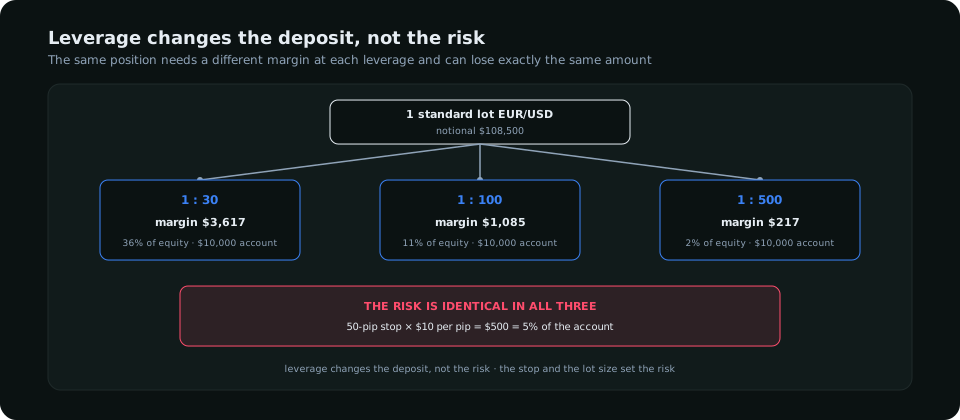
Take one standard lot of EUR/USD on a 10,000-dollar account with a 50-pip stop. At 1:30 the margin is 3,617 dollars; at 1:500 it is 217 dollars. The risk is the same in both cases: 50 pips at 10 dollars a pip is 500 dollars, 5% of the account, far too much by the risk per trade guide's standard. Leverage changed the deposit and nothing else. The danger of high leverage is only that it permits a position this large; a trader who sizes from the stop (100 dollars of risk over 50 pips is 2 dollars a pip, 0.2 lots) uses a tiny fraction of the available leverage on every account and never meets the margin-call threshold. High leverage is harmless to a trader with a sizing rule and lethal to one without. Regulators who cap leverage at 1:30 are protecting the second trader; the first was never at risk from it.
Spread: the cost of opening
The spread is the difference between the price you can buy at (the ask) and the price you can sell at (the bid). A EUR/USD quote of 1.08502 / 1.08510 has a spread of 0.8 pips, and a trade that opens at the ask and closes at the bid pays it: a position is 0.8 pips under water the instant it opens. On a standard lot that is 8 dollars; on a micro lot, 8 cents. Spreads vary by pair (0.5–1.5 pips on majors, 2–5 on crosses, more on exotics), by time (tightest in the London–New York overlap, two to three times wider in the Asian session and around releases), and by account type (raw spread plus commission versus a wider all-in spread). The spread is a cost per trade, so it matters most to strategies with small targets; the scalping guide shows how a 0.8-pip spread takes a fifth of a 6-pip target and nothing from a 150-pip one. Slippage, the difference between the price requested and the price filled, is the spread's variable companion, small in normal conditions and large around news.
How the four connect: a worked trade
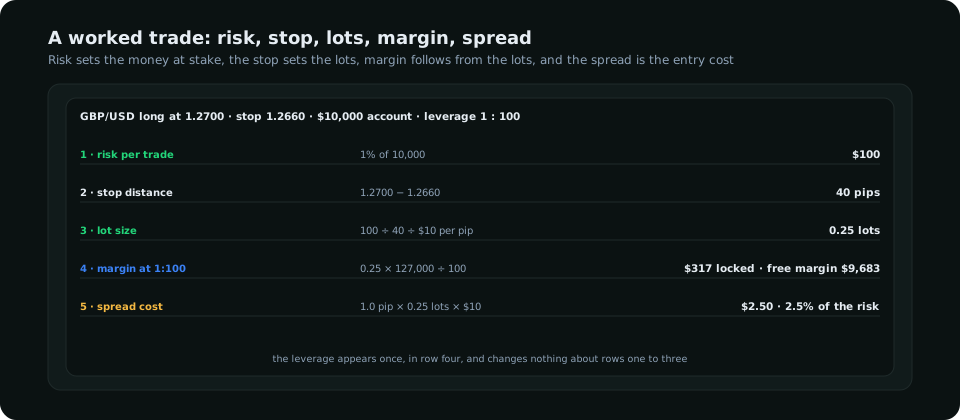
| Step | Calculation | Result |
|---|---|---|
| 1 · Risk per trade | 1% of 10,000 | 100 dollars |
| 2 · Stop distance | 1.2700 − 1.2660 | 40 pips |
| 3 · Lot size | 100 ÷ 40 ÷ 10 dollars per pip | 0.25 lots (2.5 mini lots) |
| 4 · Margin at 1:100 | 0.25 × 127,000 ÷ 100 | 317 dollars locked; free margin 9,683 |
| 5 · Spread cost | 1.0 pip × 0.25 lots × 10 dollars | 2.50 dollars (2.5% of the risk) |
The leverage appears in exactly one line and changes nothing about the trade's risk. At 1:30 the margin would be 1,058 dollars and the trade identical; at 1:500, 63 dollars and still identical. A trader who ran this calculation on every trade would use 3% of their equity as margin and could never receive a margin call short of a gap larger than their stop. The pip guide covers the pip value used in step 3 for pairs where it is not 10 dollars.
Choosing leverage and lot size in practice
- Choose the leverage your regulator allows and ignore it. Higher leverage lowers the margin locked per position and gives more free margin to hold several positions. It should never raise the lot size.
- Size from the stop every time. Account risk ÷ stop in pips ÷ pip value. If the result is below your broker's minimum lot (0.01), the stop is too wide for the account or the account is too small for the pair; widen neither, trade a smaller instrument.
- Keep used margin under 10–15% of equity across all open positions. Above that, a normal adverse day brings the margin level toward the warning threshold.
- Count the spread as part of the stop. A 40-pip stop with a 1-pip spread is a 41-pip risk; on small targets, the difference is the edge.
- Watch the spread at the times you trade. A strategy tested on the 0.8-pip London spread fails on the 2.5-pip Asian one.
Frequently asked
What leverage should a beginner use in forex?
Whatever the account offers, provided position size is set from the stop and the risk per trade and never from the leverage. A beginner sizing at 0.5% risk uses a tiny fraction of even 1:30. The danger is sizing to the leverage, not the leverage.
What is margin in forex?
The deposit the broker locks against an open position, equal to the notional divided by the leverage. It is collateral, returned on close; it is not the amount at risk. Positions are closed automatically if floating losses push equity too close to the margin used.
What is a good spread in forex?
Under 1 pip on the majors in the London and New York sessions on a decent account; 0.1–0.5 pips plus a few dollars commission per lot on a raw account. Above 2 pips on a major is expensive.
Everything on SMC Terminal is analysis and education, not a recommendation to buy or sell. Figures in the example are illustrative. Trading carries a substantial risk of loss. Manage your risk.