Forex Trading for Beginners: Currency Pairs, Pips, Lots and Spreads
Forex trading for beginners starts with four words that every price, cost and position size is built on: pair, pip, lot and spread. This guide explains each with real numbers — how a quote is read, what a pip is worth, how lots turn into money at risk, and why the spread is the first thing a trade has to earn back.
Most beginner losses are not about direction. They come from not knowing what the numbers on the screen mean: how much a one-pip move is worth, what "0.5 lots" commits you to, why a trade opens in loss. This guide is the vocabulary, with the arithmetic attached, so that the first live trade is sized and read correctly. For how the market itself works — who trades it, when, and why prices move — see the companion guide; this one is strictly about pairs, pips, lots and spreads.
Currency pairs: what a quote says
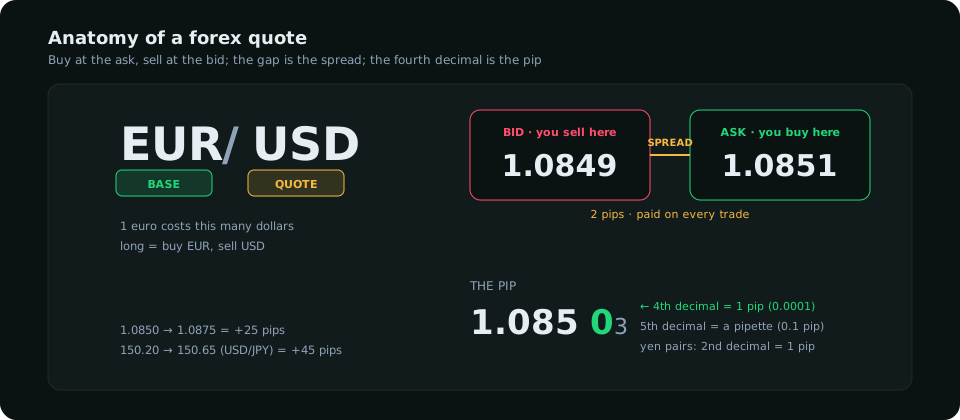
Every forex price is a ratio of two currencies. In EUR/USD 1.0850, the first currency (EUR) is the base, the second (USD) is the quote, and the number says how much of the quote currency one unit of the base is worth: one euro costs 1.0850 dollars.
- Buying the pair means buying the base and selling the quote: long EUR/USD profits if the euro strengthens against the dollar.
- Selling the pair is the reverse. There is no "owning" anything — every trade is a bet on one currency versus the other.
- Majors all contain the US dollar (EUR/USD, GBP/USD, USD/JPY, USD/CHF, AUD/USD, USD/CAD, NZD/USD) and carry the tightest spreads. Crosses (EUR/GBP, GBP/JPY) leave the dollar out and cost more to trade. Exotics pair a major with an emerging-market currency and cost the most.
Bid, ask and spread
A broker shows two prices. The bid is what the broker pays you to sell; the ask is what you pay to buy. The ask is always higher, and the difference is the spread — the broker's price for providing the market. EUR/USD quoted 1.0849 / 1.0851 has a 2-pip spread… or, with modern five-decimal pricing, 1.08492 / 1.08508 has a 1.6-pip spread.
Two consequences beginners meet on the first trade:
- A new trade opens in a small loss equal to the spread. You bought at the ask; the position is valued at the bid. Nothing is wrong.
- The spread is a cost per trade, paid whether the trade wins or loses. On a 10-pip scalp a 1.5-pip spread is 15% of the target; on a 150-pip swing trade it is 1%. This is why short-term trading is so sensitive to the broker and the hour — spreads widen when liquidity is thin, around news, and outside the London and New York sessions (see the best time to trade forex).
Some accounts quote a raw spread plus a fixed commission per lot (e.g. $7 round trip). Add the two together when comparing brokers; a "zero spread" account with a $7 commission is roughly a 0.7-pip spread on EUR/USD.
Pips: the unit of movement
A pip ("percentage in point") is the standard unit of price change: 0.0001 for most pairs and 0.01 for pairs quoted in Japanese yen. EUR/USD moving from 1.0850 to 1.0875 moved 25 pips; USD/JPY from 150.20 to 150.65 moved 45 pips. The fifth decimal brokers now show (1.08503) is a pipette, a tenth of a pip; ignore it when counting and stop confusing the two.
Lots: the unit of size
Forex is traded in lots, fixed quantities of the base currency:
| Lot | Units of base currency | Pip value on EUR/USD (USD account) |
|---|---|---|
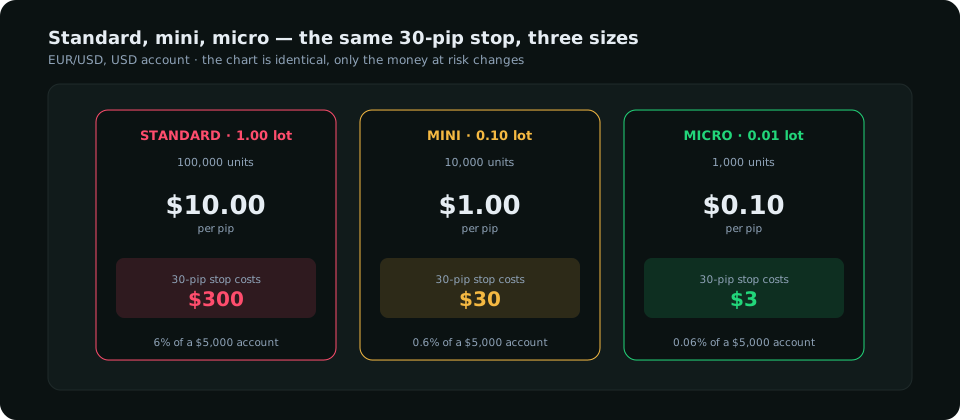
| Standard (1.0) | 100,000 | $10.00 per pip |
| Mini (0.1) | 10,000 | $1.00 per pip |
| Micro (0.01) | 1,000 | $0.10 per pip |
The pip value is what connects movement to money. A 30-pip loss costs $300 on one standard lot, $30 on a mini lot, $3 on a micro lot. Nothing about the chart changes between those three; only the exposure does. This is why size is the most important decision a beginner makes, and why it should come from the stop distance rather than from the balance or the leverage available — the lot size calculator guide works through it.
Pip value when the dollar isn't the quote
The $10-per-lot figure holds for any pair whose quote currency is USD. For USD/JPY the pip value is ¥1,000 per lot, which in dollars is 1,000 ÷ the current USD/JPY rate (about $6.67 at 150.00). For a cross like EUR/GBP, the pip is worth £10 per lot, converted to your account currency. Brokers' contract specifications and any position-size calculator do this for you; the point is to know that it varies.
Leverage and margin, briefly
Leverage lets you control a lot with a fraction of its value as margin: at 1:30, a standard lot of EUR/USD (about $108,500) needs roughly $3,600 of margin. Leverage does not change what a pip is worth — a standard lot still moves $10 per pip whether you posted $3,600 or $108,500. It only changes how large a position your balance permits, which is not the same as how large it should be. Treat the margin requirement as a ceiling you never approach, not a guide.
A worked example, start to finish
| Step | Detail |
|---|---|
| Account and risk | $5,000; risk 1% per trade = $50 |
| Idea | Long GBP/USD; quote 1.26502 / 1.26516 (1.4-pip spread) |
| Stop | Below the swing low at 1.26120 → 38 pips from entry + 1.4-pip spread ≈ 40 pips of risk |
| Size | $50 ÷ (40 pips × $10 per lot) = 0.125 → round down to 0.12 lots (12 micro lots) |
| Target | 1.27300 → 78 pips; ratio about 2 : 1 |
| Outcome A: target hit | 78 pips × $1.20 per pip = +$93.60, minus any commission |
| Outcome B: stopped | 40 pips × $1.20 = −$48, within the planned $50 |
Notice the order: risk in money first, stop from the chart second, size last. Beginners who pick the size first ("0.5 lots feels right") are deciding how much they can lose without ever calculating it.
Reading a trading platform
- Volume on an order ticket means lot size, not market volume.
- Equity is balance plus open profit/loss; free margin is equity minus margin in use. A margin call happens when free margin runs out — a direct result of over-sizing.
- Swap is the overnight interest credited or charged for holding a position past the broker's rollover time; it follows the interest-rate difference between the two currencies and matters for multi-day trades.
Checklist before the first live trade
- Can you say which currency you are buying and which you are selling?
- Do you know the pip value of this pair in your account currency, per lot?
- Is the stop placed on the chart before the size is chosen?
- Is the spread included in the risk, and is it small relative to the target?
- Is the size derived from money at risk ÷ (stop × pip value), rounded down?
Five yeses and the mechanics are handled. Everything after that — reading structure, positioning, sessions — is analysis, and a dashboard such as the terminal or a plain charting platform and the CFTC's report will carry you into it. The mechanics are the part nobody can do for you.
Everything on SMC Terminal is analysis and education, not a recommendation to buy or sell. Prices and spreads are illustrative; check your broker's contract specifications. Trading carries a substantial risk of loss. Manage your risk.