ICT Killzones in Pakistan and Gulf Time: The Session Clock for Traders East of London
Killzone charts are written in New York time, which puts the best trading windows at awkward hours for anyone in Karachi, Dubai or Riyadh. Here are the exact windows in PKT, GST and UTC, what each one is for, and how daylight saving moves them twice a year.
Almost every killzone chart you will find is drawn in New York time, because that is where the method comes from. If you trade from Karachi, Lahore, Dubai, Doha or Riyadh, that means doing the conversion in your head every day — and getting it wrong twice a year when the United States changes its clocks and your country does not.
This is the full session clock for traders east of London: every window in Pakistan Standard Time, Gulf Standard Time and UTC, what each window is actually for, and the two dates on which the whole table shifts.
Why the windows exist at all
A killzone is not a magic hour. It is the overlap between a major financial centre opening and the order flow that opening brings. Banks, funds and dealers execute the bulk of their business in the first hours of their own session; the rest of the day is thinner. Liquidity is taken — stops swept, ranges broken — when there is enough volume to take it, and that volume arrives on this schedule.
The three windows ICT defines, in the time they are defined in:
- Asia killzone: 20:00–00:00 New York. Tokyo and Sydney build the overnight range. Usually quiet; its highs and lows are the first liquidity London goes after.
- London killzone: 02:00–05:00 New York. The European open. The day's first real directional push, and the most reliable window for the "sweep Asia's range, then reverse" pattern.
- New York killzone: 07:00–10:00 New York. The US open plus the 08:30 data releases. Either continues London's move or reverses it; the reversal usually comes after a sweep of the London high or low.
The same windows in your time
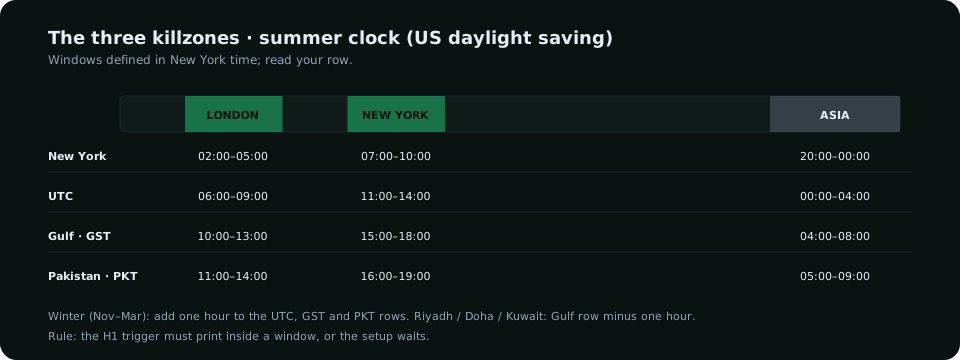
Pakistan (PKT) is UTC+5 all year. The Gulf (GST — UAE, Oman) is UTC+4 all year; Saudi Arabia, Qatar, Kuwait and Bahrain are UTC+3. None of them observe daylight saving. New York does: Eastern Daylight Time (UTC−4) from the second Sunday of March to the first Sunday of November, Eastern Standard Time (UTC−5) the rest of the year. So the table has two halves.
| Killzone | New York | UTC (summer) | Gulf GST (summer) | Pakistan PKT (summer) |
|---|---|---|---|---|
| Asia | 20:00–00:00 | 00:00–04:00 | 04:00–08:00 | 05:00–09:00 |
| London | 02:00–05:00 | 06:00–09:00 | 10:00–13:00 | 11:00–14:00 |
| New York | 07:00–10:00 | 11:00–14:00 | 15:00–18:00 | 16:00–19:00 |
| Killzone | New York | UTC (winter) | Gulf GST (winter) | Pakistan PKT (winter) |
|---|---|---|---|---|
| Asia | 20:00–00:00 | 01:00–05:00 | 05:00–09:00 | 06:00–10:00 |
| London | 02:00–05:00 | 07:00–10:00 | 11:00–14:00 | 12:00–15:00 |
| New York | 07:00–10:00 | 12:00–15:00 | 16:00–19:00 | 17:00–20:00 |
For Riyadh, Doha, Kuwait and Manama subtract one hour from the Gulf column.
What this means for a Gulf or Pakistan day
Read the table as a working day rather than a list of hours and the shape is actually favourable:
- Morning (PKT 05:00–09:00): Asia. The range forms while you have breakfast. Do not trade it; mark its high and low. That is the liquidity London will go for.
- Late morning to early afternoon (PKT 11:00–14:00): London. The best window of the day for an SMC trader — the Asia sweep and reversal happens here. If you can only watch one window, watch this one.
- Late afternoon (PKT 16:00–19:00): New York. The 08:30 New York releases land at 17:30 PKT in summer (18:30 in winter). This is where a London move either extends or gets undone. Scheduled-risk window: check the calendar before entering.
- Evening onward: nothing. New York's afternoon is the thinnest part of the day. A sweep at 22:00 PKT is noise.
The hours that are hard for a European or American trader — the 11:00–14:00 London window — are the middle of the working day in Karachi and Dubai. The hours that are hard for you — Asia at 05:00 — are the ones you should be sleeping through anyway.
The two dates that catch everyone
In 2026 the United States moved to daylight saving on 8 March and returns to standard time on 1 November. On those two Sundays every window in your local time shifts by an hour — earlier in March, later in November. London itself changes on different dates (the last Sunday of March and October), which is why the London killzone's local start drifts by an hour for roughly two weeks each spring and autumn relative to the New York definition. The terminal's killzone strip is computed from New York time for exactly this reason: the windows are defined there, and converting from there is the only way to be right on every day of the year.
The rule we use
Everything above reduces to one rule on the Market Trend tab: the H1 trigger — the market-structure shift after a sweep — has to print inside a killzone, or the setup waits. The "When to execute" strip under the trade plan shows the three windows on a 24-hour bar with a marker for right now, in your clock, and says in words whether a window is open, when the next one opens, and whether it is already a Friday afternoon with nothing left this week. It also refuses to show session levels on the chart: the windows are a filter on timing, not another set of lines to trade from.
If you want to see how the timing rule combines with the chart and the weekly positioning report, read The Sweep Before the Move — the three-part check is worked through on a live gold setup.
Everything on SMC Terminal is analysis and education, not a recommendation to buy or sell. Manage your risk.
More from the desk
All posts →