Forex Trading Signals Explained: Confirmation, Risk and False Positives
A forex trading signal is a claim that a move is about to happen. Whether it comes from an indicator, a pattern, a desk read or a paid service, the claim has a false-positive rate, and the trader's job is to know it, confirm against it and size for it. This guide explains what a signal actually is, how to measure how often it is wrong, the confirmation sequence that cuts the false positives, and how to evaluate a signal source before risking money on it.
Every forex trading signal is a claim: a move in this direction is about to happen. The claim can come from an indicator crossing a line, a chart pattern completing, a positioning extreme, an analyst's note or a paid service's alert. What it cannot come with is certainty. Every signal has a false-positive rate, the share of the time it fires and nothing follows, and a trader who does not know that rate is either sizing blindly or not sizing at all. This guide explains what a signal is in statistical terms, how to measure how often it is wrong, the confirmation sequence that filters the wrong ones out, and how to judge a signal source, including the ones that charge for the privilege.
What a signal is
| Kind | Example | Fires | Typical false-positive rate |
|---|---|---|---|
| Indicator | RSI crosses below 30; moving-average crossover | Often; several times a week per pair | High; 60–70% in ranges, lower in trends |
| Structure | Break of structure after a liquidity sweep; order block retest | A few times a week per pair | Moderate; 45–55% with no further filter |
| Positioning | COT index above 90; retail 80% long | Rarely; a few times a year per market | Low as a condition, high as a timing signal |
| Discretionary / service | "Buy EUR/USD 1.0850, stop 1.0820, target 1.0920" | Whenever the provider says | Unknown until measured; usually not published |
A signal has two numbers: how often it fires and how often it is right. A signal that fires constantly and is right half the time is noise with a schedule. A signal that fires rarely and is right 70% of the time is valuable but needs patience. The trader's edge comes from combining a frequent signal (the trigger) with a rare one (the condition) so that the frequent one is only acted on when the rare one agrees. That is the whole logic of confirmation.
Measuring the false-positive rate
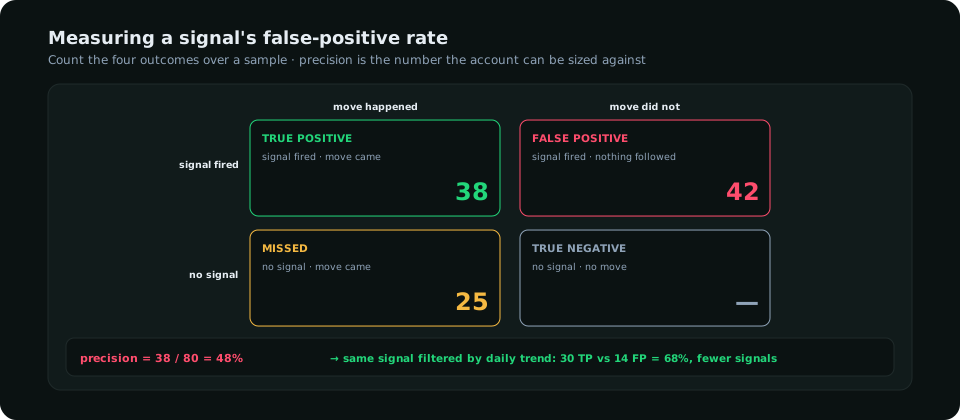
Define the signal mechanically, define what "the move happened" means (say, price reached 1.5 times the stop distance in the signal's direction before hitting the stop), and count over a hundred or more instances. Precision, the share of signals that worked, is the number a trader can size against. Most indicator signals land near 50% on their own, which is why they feel random; adding a context filter (direction of the daily trend, position in the range, the COT read) typically lifts precision into the 60s at the cost of fewer signals. The backtesting guide covers how to count honestly, including the signals you would have skipped.
The confirmation funnel
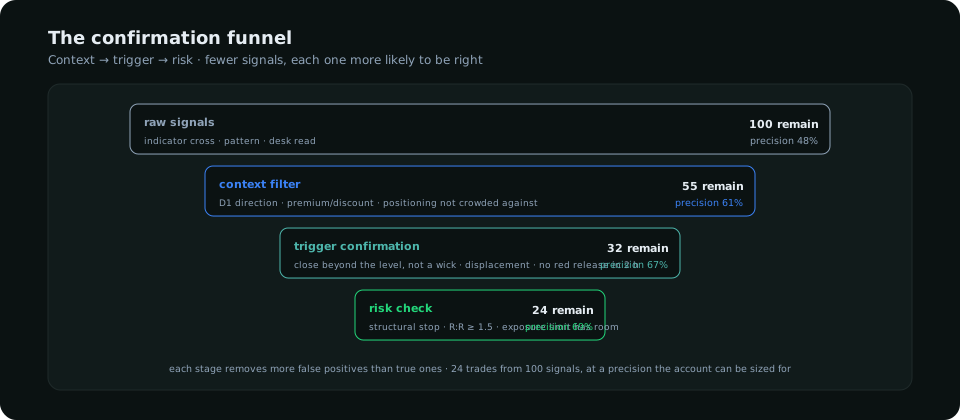
- Context. Does the higher-timeframe structure, the range position and the positioning read allow a trade in the signal's direction? A buy signal in the premium of a daily downtrend with speculators crowded long fails the gate. The SMC strategy guide sets out the structure half; the COT guide the positioning half.
- Trigger. Did the signal complete, or merely approach? A level is broken on a close, not a wick; a reversal is confirmed by a displacement candle, not a doji. And is the next two hours clear of a red release?
- Risk. Is there a structural stop, is the reward-to-risk to the first target at least 1.5, and does the exposure limit have room? A signal with no sensible stop is not a trade however good the context.
The funnel's cost is missed moves: some of the signals it discards would have worked. That is the correct trade; the account is sized for the precision of the signals taken, and a few missed winners cost nothing, whereas false positives taken at full size cost real money.
Evaluating a signal source
A paid or free signal service should be judged like any strategy, and most cannot survive the examination. Ask for, or build yourself from their history: the number of signals, the win rate, the average reward-to-risk as stated at the time of the signal (not as adjusted afterwards), the maximum drawdown in R, and the longest losing streak. Red flags: results quoted in pips without the risk per trade, win rates above 80% (usually achieved with stops far wider than targets), "closed at breakeven" appearing often (a loss relabelled), targets changed after entry, and no record of signals that were stopped. A service that publishes a full, time-stamped log with stops and targets fixed at issue is rare and worth the subscription if its expectancy after costs is positive; a service that publishes screenshots of winners is marketing.
Trading someone else's signal
- Run it through your own funnel. The provider's context is not yours; check structure, positioning and the calendar before taking it.
- Use your own risk per trade, not the provider's lot size. The risk per trade guide sets the number; their stop sets the size.
- Do not chase. A signal at 1.0850 taken at 1.0875 has a different reward-to-risk; if it no longer clears 1.5, it is a different trade.
- Log the ones you skip. Your filtered version of the service is its own strategy; measure it.
- Correlate. Three signals from one provider on three dollar pairs are one dollar trade.
Where signals fit
A signal is the last step of an analysis, not a substitute for it. The macro backdrop, the positioning and the structure decide the direction and whether to trade at all; the signal only decides when. On SMC Terminal that order is built in: the terminal's reads compose the bias per pair, the calendar and session clock gate the timing, and the AI chart read for each market states its trigger, stop, targets and the confirmations still outstanding, or says NO TRADE when the evidence is insufficient, which is the honest version of a signal. The daily workflow guide shows where in the morning routine a signal is allowed to appear.
Frequently asked
Are forex trading signals reliable?
Each signal has a measurable precision; most raw signals are right about half the time, and filtered ones 60–70%. "Reliable" means knowing the number and sizing for it, not finding a signal that is always right.
Should I pay for forex signals?
Only for a provider that publishes a full time-stamped log with stops and targets fixed at issue, and only after you have measured its expectancy after your costs. Most services cannot pass that test.
What is the best confirmation for a trading signal?
Context first (higher-timeframe direction, range position, positioning), then a completed trigger on a close, then a structural stop with reward-to-risk of at least 1.5. Each stage roughly halves the false positives.
Everything on SMC Terminal is analysis and education, not a recommendation to buy or sell. Figures in the example are illustrative. Trading carries a substantial risk of loss. Manage your risk.