London Forex Session: Market Activity, Preparation and Trade Filters
London is where the forex day actually starts: the largest share of global volume, the first directional push, and the most reliable pattern in intraday trading — the raid on the Asian range. This is how the session behaves hour by hour, how to prepare for it, and the filters that keep you out of the bad trades.
Roughly 38% of all foreign-exchange turnover goes through London — more than New York and Tokyo combined. When London's banks, funds and dealers come in, the overnight range that Asia built meets real size for the first time, and the result is the most dependable intraday behaviour in the market: a push through one side of the Asian range, a decision, and a directional leg that New York then either extends or reverses.
This guide walks the session hour by hour, shows how to prepare for it in ten minutes the night before, and sets out the filters that separate a London setup worth taking from one worth watching.
The hours, in your time
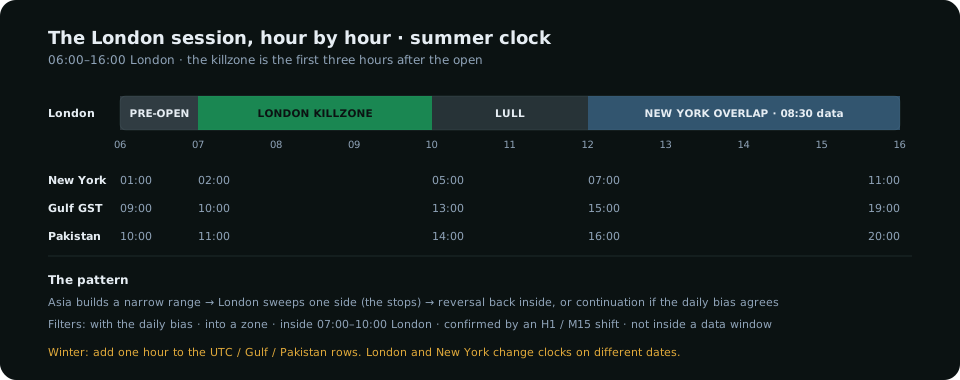
| Phase | London | New York | Gulf (GST) | Pakistan (PKT) | What happens |
|---|---|---|---|---|---|
| Pre-open | 06:00–07:00 | 01:00–02:00 | 09:00–10:00 | 10:00–11:00 | Frankfurt desks arrive; the Asia range is tested, rarely broken |
| Killzone | 07:00–10:00 | 02:00–05:00 | 10:00–13:00 | 11:00–14:00 | The sweep of the Asia high or low and the first real leg |
| Mid-session | 10:00–12:00 | 05:00–07:00 | 13:00–15:00 | 14:00–16:00 | Consolidation; the move pauses before US data |
| Overlap | 12:00–16:00 | 07:00–11:00 | 15:00–19:00 | 16:00–20:00 | New York joins; 08:30 data; the day's largest candles |
For traders east of London this is a comfortable day: the killzone is late morning, the overlap is late afternoon, and nothing worth watching happens after dinner. The complete session clock, with the daylight-saving dates, is in ICT Killzones in Pakistan and Gulf Time.
What London actually does
Asia trades thin. Its range is narrow and its highs and lows are obvious, which means stops sit just beyond them: buy stops above the high from Asian shorts and breakout traders, sell stops below the low. London has size to fill and those stops are the cheapest fill available. So the typical open is a run through one side of the Asian range — the "raid" or "sweep" — followed within an hour or two by one of two things:
- Reversal: the sweep was the fill; price closes back inside the range and the real leg goes the other way. This is the classic pattern and the one Smart Money traders wait for, because the sweep plus the structure shift back inside gives a defined entry and a stop beyond the sweep.
- Continuation: the break holds, the range becomes support or resistance, and the day trends. More common when the higher-timeframe bias and the overnight news point the same way.
Which one you get is not random. It depends on the daily bias, on positioning, and on whether the sweep took liquidity that mattered. That is what the filters below are for.
Preparation: ten minutes the night before
- Bias: which way does the daily and 4-hour structure lean on the two or three pairs you trade? Write it down. London setups against the daily bias are the ones that fail.
- Levels: mark the previous day's high and low, the nearest zones in the bias direction, and any equal highs or lows. Tomorrow's Asia range will be added in the morning.
- Calendar: anything at 08:30 New York (13:30 London)? A European release at 09:00 or 10:00 London? Those hours get a wider stop or no trade.
- Positioning: a glance at the weekly report. If speculators are at a three-year extreme in a pair, a sweep against them is the trade to favour.
In the morning, add the Asian high and low, and you have the whole map before the first London candle.
The filters
A London sweep is a precondition, not a trade. Take it only when all of these are true:
- With the daily bias. A sweep of the Asia low in a daily uptrend is a long setup; a sweep of the Asia high in a daily uptrend is noise unless it also takes a higher pool.
- Into a zone. The sweep runs into, or stops at, a 4-hour or hourly zone in the bias direction. A sweep into nothing has nothing to reverse from.
- Inside the killzone. 07:00–10:00 London. A break at 11:30 is usually a drift.
- Confirmed by structure. An hourly or 15-minute close back inside the range beyond the last opposing swing — the shift. Entry on the retest, stop beyond the sweep, first target the opposite side of the Asia range, second the next pool.
- Not inside the data window. No entries in the twenty minutes before a scheduled release in either currency.
Five filters remove most London trades. That is the point: the session offers two or three real setups a week across the majors, not two or three a day.
Managing a London trade into New York
A London leg that is still running at 12:00 London (07:00 New York) meets the US session's own agenda. The practical rule: take the first target before the overlap, move the stop to break-even, and let the remainder decide itself on the 08:30 data. New York reverses a London move roughly as often as it extends one; holding full size through that coin flip gives back the morning's edge.
The terminal's Market Trend tab marks the session windows under each setup, in your own clock, and requires the hourly trigger to print inside one — the same filter as above, enforced. The sweep-and-shift sequence itself is covered in The Sweep Before the Move.
Everything on SMC Terminal is analysis and education, not a recommendation to buy or sell. Manage your risk.