Change of Character (CHoCH) vs BOS: How They Differ
A break of structure confirms a trend; a change of character is the first crack in one. Traders confuse the two constantly, and the confusion costs money because they call for opposite responses. This guide defines both precisely, shows the four-candle sequence that separates them, and gives the validation checklist for a CHoCH before acting on it.
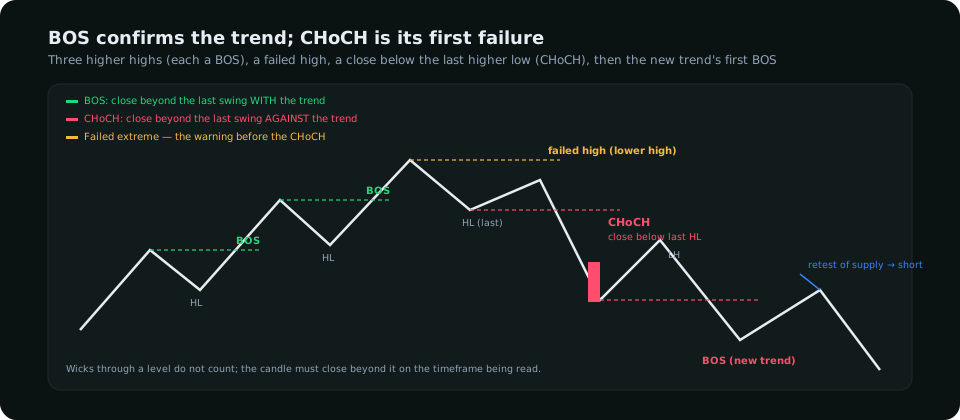
Market structure is the sequence of swing highs and swing lows a market leaves behind. An uptrend makes higher highs and higher lows; a downtrend the reverse. Two events describe what happens to that sequence. A break of structure (BOS) is price closing beyond the last swing in the direction of the trend — a higher high in an uptrend — and it confirms continuation. A change of character (CHoCH) is price closing beyond the last swing against the trend — below the last higher low in an uptrend — and it is the first evidence that the trend may be ending. Same mechanism, opposite meaning, opposite trade. This guide draws the line between them precisely, because most of the "CHoCH" calls on charts are something else.
The definitions, with the swing rules
| Break of structure (BOS) | Change of character (CHoCH) | |
|---|---|---|
| What breaks | The last swing with the trend (a higher high in an uptrend) | The last swing against the trend (the last higher low in an uptrend) |
| What it means | Continuation; the trend has made a new leg | The sequence has failed; a reversal or a range may be starting |
| Confirmation | A candle close beyond the level on the timeframe being read | A candle close beyond the level — and, ideally, a failed attempt at a new high first |
| What to do | Look for a pullback into the order block that produced the break | Stop looking for longs; wait for the first bearish BOS and a retest before shorting |
| Frequency | Several per trend | Once per trend — the first one; after that the breaks are BOS of the new trend |
The swing rule matters. A swing high is a candle whose high is above the highs of the candles on both sides (a three-candle fractal at minimum; many traders require two on each side). Breaking a wick is not a break; the candle must close beyond the level on the timeframe being read. Those two rules remove most false calls on their own. The BOS guide covers the swing identification in more depth.
Why most CHoCH calls are wrong
The common error is calling a change of character on a lower-timeframe break while the higher timeframe is simply pulling back. A 15-minute "CHoCH" inside a 4-hour uptrend is usually the 4-hour pullback in progress; it will produce a 15-minute downtrend that ends at the 4-hour demand level, exactly where the higher-timeframe trader was waiting to buy. The second error is reading a liquidity sweep as a CHoCH: price wicks below the higher low, takes the stops resting there, and closes back above. That is the opposite of a change of character — it is the trend refuelling.
The practical rule: a change of character is called on the timeframe whose structure you are trading, confirmed by a close, after the trend has first failed to make a new extreme. A CHoCH that comes straight off a fresh higher high — no failed attempt, no lower high — is far more often a deep pullback.
The validation checklist
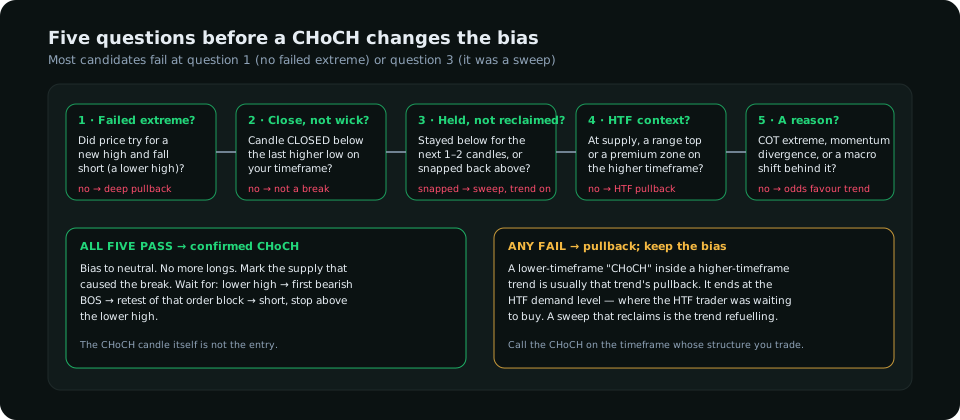
- Failed extreme. Did price try for a new high and fall short (a lower high), or at least stall? A CHoCH after a failed attempt carries far more weight than one straight off a new high.
- Close, not wick. Did a candle close below the last higher low on the timeframe you trade?
- Held, not reclaimed. Did price stay below for the next one or two candles, or did it snap back above (a sweep)?
- Higher-timeframe context. Is the higher timeframe at a level where a reversal makes sense — supply, the top of a range, a premium zone per the equilibrium rule? A 1-hour CHoCH in the middle of a daily uptrend with no level nearby is a pullback until proven otherwise.
- A reason. Positioning at an extreme (the COT index near 90 or 10), momentum divergence, or a macro shift makes a reversal plausible; without one, the odds favour the trend resuming.
Trading after a confirmed CHoCH
The change of character itself is not the entry. It is the signal to stop trading with the old trend and to prepare for the new one. The sequence after a bearish CHoCH in a former uptrend is: price pulls back up (the first lower high), then closes below the low the CHoCH made — the new downtrend's first BOS. The trade is the retest of the supply that produced that first bearish BOS, with the stop above the lower high. Entering on the CHoCH candle itself means buying the first bounce of a move that may still be a pullback; waiting for the first BOS and the retest costs some of the move and removes most of the false starts.
| Phase | What you see | Action |
|---|---|---|
| 1. Failed high | Price stalls below the prior high | Tighten management on existing longs; no new longs at highs |
| 2. CHoCH | Close below the last higher low | Bias to neutral; no longs; mark the supply that caused the break |
| 3. Lower high | Pullback that fails below the old high | Bias to bearish on this timeframe |
| 4. First bearish BOS | Close below the CHoCH low | Mark the order block of the breaking move |
| 5. Retest | Price returns to that order block and rejects | Short, stop above the lower high, target the next demand |
CHoCH on multiple timeframes
Each timeframe has its own structure, and a CHoCH on one is routine on another. A 15-minute CHoCH happens several times a day; a daily CHoCH a few times a year. The useful alignment is a lower-timeframe CHoCH at a higher-timeframe level: a 15-minute change of character at 4-hour supply is the trigger for the 4-hour trader's short, and the 4-hour level is the context that makes the 15-minute signal worth taking. Without that alignment, a lower-timeframe CHoCH is a lower-timeframe event only. The SMC strategy article shows the full top-down sequence.
Frequently asked
Is CHoCH bullish or bearish?
Either. A bearish CHoCH breaks the last higher low in an uptrend; a bullish CHoCH breaks the last lower high in a downtrend. The word describes the failure of the sequence, not a direction.
Can a CHoCH and a BOS happen on the same candle?
Not on the same timeframe. A close below a higher low is a CHoCH; the next close below a low is a BOS. On different timeframes, yes — a 1-hour BOS down is frequently the candle that prints the 15-minute CHoCH.
What is a false CHoCH?
A wick through the higher low that closes back above it. That is a liquidity sweep, and it usually means the trend continues. The close rule exists to filter it.
Everything on SMC Terminal is analysis and education, not a recommendation to buy or sell. Chart sequences are illustrative. Trading carries a substantial risk of loss. Manage your risk.