How to Choose a Forex Trading Strategy: Trend, Breakout or Reversal?
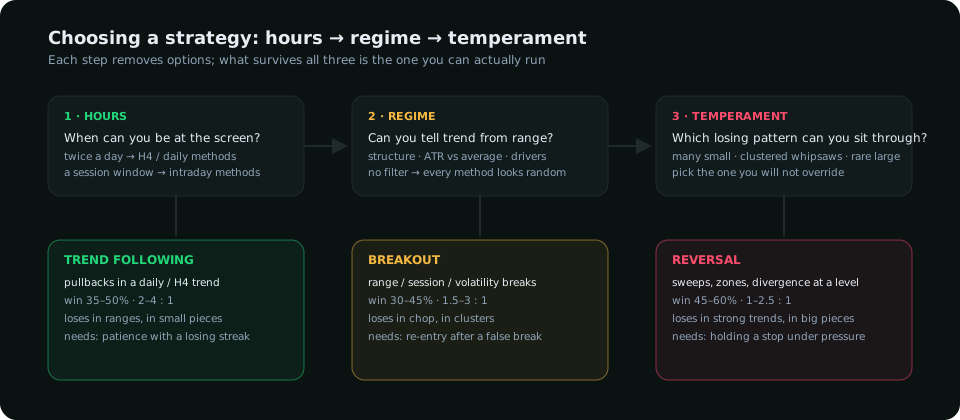
There is no best forex trading strategy, only the one that fits your hours, your temperament and the market you are in. This guide compares trend following, breakout and reversal trading on the measures that matter — win rate, ratio, time in the screen, drawdown shape — and gives you a decision path for picking one and sticking to it long enough to know.
Search "best forex trading strategy" and you will find a thousand answers, each one certain. They cannot all be right, and the reason is simple: a strategy is a fit between three things — a market state, a trader's schedule and a trader's temperament — and the third one is different for everybody. The method that makes one person consistent makes another person anxious enough to break every rule in it. So the useful question is not "which strategy is best?" but "which family of strategies fits me, and how do I find out without losing a year?"
This guide compares the three families that nearly every retail method belongs to — trend following, breakout trading and reversal trading — on the measures that actually decide whether you will keep doing them. Then it gives you a decision path.
The three families in one table
Most named strategies are a variation of one of these. Moving-average crossovers, pullback entries and "buy the higher low" are trend following. Range breaks, session-open breaks and volatility expansions are breakout trading. Supply-and-demand fades, liquidity-sweep entries and divergence trades are reversals. The names on the box change; the statistics underneath do not.
| Trend following | Breakout | Reversal | |
|---|---|---|---|
| Core idea | Join a move already under way after a pause | Enter as price leaves a range or level | Fade a move at a level where it should fail |
| Typical win rate | 35–50% | 30–45% | 45–60% |
| Typical reward-to-risk | 2 : 1 to 4 : 1 | 1.5 : 1 to 3 : 1 | 1 : 1 to 2.5 : 1 |
| When it earns | Trending weeks and months | Transitions from quiet to active | Ranges and exhausted trends |
| When it bleeds | Ranges — repeated small losses | Choppy markets — false breaks | Strong trends — fading a freight train |
| Drawdown shape | Long, shallow strings of small losses | Clusters of whipsaws | Rare but large losses when wrong |
| Screen time | Low — set and manage | Medium — must be there at the break | Medium to high — timing is everything |
| Hardest part emotionally | Taking the eighth small loss in a row | Re-entering after a false break | Holding a stop while price runs at you |
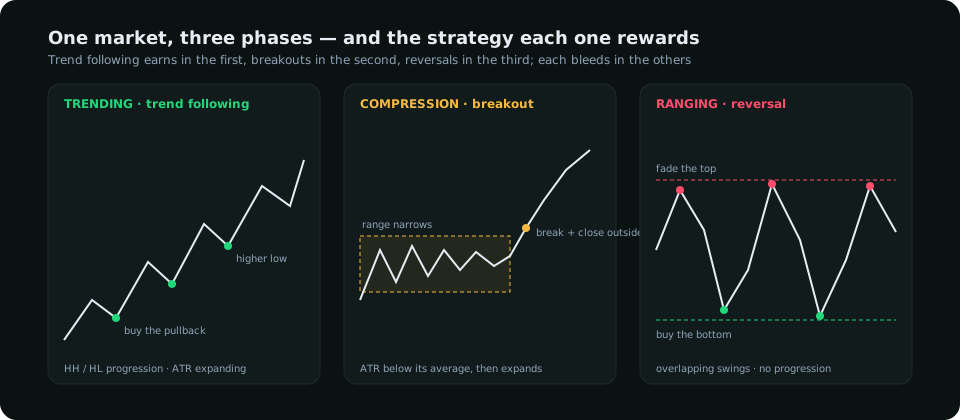
Read the "when it bleeds" row carefully, because that is the row that decides whether you stay with a method. Every strategy has a losing environment. Trend following loses in ranges, and markets range about two-thirds of the time, so a trend follower spends most of the year taking small losses and must have the stomach for that. Reversal trading loses when a trend refuses to end, and those losses tend to be large because the trader keeps "knowing" it will turn. Breakout trading loses in chop, which is where most traders first meet it, which is why so many give it up.
What the market is doing right now matters more than the method
The single biggest improvement most traders can make is not a better entry but a regime filter — a simple way to classify whether the market they are about to trade is trending, ranging or in transition, and to use the family that fits. Three practical ways to do that:
- Structure. On the daily and 4-hour chart, is price printing higher highs and higher lows (or the reverse)? That is a trend, and pullback entries in its direction are the highest-probability trades available. Overlapping swings with no progression is a range.
- Volatility against its own average. A 14-day ATR well below its 100-day average is compression — the breakout family's environment. ATR expanding above average with directional closes is a trend in progress.
- Who is driving. A move backed by rates, the dollar's drivers and speculative positioning (the kind of context a multi-read dashboard is built to surface) tends to persist; a move with nothing behind it is a candidate for reversal. This is the filter most chart-only traders never apply, and it is the one that separates a trend that continues from a trend that is about to be faded.
Some traders run one family and simply stay out when the regime is wrong. Others run two — a trend method and a range method — and switch. Either works. What does not work is running a reversal method in a trend because the setup "looks the same".
Match the strategy to your hours
Your available screen time eliminates strategies before temperament even enters. Be honest about it.
| Your situation | Realistic families | Why |
|---|---|---|
| Full-time job, can check charts morning and evening | Trend following on H4 / daily; swing reversals at major levels | Entries can be placed as pending orders; management is once or twice a day |
| Two or three free hours in the London or New York session | Session breakouts; intraday reversals at the session's liquidity sweeps | Both need you present at a specific time — and that time is defined by the session, not by you |
| Flexible hours, can watch most of the day | Any — but beware, more screen time usually means more trades, not better ones | The constraint here is discipline, not access |
| In a time zone where London opens at midnight | Asian-range breakouts; higher-timeframe trend entries set the night before | Fighting your sleep for the New York open is a losing strategy in itself — see the best time to trade forex |
Match the strategy to your temperament
This is the part most guides skip because it is uncomfortable. Ask yourself which of these you would find harder:
- Taking eight small losses in a row, knowing the ninth may be the one that pays for all of them. If that is tolerable, trend following fits. If you would start skipping entries by the fifth loss, it does not — the method's edge lives in the trades you would skip.
- Watching a trade go 40 pips against you and holding, because the stop is at the right place. If that is tolerable, reversal trading fits. If you would move the stop or close early, your realised ratio will be a fraction of the planned one and the method will not earn.
- Being stopped out on a false break and immediately re-entering on the real one. If you can do that without resentment, breakouts fit. If one whipsaw puts you off the setup for the day, they do not.
Pick the family whose hard part you can genuinely live with. A slightly worse strategy you execute correctly beats a better one you keep overriding.
A fair test: how to find out without losing a year
Once you have a candidate, the method has to be tested in a way that produces a verdict rather than a feeling. The components:
- Write the rules down so that two people would take the same trade. Regime filter, entry trigger, stop placement, target, management. If a rule says "when it looks strong", it is not a rule yet.
- Backtest at least 100 trades by hand on the timeframe you will trade, marking each as win, loss or break-even with its realised ratio. One hundred is the minimum for the win rate to mean anything; forty trades can be luck in either direction.
- Forward test on a demo or at minimum size for 30 trades, recording every deviation from the rules. The deviations are the finding — they tell you where the method fights your temperament.
- Judge expectancy, not the win rate. Expectancy = (win rate × average win) − (loss rate × average loss), in R. A method at +0.25R per trade over 130 trades is a real method; a method at 65% win rate with 0.6 : 1 average ratio is a slow loss. The risk-to-reward guide has the break-even table.
Give the test a fixed horizon and do not change the rules inside it. The most common way traders fail to find a strategy is not that none works; it is that they change the rules every twenty trades and therefore never collect a sample on any of them.
A note on combining the three
Experienced traders often end up using all three families — but as one process, not three strategies. A liquidity sweep (reversal) at a higher-timeframe level that then breaks the short-term structure (breakout) in the direction of the daily trend (trend following) is one trade with three confirmations, and it is the backbone of the market-structure approach. That is where many traders end up. It is not where to start. Start with one family, test it properly, and add the others only when the first one is producing a stable record.
Checklist before you commit to a strategy
- Which family is it? (Most "unique" strategies are one of the three.)
- What regime does it need, and how will I identify that regime before entering?
- Do the hours it needs exist in my week, every week?
- What is its losing pattern, and can I sit through it?
- Have I written rules a stranger could follow, and tested 100 of them?
- What expectancy did the test show, in R per trade, after spread?
If every line has an honest answer, you have chosen a strategy. If the answers are missing, you have chosen a hope — and the market charges for those.
Everything on SMC Terminal is analysis and education, not a recommendation to buy or sell. Win rates and ratios above are typical ranges for illustration, not guarantees. Trading carries a substantial risk of loss. Manage your risk.