How to Choose a Forex Trading Platform: Charts, Execution and Analysis
The best forex trading platform is three platforms: one to analyse, one to chart, one to execute. Most comparison articles rank brokers by bonus size. This one explains the three jobs, what matters in each, the costs that are not on the pricing page, and a short checklist for the decision.
Search "best forex trading platform" and you get ranked lists of brokers, each with a star rating and an affiliate link. The lists are not useless, but they answer the wrong question. A platform is not one thing. It is three jobs — deciding what to trade, seeing it on a chart, and sending the order — and the software that is best at one is rarely best at the others. Traders who understand this run two or three tools and stop looking for the one that does everything.
This guide separates the three jobs, lists what actually matters in each, and ends with a checklist short enough to use.
The three jobs
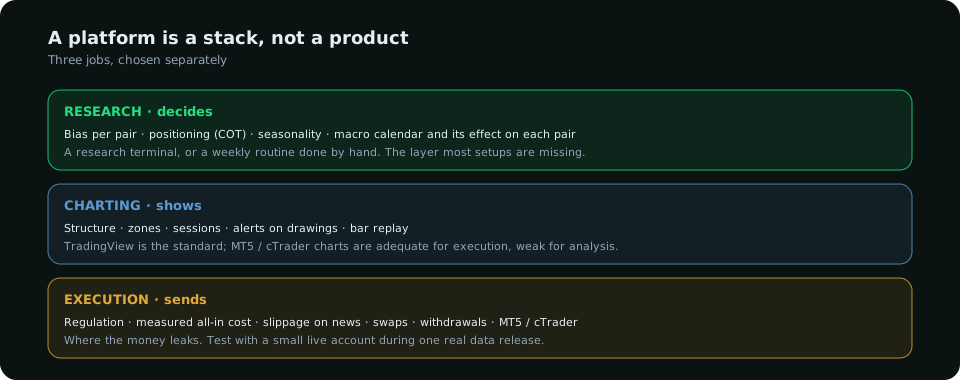
- Research / analysis: the weekly positioning report, seasonality, the macro calendar and its effect on each pair, composed into a bias. This is where the decision is made and where most platforms offer nothing beyond a news feed. It is the job SMC Terminal was built for.
- Charting: candles, structure, zones, sessions, alerts. TradingView is the standard; MetaTrader and cTrader have capable built-in charts that are weaker at alerts and layout.
- Execution: the broker's platform — MetaTrader 4 or 5, cTrader, or the broker's own app — where the order is placed, the spread paid and the swap charged. This is where the money leaks.
Choosing the execution layer (the broker)
Everything on a broker's homepage is marketing. These are the things that decide whether you keep your money:
- Regulation. A licence from a serious regulator (FCA, ASIC, CySEC, the DFSA in Dubai, SECP-registered in Pakistan where applicable) with client-money segregation. An offshore licence is a licence to disappear. This is the first filter and it removes most of the list.
- All-in cost, measured. Spread plus commission on the pairs you trade, during the hours you trade. A "0.0 pip" account with a $7 round-turn commission costs 0.7 pips on EUR/USD — compare that with a 0.9-pip no-commission account. Measure at the London open and at the New York data, not at 3am.
- Execution quality. Slippage on stops during news, requotes, and whether a market order fills at the price shown. Only a demo during a real release or a small live account tells you this.
- Swaps. Overnight financing on positions held past 5pm New York, tripled on Wednesday. For a swing trader this is a larger cost than the spread; for a gold long it can be a serious one. Swap-free accounts exist and usually carry an admin fee instead.
- Deposits and withdrawals. Local methods, speed, and whether withdrawals require a phone call. Read the complaints, not the reviews.
- Platform. MT5 is the most widely supported and has the deepest third-party ecosystem; cTrader has the better interface and depth-of-market; proprietary apps lock you in. If you chart elsewhere, this matters less than the five points above.
Choosing the charting layer
Charting is about seeing structure clearly and being told when something has happened. TradingView wins on both: clean rendering, drawings that carry alerts, layouts, bar replay and the built-ins that matter (ATR, Sessions, Volume Profile, Anchored VWAP — our indicator guide covers the setup). Its free tier is enough to start; the first paid tier buys more alerts and indicators per chart. MetaTrader's charts are adequate for execution and poor for analysis; most traders who try to do everything in MT4 end up with a cluttered chart and no alerts.
One caution: broker data on TradingView is the broker's CFD price, which can differ from the futures or interbank feed by a few pips and by hours of session time. Mark your levels on the feed you execute on.
Choosing the research layer
This is the layer that does not exist in most setups, and its absence is why so many well-charted trades are taken in the wrong direction. The questions it has to answer every week: which way is each pair leaning on the higher timeframes; how crowded is positioning; what is the seasonal tendency; what does this week's calendar do to the pair; and — put together — what is the bias and where is the area to execute it. Doing this by hand means downloading the CFTC report, keeping three years of it, building seasonal maps and reading the calendar against each currency. Doing it with a terminal means it is already done when the session opens. The point is not which tool; the point is that someone does the job before the chart is opened.
Common configurations
| Trader | Research | Charting | Execution |
|---|---|---|---|
| Beginner, small account | A research terminal or a weekly routine | TradingView free | Regulated broker, MT5, micro lots |
| Intraday SMC trader | Terminal (bias, areas, sessions) | TradingView with alerts | Low-spread raw account, cTrader or MT5 |
| Swing / macro trader | Terminal + own notes | TradingView | Broker with low swaps or swap-free account |
The checklist
- Regulated by a serious authority, client money segregated. If not, stop here.
- Measured all-in cost on your pairs, in your hours, below 1 pip on EUR/USD equivalent.
- Slippage on a stop during one real data release, on a small live account, acceptable.
- Swaps known and acceptable for your holding period.
- Withdrawal tested once, early, with a small amount.
- Charting separate from execution, with alerts on drawings.
- A research routine or tool that produces a written bias per pair before the session.
A platform is a stack, not a product. Build the stack for the three jobs and the "best platform" question answers itself. For the trading method the stack is built to serve, start with how the market works and how to size it.
Everything on SMC Terminal is analysis and education, not a recommendation to buy or sell or an endorsement of any broker. Trading carries a substantial risk of loss. Manage your risk.